Normal

Why Accurate Metadata Translation Boosts Global SEO

MultiLipi
MultiLipi6/24/2025
20 Minutes read
Blog cover image

Visual banner titled 'Importance of Meta tags for Building Multilingual Websites' for a multilingual Seo website

Search engines treat translated metadata (such as page titles and meta descriptions) somewhat differently from regular content, and this can significantly affect how your multilingual site ranks globally. Accurately translating your website’s metadata is essential for effective website translation and multilingual SEO. When done right, it improves search engines’ understanding of your pages and directly influences user engagement factors like click-through rates, ultimately boosting international visibility. In other words, metadata translation is a key SEO factor no global website owner can afford to ignore – although achieving accuracy comes with challenges. In this guide, we’ll explore why translating metadata matters and how to do it correctly to translate your website for better global reach.

Key Points:

  1. Improved Search Visibility: Accurate metadata translation helps search engines better understand your content in each language, directly improving your multilingual site’s visibility and rankings (weglot.com).

  2. Language-Specific Optimization: Each language has unique characteristics – effective strategies must account for differences in keywords, length, and cultural context, rather than using one-size-fits-all metadata.
     
  3. Technical SEO Setup: Proper technical implementation (e.g. hreflang tags, URL structures, sitemaps) is essential to ensure search engines correctly index and serve your translated pages to the right audience.
     
  4. Translation Approach Matters: You can translate website metadata manually or automatically – a hybrid approach combining both often provides the best balance of scale and quality.
     
  5. Streamlined Workflows with the Right Tool: Using a dedicated multilingual website translator platform can simplify metadata translation by automating initial translations and allowing easy manual refinements. For example, MultiLipi’s AI-driven translation solution automates metadata translation while giving you full control to edit and optimize each snippet (multilipi.com)

Why Accurate Metadata Translation Directly Impacts Global Search Rankings
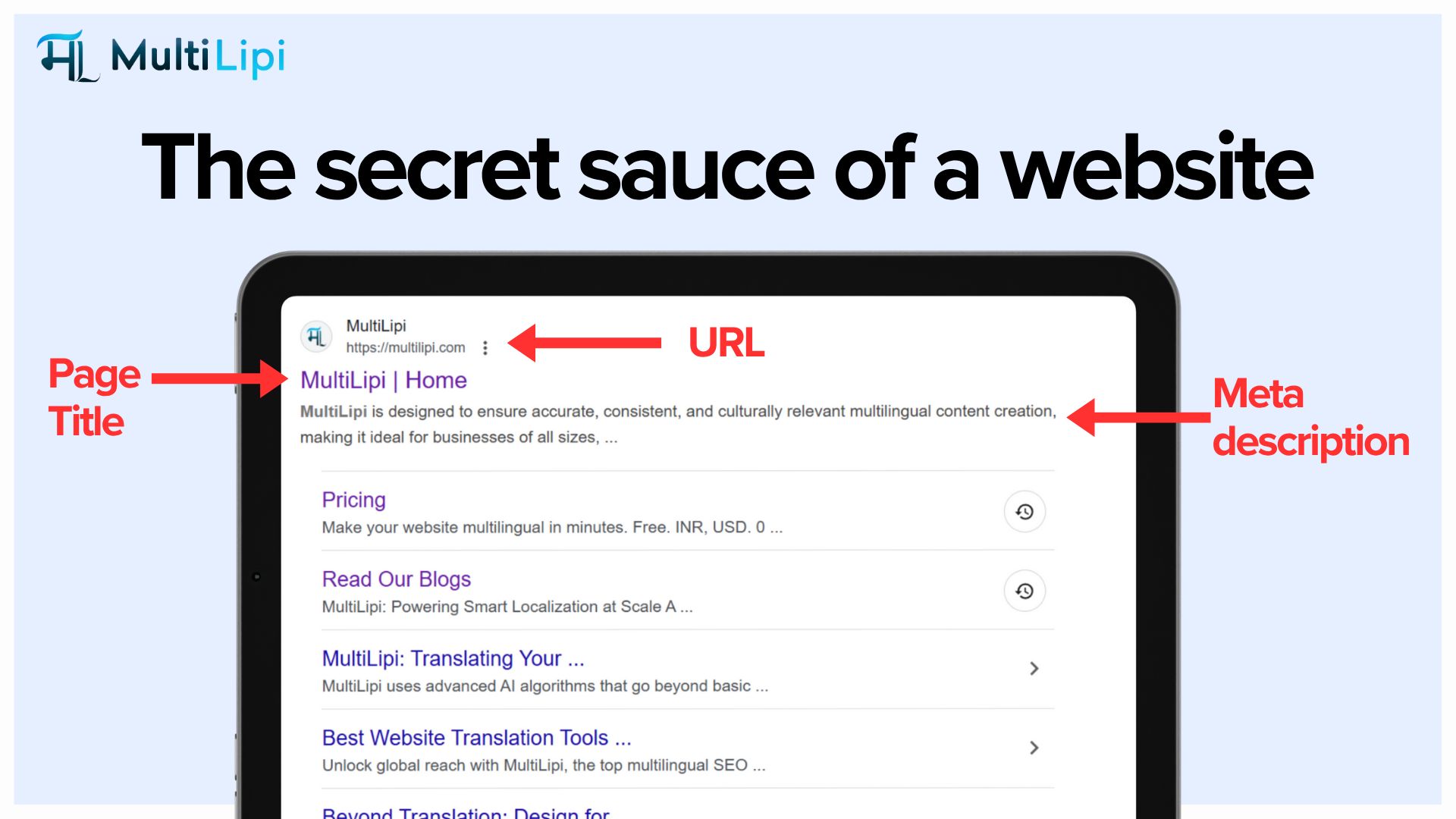
MultiLipi search result showing page title, URL, and meta description as key SEO elements for a multilingual website

Metadata – including title tags and meta descriptions – serves as a concise summary of a webpage’s content in search results. Translating these elements accurately into your target languages ensures search engines can properly interpret and categorize your content for each locale, improving your rankings in local search results (weglot.com). Equally important, these translated snippets are the first introduction to your brand that users see on a search page, so making a good first impression is critical for enticing clicks.

On the other hand, poorly translated metadata can confuse or mislead users. If your title or description reads strangely or irrelevant due to a bad translation, users are likely to skip your result or bounce off your site quickly – damaging your click-through rate and increasing bounce rate, which in turn harms SEO performance (weglot.comlinguise.com). In short, inaccurate translations lead to lost traffic.

Another critical factor is implementing hreflang tags for all language versions of your site. Hreflang annotations signal to search engines which language and region each page is intended for. If these tags are missing or misconfigured, even the best-translated metadata may not be shown to the right audience (weglot.comlinguise.com). Every multilingual site should use hreflang (with correct language-country codes) so Google and other engines serve users the appropriate local version of your content. Without hreflang, a French meta description might mistakenly show up for English-speaking users, or vice versa, undermining your efforts.

Bottom line: Accurate metadata translation improves both search engine understanding of your content and the user appeal of your search snippets. It’s a direct contributor to higher global SEO performance when paired with proper technical SEO configuration.

Critical Components of Successful Metadata Translation

Visual showing key components of successful metadata translation: intent-focused copy, localized keywords, and translation memory.

Achieving high-quality metadata translations requires both linguistic and strategic considerations:

  • Market-Specific Keyword Research: Start by researching search behavior in your target market. Identify the keywords and phrases local users actually search for, rather than directly translating your English keywords. Focus on terms that have good search volume and align with user intent in that language. Tools like Semrush and Ahrefs (and free resources like Google Trends) are invaluable for this process, helping you discover high-volume local search terms and topics (localizejs.com). By tailoring your titles and descriptions to include language-specific keywords, you connect more effectively with local audiences and search algorithms.
     
  • Intent Over Literal Translation: Always prioritize conveying the meaning and intent of the metadata, rather than doing a word-for-word translation. A phrase that works well in English might not have an equivalent in, say, Japanese or Arabic. It may require rephrasing or a creative approach (also known as transcreation) to resonate in the target language. For example, a clever marketing tagline in English could sound awkward or even change meaning if translated literally (linguise.com). Maintain the core message but adapt wording to fit local cultural nuances and search behavior. This ensures your metadata remains clear, compelling, and relevant to native speakers.
     
  • Use of Translation Memory & Glossaries: Consistency is key in multilingual content. Implementing a translation memory system or glossary can greatly improve consistency across similar pages. These tools store previously translated segments and your preferred terminology so you can reuse them for new content. For instance, MultiLipi offers a built-in glossary that lets you define translations for specific terms (e.g. product names or slogans) to enforce uniform wording across all languages (multilipi.com). By using a glossary or translation memory, you ensure that a phrase like “Free Trial” or your brand tagline is always translated the same preferred way every time it appears, strengthening brand recognition and avoiding inconsistent wording.
     
  • Leverage Data and Analytics: In addition to linguistic accuracy, use data to guide your metadata strategy. Monitor how users in different regions engage with your translated pages. Analytics and business intelligence tools can provide insight into which translated metadata versions have higher click-through rates or conversion rates. For example, integrating platforms like MicroStrategy or Sisense could help you analyze performance by region (weglot.com). If the meta description in German has a lower CTR than the English one, it might indicate the phrasing isn’t resonating and needs tweaking. Data-driven adjustments ensure your metadata is not only accurately translated but also optimized for results.
     

By combining thorough keyword research, cultural insight, consistency tools, and performance analysis, you set a strong foundation for successful metadata translation across all your target languages.

Language-Specific Optimization and Character Limits

Different languages often require tailored optimization approaches due to variations in length and script. One major consideration is text expansion or contraction. For instance, a sentence in German can be around 20–30% longer than its English equivalent (dorotapawlak.eu). This means a meta title that fits within Google’s pixel limits in English might be too long in German, causing it to truncate in search results. Always account for these differences – if you translate an English title directly, check that the translated version stays within recommended character limits (roughly 55–60 characters for titles, ~155–160 for descriptions in most cases, though these limits can vary by language and search engine). Planning for text expansion (or contraction, in languages like Chinese) will help preserve your metadata’s full message in SERPs.

CJK characters and special scripts: Languages like Chinese, Japanese, and Korean use characters that take up single spaces but convey more meaning per character. They may display differently on search pages (e.g. Google often shows fewer characters for CJK languages). Ensure your titles and descriptions in these languages are concise and still informative. Also be mindful of any required format (for example, Japanese metadata might include full-width punctuation).

Right-to-Left (RTL) languages: Arabic, Hebrew, and other RTL languages require special attention for how metadata is presented. Ensure that your website’s code properly declares the language direction so that titles and descriptions render correctly. Even in search results, you want to avoid garbled or misordered text. Simple things like the placement of punctuation in RTL text can affect readability. In short, always test how your metadata appears for RTL languages – they often need adjustments in wording or formatting for clarity (linguise.com).)

Local punctuation and characters: Each language has its own typographical conventions. Spanish uses inverted question/exclamation marks, French and German use accented characters, etc. Use the correct localized characters in your metadata – it not only looks more professional, but also can impact keyword relevancy (for example, “años” with ñ is a different word from “anos” without it). Don’t assume you can use English punctuation for all; adopting locale-specific punctuation and spacing will make your snippets look native. Neglecting these nuances can lead to misinterpretation or an unpolished impression, which can hurt user engagement.

Finally, always preview your translated metadata as it would appear in search results. Many SEO tools provide snippet preview functionality. This allows you to catch issues like truncation, weird symbols, or phrasing that might need refinement before it goes live.

Technical Requirements: Hreflang Tags and URL Structure

Accurate translation alone isn’t enough – the technical SEO setup of your multilingual site must also be sound. Proper technical implementation ensures search engines can discover and index your translated content efficiently (weglot.com). The cornerstone elements to get right are hreflang, URL structure, canonical tags, and sitemaps:

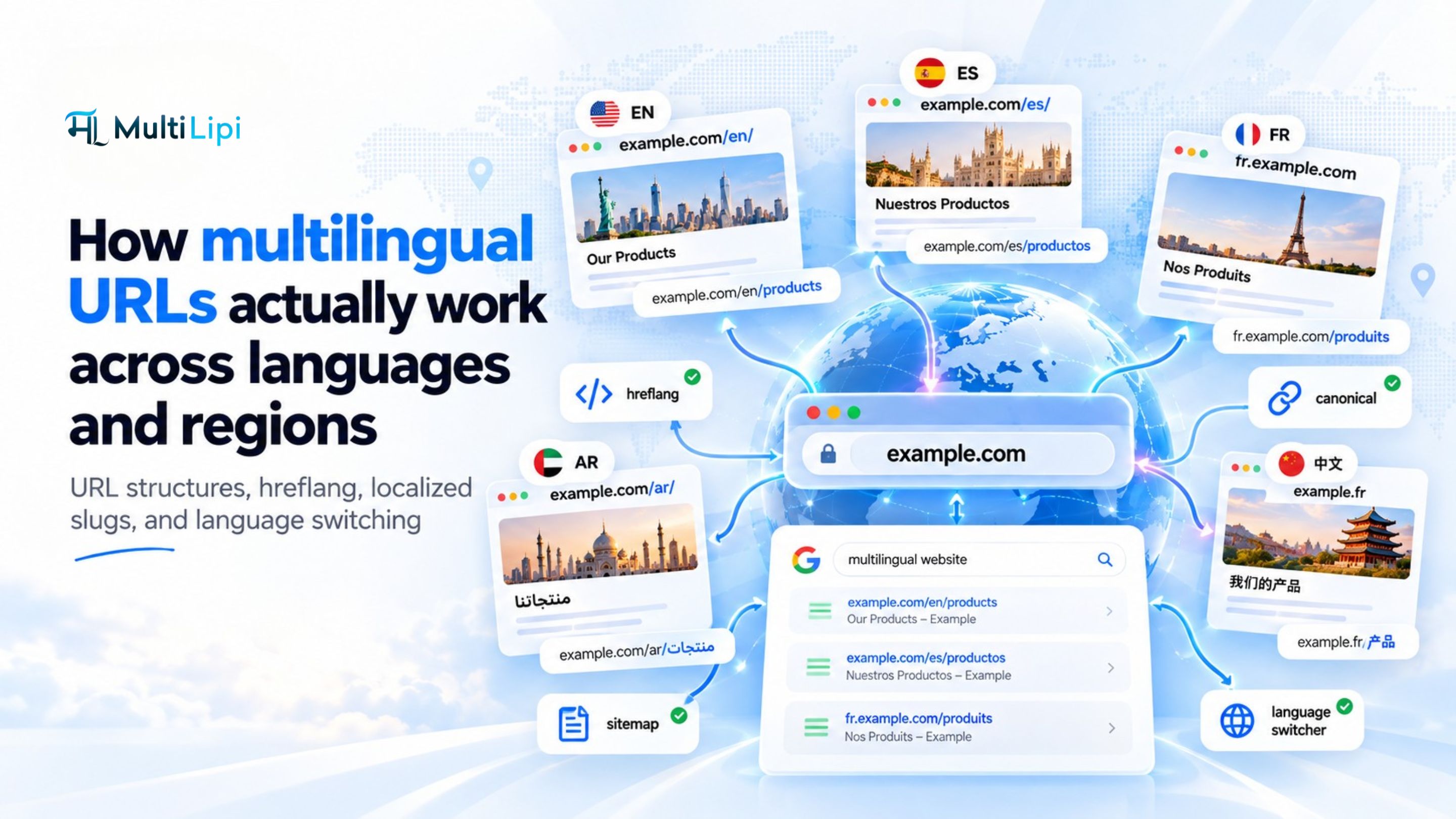
  • Hreflang Attributes: As mentioned, always use hreflang tags to specify the language (and optionally, region) of each page. For example, your French page should have a hreflang="fr" (or “fr-FR” for France vs “fr-CA” for Canadian French) linking to itself, and reciprocal tags linking back to the other language versions. This helps Google serve the French page to French users, the Spanish page to Spanish users, etc., rather than guessing. It also prevents duplicate content issues by explicitly linking equivalent pages. A correctly implemented hreflang setup is vital – without it, even if you translate meta tags perfectly, search engines “don’t know which language version to display to users”, leading to suboptimal results (linguise.com). Be meticulous with the language codes and ensure every page references all its alternates (including a self-referential tag).
     
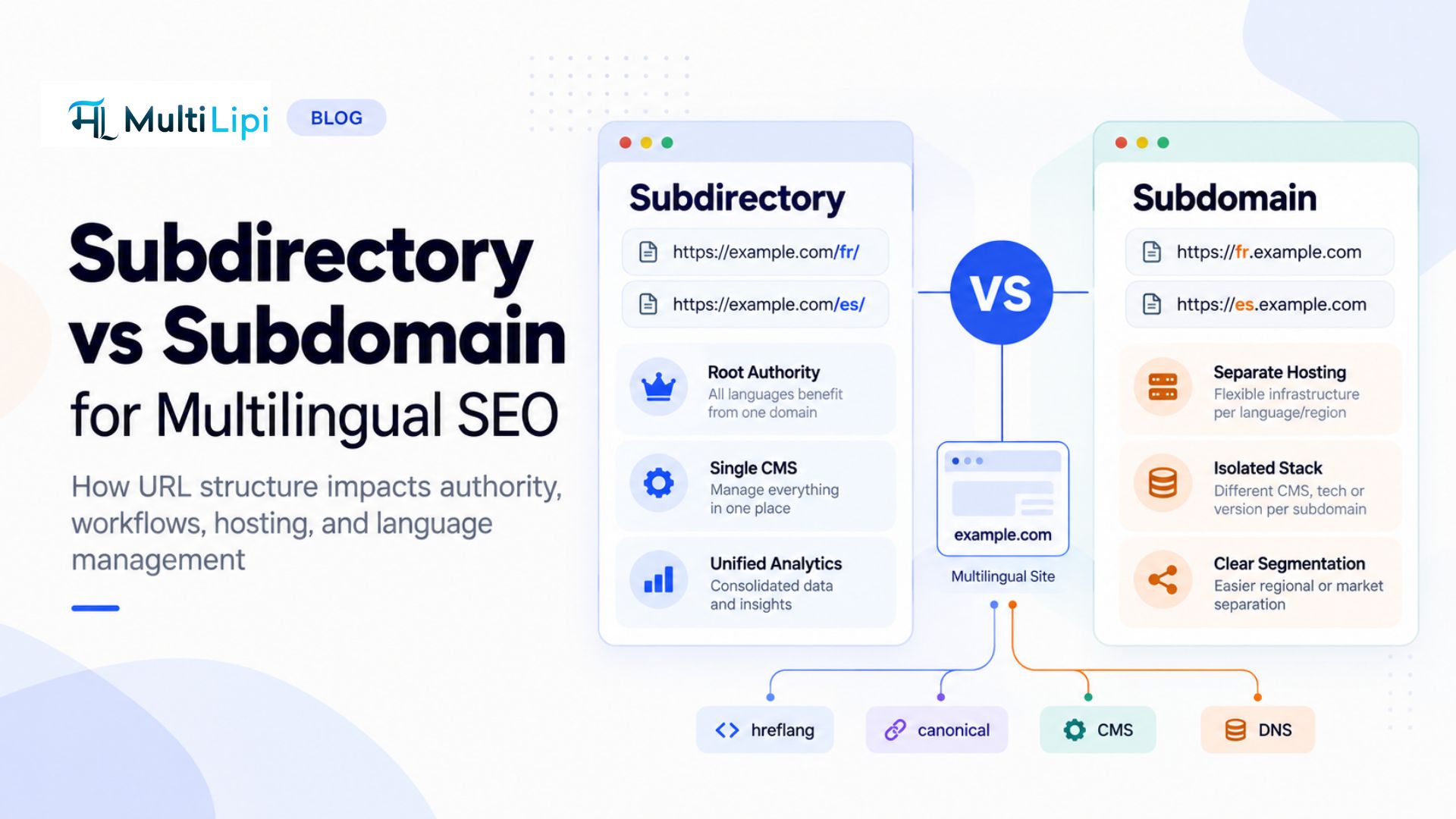
  • URL Structure (Subdomains vs Subdirectories): Decide on a URL strategy for your multilingual content and apply it consistently. The two common approaches are subdirectories (e.g. yourwebsite.com/es/page) or subdomains (e.g. es.yourwebsite.com/page). There’s no one-size-fits-all answer – each has pros and cons, and either can work for SEO if done right. Subdirectories are often simpler to implement and concentrate all SEO authority on one domain, while subdomains can allow more separation (sometimes used if targeting different countries or when using a proxy service). The key is to be consistent and make sure each language’s pages are clearly separated in one of these structures (localizejs.com) . MultiLipi supports both options – for instance, you can choose language-specific subfolders like /fr/ or dedicated subdomains like fr.yoursite.com depending on your needs (wordpress.org). Whichever structure you choose, update internal links and navigation to point users (and crawlers) to the correct localized URLs.
     
  • Canonical Tags: If you have multiple versions of a page, use canonical tags appropriately to avoid duplicate content penalties. Generally, each language page should canonically reference itself (since it’s original content in that language, not a duplicate). Do not point different language pages to a single canonical URL, or search engines might ignore the alternates. The only time canonical comes into play is if you have duplicate content in the same language (e.g. a printer-friendly page). For multilingual SEO, hreflang is the primary tool, not cross-language canonicals. Ensure your CMS or translation plugin sets this up correctly.
     
  • Localized Sitemaps: For large sites, consider creating separate XML sitemaps for each language (or a combined sitemap listing all alternate URLs with hreflang). This helps search engine bots efficiently crawl your site’s structure. For example, you might have sitemap-en.xml, sitemap-fr.xml, etc., each containing URLs only for that language. Submit these in Google Search Console (and Bing Webmaster Tools, etc.) for the respective locales. This ensures no translated page is overlooked due to crawl depth issues. If maintaining multiple sitemaps is burdensome, a single sitemap is fine too – just make sure every URL is included and hreflang relationships are noted.
     
  • Other Technical Elements: Remember that metadata isn’t just titles and descriptions. Don’t forget to translate image alt attributes, Open Graph tags (for social media sharing), and any other meta tags that carry content (like Twitter Card metadata, JSON-LD schema descriptions, etc.). These can impact SEO and how your pages appear on social platforms. For example, an image’s alt text in the user’s language can help with image SEO and accessibility, and a translated Open Graph description will make your content more appealing when shared on local social networks. Many site owners overlook these technical metadata elements during localization (linguise.com), so ensure your workflow or translation tool captures them.
     

Getting these technical details right goes hand-in-hand with linguistic accuracy. Together, they create a solid infrastructure for multilingual site SEO success – where each localized page can perform to its fullest potential in search rankings.

Automation vs. Manual Translation MultiLipi Approaches

MultiLipi features for global SEO including metadata translation, multilingual SEO best practices, glossary tools, visual editor, sync, and bulk management.

When it comes to translating metadata for a multilingual website, one common question arises: should you rely on automated translation tools or invest in human translators for this task? The answer often lies somewhere in the middle. Let’s examine both approaches:

Automated Metadata Translation: Pros & Cons

  • (+) Speed and Scalability: Automated translation offers incredible speed. If you have a large e-commerce site or frequent blog updates, machine translation can turn around hundreds of meta tags almost instantly. This scalability makes it feasible to translate this webpage and thousands of others without waiting on human schedules. It’s ideal for quick turnarounds or testing multiple languages rapidly.
     
  • (+) Timely Updates: For content that changes often (news articles, dynamic product listings), automated tools ensure your metadata in all languages stays up-to-date. You won’t risk having an outdated Spanish meta description because a translator wasn’t available; the system translates new metadata on the fly.
     
  • (-) Nuance and Quality Issues: The downside is that pure machine translation may lack the cultural nuance needed for effective SEO copy. Automated tools can misinterpret idioms, tone, or context. A literal translation might come across as awkward or unclear to native speakers (linguise.com). This could hurt click-through rates if the meta description doesn’t make sense or appeal to the local audience.
     
  • (-) Inaccurate Keyword Alignment: Machines might not choose the same keywords a human SEO translator would. For example, an automatic translation might use a technically correct word that has zero search volume in the target language, whereas a human would know to use the more popular synonym. These subtleties mean fully automated metadata translations can sometimes be suboptimal for SEO performance.

Manual Metadata Translation: Pros & Cons

  • (+) Higher Accuracy & Cultural Relevance: Human translators (especially those experienced in SEO) can craft metadata that reads naturally and persuasively in the target language. They can maintain your brand voice and incorporate culturally relevant references or calls-to-action that machines would miss. The result is meta titles and descriptions that resonate with local users and search engines alike. This is particularly important for marketing content where tone and emotion matter.
     
  • (+) Intent Matching: A skilled human translator will focus on user intent and relevant keywords, not just literal meaning. They can ensure the translated metadata actually appeals to what local users are looking for. For instance, if your English meta title is “10 Tips for Great Web Design,” a human might know that in French, users are more likely to search a phrase that translates to “10 Ways to Improve Your Website” – adjusting the wording to match local search habits.
     
  • (-) Time-Consuming & Costly: Doing everything manually takes significantly more time. Crafting and reviewing metadata for dozens or hundreds of pages across multiple languages can be a slow process, delaying your global content launches. This can be impractical for large sites or time-sensitive updates. Additionally, quality human translation (and subsequent SEO copy editing) can be expensive, especially if you need professional linguists for many languages.
     
  • (-) Inconsistency Risks: Without a structured process, manual translation by different people can introduce inconsistencies. One translator might use a different phrase than another for the same concept, which could dilute your messaging. (This can be mitigated by using glossaries and providing clear guidelines to translators, but it’s something to manage carefully.)
     

Finding the Right Balance – The Hybrid Approach: The good news is that you don’t have to strictly choose one or the other. Many organizations find that a hybrid approach to metadata translation yields the best results (weglot.com). In practice, this means using machine translation to handle the heavy lifting of initial translation, then having a human (such as a native-speaking editor or your marketing team) review and refine those translations. This approach offers the speed of automation with the nuance of human oversight. You can quickly get a draft translation for, say, 100 product meta descriptions, and then spend focused time polishing the most important ones or correcting any awkward phrasing.

Modern translation platforms support this workflow seamlessly. For example, you might plug your site into an AI-powered website page translator like MultiLipi to generate instant metadata translations, and then use its post-editing interface to fine-tune each one for tone and keywords. By automating the rote work and reserving human effort for quality control, you achieve high translation quality and fast turnaround (weglot.com). Many businesses report that this combo (often called AI + human in the loop) dramatically reduces time-to-market for new languages without sacrificing SEO performance.

In summary, automation vs manual is not an either/or decision. Use automation to work at scale, but always plan for a human review stage – especially for customer-facing text like metadata where a little nuance goes a long way.

Accelerate Your Global SEO Efforts with MultiLipi
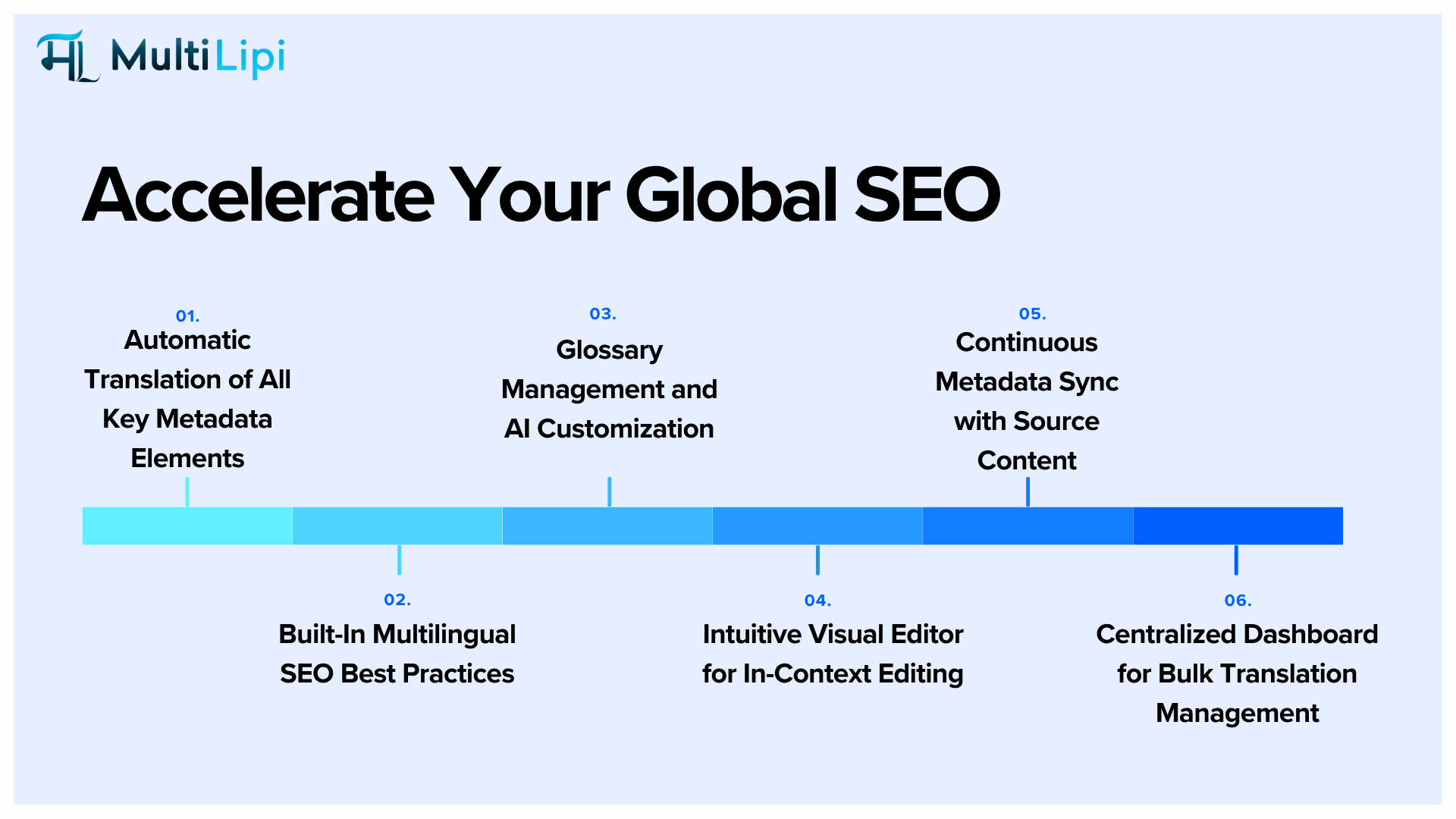
Infographic highlighting six key features of MultiLipi for multilingual SEO Accelerating Your Global SEO

MultiLipi is an AI-driven website translation platform designed to streamline metadata translation and take the headaches out of multilingual SEO. It combines the power of automation with the finesse of human editing in one cohesive workflow. Here’s how MultiLipi helps you optimize your metadata (and broader content) for global search success:

  • Automatic Translation of All Key Elements: MultiLipi’s solution automatically detects and translates essential on-page elements like meta titles, meta descriptions, headings, image alt text, and even custom fields or SEO tags. This ensures no piece of metadata is left untranslated. The platform is built to handle full multilingual site SEO – for example, it will translate your URL slugs or create SEO-friendly URL structures for each language, rather than keeping English URLs (wordpress.org). By covering things like translated URLs and alt tags, MultiLipi makes sure your entire page is optimized for local search, not just the visible text.
     
  • Built-In Multilingual SEO Best Practices: When you use MultiLipi, the technical SEO configuration is largely taken care of for you. The platform can automatically create language-specific subdirectories or subdomains for your translated content, depending on your preference, and implement hreflang tags site-wide (wordpress.org). This means from day one, your translated pages are properly structured and indexed by search engines in each region. MultiLipi is fully optimized for multilingual SEO, as the WordPress plugin description highlights – every translated page is indexable by Google, and your site architecture is configured for international targeting out of the box  (wordpress.orgwordpress.org.)
     
  • Glossary and AI Customization: MultiLipi includes glossary management and a translation memory, allowing you to define specific translations for brand names, industry terms, or any phrases you care about. The platform will consistently use those preferred translations across your site, preserving brand voice and terminology in all languages (multilipi Translation memory). For example, if you always translate “Contact Us” as “Kontakteer Ons” in Dutch (instead of a machine’s default), you can lock that in. This feature ensures that the nuances of your branding and messaging carry over accurately, which is a big advantage for metadata where small wording differences matter.
     
  • Intuitive Editing Dashboard (Visual Editor): A standout feature of MultiLipi is its user-friendly dashboard and live visual editor. After the initial machine translation, you can easily review and edit translations within a preview of your webpage. This means you can see your translated title or description in context – how it fits on the page, whether it exceeds any character limits, etc. – and adjust it on the spot (multilipi Virtual editor). The editor allows you to fine-tune translations for SEO, such as tweaking a meta description to include a target keyword or to better entice clicks. Because you’re editing in context, it’s easy to ensure your translated metadata stays within the required length and looks perfect for users.
     
  • Continuous Updates and Bulk Management: As your primary site content changes, MultiLipi automatically detects new or updated metadata and will prompt translation updates in your other languages. This automation significantly reduces the manual effort of keeping all language versions in sync. Moreover, the platform’s centralized dashboard lets you manage translations in bulk. For instance, you can filter specifically for SEO metadata (like all your meta titles in French) and edit them in one place. This bulk editing capability is a huge time-saver for larger websites. MultiLipi essentially provides an end-to-end workflow: from initial translation to editing to publishing – all in one hub.
     

All these features work together to ensure that your translated metadata isn’t just accurate, but optimized. MultiLipi’s approach of combining high-quality machine translation with easy human refinement means you get both speed and precision. By using the platform, businesses can achieve multilingual SEO best practices with much less effort than doing everything manually. In short, MultiLipi empowers you to present a fully optimized, multilingual website to the world – without needing to be a technical SEO expert or fluent in multiple languages.

(MultiLipi vs. others:) If you’ve been considering alternatives – such as purely manual translation or generic translation plugins – it’s worth noting how a solution like MultiLipi stands out. MultiLipi was built with SEO in mind, so it inherently handles things that others might require extra configuration (hreflang, metadata translation, etc.). Its AI-human hybrid workflow means you don’t trade off quality for speed. And features like collaborative editing (adding team members to the dashboard) make it scalable for organizations. Essentially, MultiLipi wraps translation + localization + SEO into one package so you can focus on growing your global audience.

Best Practices for Metadata Translation

To wrap up, here is a checklist of best practices and tips to ensure your metadata translation truly boosts your global SEO:

  • Account for Text Length Differences: Always consider how much longer or shorter your translated text might be. Design your titles and descriptions to fit within search engines’ recommended lengths for each language. For instance, allow ~30% extra space for German text expansion (dorotapawlak.eu). After translating, use an SEO snippet tool or Google’s preview to check for truncation in each target language. Edit down if necessary to keep important words from being cut off.
     
  • Incorporate Language-Specific Keywords: Don’t assume your source-language keywords are the best ones in another market. Do fresh keyword research or use tools like Google Trends to find what phrases locals use. Then incorporate those keywords naturally into your translated metadata. This improves relevance and can significantly boost local search rankings (localizejs.com). (Tip: Also localize any numeric formats or units in your metadata – e.g., converting currency or date formats – since searchers might use local notation in queries.)
     
  • Use Language-Appropriate Schema Markup: If you use structured data (JSON-LD, etc.) on your pages, translate any content within that markup as well, or use schema properties that support multiple languages. For example, for Organization or Product schema, provide translated name or description fields where applicable. This helps search engines display rich results (like knowledge panels or rich snippets) in the user’s language. It’s an often overlooked aspect of multilingual SEO.
     
  • Implement Hreflang and Locale-Specific URLs: This is worth repeating – use hreflang for every page and verify it’s correct. Also, structure your site with clear language indicators in URLs (whether subdirectory or subdomain). For instance, a URL ending in /es/producto instantly signals both users and search bots that this is a Spanish page. If you have distinct regional content (e.g. en-US vs en-GB), include that in hreflang and possibly use separate URLs for clarity. Proper language targeting avoids user confusion and improves indexation for the right audience (weglot.com).
     
  • Consider Regional Variants and Dialects: Optimize for regional differences within the same language. For example, Spanish in Spain vs. Spanish in Mexico – if you target both, you might need slight metadata tweaks (different vocabulary or formal/informal tone). Similarly, European French vs Canadian French have some distinctions. Reflect those in your meta copy to maximize local relevance. If you use hreflang with region codes (like fr-FR, fr-CA), ensure the content actually matches those locales.
     
  • Mind the Search Engine-Specific Rules: If you’re targeting markets where Google isn’t the dominant engine, adjust your metadata strategy accordingly:
     
    • Baidu: Titles should be under 80 characters (and meta descriptions under ~200) for Baidu’s index (advance-metrics.com). Use Simplified Chinese keywords in your titles, as Baidu heavily relies on keyword presence. Also, Baidu still pays attention to meta keywords tag (unlike Google), so consider adding a few relevant ones in Chinese.
       
    • Yandex: The Russian search engine favors fully localized content. Ensure your titles and descriptions are not just translated but also localized with Cyrillic script and Russian context. Yandex’s algorithm also allows you to set a regional target in Yandex Webmaster – do that to boost local rankings (delante.co). Avoid any spammy or repetitive wording; Yandex is stricter than Google about keyword stuffing and will downrank pages that appear over-optimized. Focus on clear, useful meta descriptions that align with Russian users’ expectations.
       
    • Naver: South Korea’s top search engine has shorter snippet length preferences – roughly <40 characters for titles and <80 for descriptions is recommended (delante.co). Naver also places a big emphasis on user click-through and engagement. Craft your metadata to include a strong call-to-action or value proposition that encourages clicks (this could indirectly improve rankings, as higher CTR is believed to benefit Naver SEO). Also, if possible, integrate Naver-specific features like metadata for Naver Blog search if you’re using those services. Overall, treat Naver like a unique ecosystem: what works on Google (long, keyword-rich metas) might not work on Naver, which prefers brevity and engagement.
       
  • Translate All Metadata (and then some): It’s not just the </span></span><span style="font-family:Arial,sans-serif"><span style="color:#000000"> and </span></span><span style="font-family:'Roboto Mono',monospace"><span style="color:#188038"><meta description></span></span><span style="font-family:Arial,sans-serif"><span style="color:#000000"> that need translation. Make sure to translate anchor text in meta tags (if any), image alt text, and even the URL slug if it makes sense. A localized URL (e.g., </span></span><span style="font-family:'Roboto Mono',monospace"><span style="color:#188038">.../mejores-jugadores</span></span><span style="font-family:Arial,sans-serif"><span style="color:#000000"> instead of </span></span><span style="font-family:'Roboto Mono',monospace"><span style="color:#188038">.../best-players</span></span><span style="font-family:Arial,sans-serif"><span style="color:#000000">) can improve relevance for local queries (</span></span><a href="https://www.linguise.com/blog/guide/how-to-translate-metadata-for-better-multilingual-seo/#:~:text=Not%20translating%20slug%20URLs" style="text-decoration:none"><span style="font-family:Arial,sans-serif"><span style="color:#1155cc"><u>linguise.com</u></span></span></a><span style="font-family:Arial,sans-serif"><span style="color:#000000">) – just be sure to implement 301 redirects from the old URLs if you change them, to preserve SEO value. Similarly, translate your Open Graph and Twitter Card tags so that when your page is shared on social media in another language, the snippet is in that language. These details contribute to a cohesive localized experience and can indirectly impact SEO (through user behavior signals and link sharing).</span></span></span><br/>  </li> <li style="list-style-type:disc"><span style="font-size:20px"><span style="font-family:Arial,sans-serif"><span style="color:#000000"><strong>Maintain Consistent Branding and Terminology:</strong> Ensure your brand name and key product terms are used consistently across all languages. Use the same transliteration or translation for your brand in every title tag, unless there’s a strategic reason to adapt it. In meta descriptions, if you have a slogan or value prop, keep it consistent in spirit. Using a translation glossary, as noted, is helpful here – MultiLipi’s glossary feature, for example, will automatically apply your approved terms so that you don’t end up with different translators calling your product three different names (</span></span><a href="https://proxy-seo.multilipi.com/#:~:text=experience,maintain%20consistent%20terminology%20across%20all" style="text-decoration:none"><span style="font-family:Arial,sans-serif"><span style="color:#1155cc"><u>multilipi.com</u></span></span></a><span style="font-family:Arial,sans-serif"><span style="color:#000000">). Consistency in metadata not only aids brand recognition but also looks professional to users who might compare snippets. It’s jarring if one language’s meta description uses a different company name or an informal tone when all others are formal.</span></span></span><br/>  </li> </ul> <p><span style="font-size:20px"><span style="font-family:Arial,sans-serif"><span style="color:#000000">Finally, always <strong>test and monitor</strong>. After implementing metadata translations, watch your analytics and search console data. Look at click-through rates by country/language and see if the new metadata is performing well. If the French page has a low CTR despite ranking, maybe the meta text isn’t appealing enough in French – you can A/B test a tweak. SEO is iterative, and multilingual SEO even more so. Keep refining your metadata based on real data, and you’ll continually improve your global search performance.</span></span></span></p> <h2><span style="font-size:24px"><span style="font-family:Arial,sans-serif"><span style="color:#000000"><strong>Try MultiLipi for Free and Boost Your Global SEO</strong></span></span></span><br/> <img alt="MultiLipi contact banner encouraging businesses to grow with localized content, featuring email and website support details " src="https://ik.imagekit.io/multilipi/media/https%3A/static.multilipi.com/media/uploads/2025/06/24/6_F3BMPQP.png" style="height:450px; width:800px" /></h2> <p><span style="font-size:20px"><span style="font-family:Arial,sans-serif"><span style="color:#000000">Properly translated and optimized metadata can have a transformative effect on your site’s global SEO. We’ve seen how implementing hreflang tags, conducting language-specific keyword research, and maintaining cultural relevance in your meta tags all contribute to better visibility in overseas markets (</span></span><a href="https://www.weglot.com/blog/metadata-translation#:~:text=%E2%80%8DWe%E2%80%99ve%20seen%20the%20benefits%20that,significantly%20improve%20their%20SEO%20overseas" style="text-decoration:none"><span style="font-family:Arial,sans-serif"><span style="color:#1155cc"><u>weglot.com</u></span></span></a><span style="font-family:Arial,sans-serif"><span style="color:#000000">). However, executing all of this manually can be complex and time-consuming. This is where </span></span><a href="https://proxy-seo.multilipi.com/" style="text-decoration:none"><span style="font-family:Arial,sans-serif"><span style="color:#1155cc"><strong><u>MultiLipi</u></strong></span></span><span style="font-family:Arial,sans-serif"><span style="color:#1155cc"><u> </u></span></span></a><span style="font-family:Arial,sans-serif"><span style="color:#000000">comes in as your solution to streamline the process.</span></span></span></p> <p><span style="font-size:20px"><span style="font-family:Arial,sans-serif"><span style="color:#000000">MultiLipi enables you to overcome the typical challenges of multilingual SEO by <strong>automatically translating</strong> all crucial metadata elements while ensuring they’re indexed correctly and optimized for each locale. The platform handles the heavy lifting of technical configuration (like creating localized URLs and adding hreflang) and gives you an intuitive interface to perfect the translations. Essentially, MultiLipi is the enabler you need to fast-track your online presence into new languages and regions (</span></span><a href="https://proxy-seo.multilipi.com/#:~:text=define%20your%20brand%E2%80%99s%20global%20success,Try%20MultiLipi%20for" style="text-decoration:none"><span style="font-family:Arial,sans-serif"><span style="color:#1155cc"><u>multilipi.com</u></span></span></a><span style="font-family:Arial,sans-serif"><span style="color:#000000">) – without compromising on quality or SEO best practices.</span></span></span></p> <p><span style="font-size:20px"><span style="font-family:Arial,sans-serif"><span style="color:#000000"><strong>Ready to go multilingual?</strong> You can get started with MultiLipi in minutes. The platform offers a free trial (one month free via the WordPress plugin, with an ongoing free tier available) (</span></span><a href="https://wordpress.org/plugins/multilipi-multilingual-seo/#:~:text=Enhance%20your%20visibility%2C%20boost%20conversions%2C,quality%20translations%20powered%20by%20AI" style="text-decoration:none"><span style="font-family:Arial,sans-serif"><span style="color:#1155cc"><u>wordpress.org</u></span></span></a><span style="font-family:Arial,sans-serif"><span style="color:#000000">), so you can see firsthand how it improves your translated website’s performance. With MultiLipi’s AI-powered translation and SEO toolkit, you’ll be able to <strong>translate this webpage and your entire site</strong> with ease, then fine-tune it for maximum impact in search results.</span></span></span></p> <p><span style="font-size:20px"><span style="font-family:Arial,sans-serif"><span style="color:#000000">Don’t let language barriers hold back your growth. Invest in accurate metadata translation and a robust tool like MultiLipi to <strong>boost your multilingual SEO</strong>. Start your free trial with MultiLipi today, and experience the increase in global traffic and engagement that comes from speaking your customers’ language – on every SERP and every page.</span></span></span></p> <p> </p><style> .blog-content { font-family: ui-sans-serif, system-ui, sans-serif, "Apple Color Emoji", "Segoe UI Emoji", "Segoe UI Symbol", "Noto Color Emoji"; color: var(--text-main, #0F172A); line-height: 1.75; font-size: 1.125rem; /* 18px */ max-width: 100%; } /* Headings */ .blog-content h1, .blog-content h2, .blog-content h3, .blog-content h4, .blog-content h5, .blog-content h6 { color: var(--text-main, #0F172A); font-weight: 700; margin-top: 2.5em; margin-bottom: 1em; letter-spacing: -0.02em; line-height: 1.25; } .blog-content h1:first-child, .blog-content h2:first-child, .blog-content h3:first-child { margin-top: 0; } .blog-content h1 { font-size: 2.5rem; /* 40px */ line-height: 1.2; margin-bottom: 1.5rem; } .blog-content h2 { font-size: 2rem; /* 32px */ border-bottom: 2px solid #E2E8F0; padding-bottom: 0.5em; margin-top: 3rem; } .blog-content h3 { font-size: 1.5rem; /* 24px */ margin-top: 2rem; } .blog-content h4 { font-size: 1.25rem; /* 20px */ font-weight: 600; } .blog-content h5 { font-size: 1.125rem; /* 18px */ font-weight: 600; } .blog-content h6 { font-size: 1rem; /* 16px */ font-weight: 600; color: #475569; } /* Paragraphs */ .blog-content p { margin-bottom: 1.75em; color: #334155; line-height: 1.8; } .blog-content p:last-child { margin-bottom: 0; } .blog-content strong, .blog-content b { font-weight: 600; color: #0F172A; } .blog-content em, .blog-content i { font-style: italic; } /* Lists */ .blog-content ul, .blog-content ol { margin-bottom: 2em; padding-left: 2em; color: #334155; } .blog-content ul li, .blog-content ol li { margin-bottom: 0.75em; padding-left: 0.5em; line-height: 1.75; } .blog-content ul li:last-child, .blog-content ol li:last-child { margin-bottom: 0; } .blog-content ul { list-style-type: disc; } .blog-content ol { list-style-type: decimal; } .blog-content ul ul, .blog-content ol ul { margin-top: 0.5em; margin-bottom: 0.5em; } .blog-content ul ol, .blog-content ol ol { margin-top: 0.5em; margin-bottom: 0.5em; } /* Links */ .blog-content a { color: #2563EB; text-decoration: none; border-bottom: 1px solid transparent; transition: all 0.2s ease; font-weight: 500; } .blog-content a:hover { border-bottom-color: #2563EB; color: #1E40AF; } .blog-content a:focus { outline: 2px solid #3B82F6; outline-offset: 2px; border-radius: 2px; } /* Images */ .blog-content img { border-radius: 0.75rem; /* 12px */ margin: 2.5em 0; max-width: 100%; height: auto; box-shadow: 0 10px 30px -10px rgba(0, 0, 0, 0.1), 0 4px 6px -2px rgba(0, 0, 0, 0.05); border: 1px solid #E2E8F0; } .blog-content figure { margin: 2.5em 0; } .blog-content figcaption { margin-top: 1em; text-align: center; font-size: 0.875rem; color: #64748B; font-style: italic; } /* Blockquotes */ .blog-content blockquote { border-left: 4px solid #3B82F6; padding: 1.5em 1.75em; margin: 2.5em 0; font-style: italic; color: #475569; background: linear-gradient(135deg, #F8FAFC 0%, #F1F5F9 100%); border-radius: 0 0.75rem 0.75rem 0; box-shadow: 0 2px 8px rgba(0, 0, 0, 0.05); } .blog-content blockquote p { margin-bottom: 0.75em; } .blog-content blockquote p:last-child { margin-bottom: 0; } .blog-content blockquote cite { display: block; margin-top: 1em; font-size: 0.875rem; color: #64748B; font-style: normal; } /* Code Blocks */ .blog-content pre { background: #1E293B; color: #E2E8F0; padding: 1.5em; border-radius: 0.75rem; overflow-x: auto; margin: 2em 0; border: 1px solid #334155; box-shadow: 0 4px 12px rgba(0, 0, 0, 0.15); line-height: 1.6; } .blog-content code { font-family: 'Menlo', 'Monaco', 'Courier New', monospace; font-size: 0.875em; } .blog-content pre code { background: transparent; color: inherit; padding: 0; border-radius: 0; } .blog-content p code, .blog-content li code { background: #F1F5F9; color: #0F172A; padding: 0.25em 0.5em; border-radius: 0.375rem; font-weight: 500; border: 1px solid #E2E8F0; } /* Tables */ .blog-content table { width: 100%; border-collapse: collapse; margin: 2.5em 0; border-radius: 0.75rem; overflow: hidden; box-shadow: 0 4px 12px rgba(0, 0, 0, 0.08); } .blog-content table thead { background: linear-gradient(135deg, #3B82F6 0%, #2563EB 100%); } .blog-content table th { padding: 1em 1.25em; text-align: left; font-weight: 600; color: #FFFFFF; font-size: 0.875rem; text-transform: uppercase; letter-spacing: 0.05em; } .blog-content table td { padding: 1em 1.25em; border-bottom: 1px solid #E2E8F0; color: #334155; } .blog-content table tbody tr { background: #FFFFFF; transition: background 0.2s ease; } .blog-content table tbody tr:nth-child(even) { background: #F8FAFC; } .blog-content table tbody tr:hover { background: #F1F5F9; } .blog-content table tbody tr:last-child td { border-bottom: none; } /* Horizontal Rule */ .blog-content hr { border: none; border-top: 2px solid #E2E8F0; margin: 3em 0; } /* Responsive Typography */ @media (max-width: 768px) { .blog-content { font-size: 1rem; /* 16px on mobile */ line-height: 1.7; } .blog-content h1 { font-size: 2rem; /* 32px */ } .blog-content h2 { font-size: 1.625rem; /* 26px */ } .blog-content h3 { font-size: 1.375rem; /* 22px */ } .blog-content h4 { font-size: 1.125rem; /* 18px */ } .blog-content ul, .blog-content ol { padding-left: 1.5em; } .blog-content pre { padding: 1em; font-size: 0.875rem; } .blog-content blockquote { padding: 1em 1.25em; } } </style></div></article><div class="mt-12 space-y-12"><div><h3 style="font-size:28px;font-weight:700;color:#0F172A;margin-bottom:24px">Read Next</h3><div class="grid md:grid-cols-3 gap-6 read-next-grid"><a href="/blog/ai-answer-readiness-brands-surface-ai-search" class="block h-full" style="text-decoration:none"><article class="rounded-xl overflow-hidden cursor-pointer group h-full" style="background:#FFFFFF;border:1px solid #E2E8F0"><div class="relative overflow-hidden" style="height:160px"><div class="relative inline-block overflow-hidden w-full h-full object-cover transition-transform duration-700 group-hover:scale-110"><img alt="AI-Answer Readiness: What Brands Must Do Now to Surface in AI-Powered Responses" loading="lazy" decoding="async" data-nimg="fill" class="w-full h-full object-cover transition-transform duration-700 group-hover:scale-110" style="position:absolute;height:100%;width:100%;left:0;top:0;right:0;bottom:0;object-fit:cover;color:transparent" src="https://ik.imagekit.io/multilipi/media/cover_images/blog_title_card_1_hPA8YJ8.png" /></div></div><div class="p-5"><span class="inline-block rounded-full px-3 py-1 mb-3" style="background:#64748B15;font-size:11px;font-weight:700;color:#64748B;text-transform:uppercase">Normal</span><h4 style="font-size:16px;font-weight:700;color:#0F172A;margin-bottom:12px;line-height:1.4">AI-Answer Readiness: What Brands Must Do Now to Surface in AI-Powered Responses</h4><div class="flex items-center gap-2" style="color:#94A3B8;font-size:12px"><span>8/31/2026</span><span>•</span><span>10 Min<!-- --> read</span></div></div></article></a><a href="/blog/geo-in-retail-ai-search-marketing-foreign-tourists" class="block h-full" style="text-decoration:none"><article class="rounded-xl overflow-hidden cursor-pointer group h-full" style="background:#FFFFFF;border:1px solid #E2E8F0"><div class="relative overflow-hidden" style="height:160px"><div class="relative inline-block overflow-hidden w-full h-full object-cover transition-transform duration-700 group-hover:scale-110"><img alt="GEO in Retail: How AI Search Marketing Attracts Foreign Tourists and Expands Footfall" loading="lazy" decoding="async" data-nimg="fill" class="w-full h-full object-cover transition-transform duration-700 group-hover:scale-110" style="position:absolute;height:100%;width:100%;left:0;top:0;right:0;bottom:0;object-fit:cover;color:transparent" src="https://ik.imagekit.io/multilipi/media/cover_images/blog_title_card_PMYmlvK.png" /></div></div><div class="p-5"><span class="inline-block rounded-full px-3 py-1 mb-3" style="background:#64748B15;font-size:11px;font-weight:700;color:#64748B;text-transform:uppercase">Normal</span><h4 style="font-size:16px;font-weight:700;color:#0F172A;margin-bottom:12px;line-height:1.4">GEO in Retail: How AI Search Marketing Attracts Foreign Tourists and Expands Footfall</h4><div class="flex items-center gap-2" style="color:#94A3B8;font-size:12px"><span>8/25/2026</span><span>•</span><span>10 Min<!-- --> read</span></div></div></article></a><a href="/blog/localization-growth-engine-china-entry-multilingual" class="block h-full" style="text-decoration:none"><article class="rounded-xl overflow-hidden cursor-pointer group h-full" style="background:#FFFFFF;border:1px solid #E2E8F0"><div class="relative overflow-hidden" style="height:160px"><div class="relative inline-block overflow-hidden w-full h-full object-cover transition-transform duration-700 group-hover:scale-110"><img alt="Localization as a Growth Engine: From China Entry to Multilingual Scale" loading="lazy" decoding="async" data-nimg="fill" class="w-full h-full object-cover transition-transform duration-700 group-hover:scale-110" style="position:absolute;height:100%;width:100%;left:0;top:0;right:0;bottom:0;object-fit:cover;color:transparent" src="https://ik.imagekit.io/multilipi/media/cover_images/blog_title_card_tqmP9aP.png" /></div></div><div class="p-5"><span class="inline-block rounded-full px-3 py-1 mb-3" style="background:#64748B15;font-size:11px;font-weight:700;color:#64748B;text-transform:uppercase">Normal</span><h4 style="font-size:16px;font-weight:700;color:#0F172A;margin-bottom:12px;line-height:1.4">Localization as a Growth Engine: From China Entry to Multilingual Markets</h4><div class="flex items-center gap-2" style="color:#94A3B8;font-size:12px"><span>8/17/2026</span><span>•</span><span>10 Min<!-- --> read</span></div></div></article></a></div></div></div></div><div class="lg:col-span-3" style="min-width:0"><div class="sticky rounded-2xl p-6 toc-pad" style="top:100px;background:#FFFFFF;border:1px solid #E2E8F0"><h3 style="font-size:16px;font-weight:700;color:#0F172A;margin-bottom:20px;text-transform:uppercase;letter-spacing:0.05em">In this article</h3><nav class="space-y-1"></nav><button class="flex items-center justify-center gap-2 rounded-xl py-3 px-4 transition-all w-full mt-4" style="background:linear-gradient(135deg, #3B82F6 0%, #2563EB 100%);color:#FFFFFF;font-size:14px;font-weight:700;border:none;cursor:pointer;box-shadow:0 4px 12px rgba(59, 130, 246, 0.25)" tabindex="0"><span>Summarize in ChatGPT</span><svg xmlns="http://www.w3.org/2000/svg" width="24" height="24" viewBox="0 0 24 24" fill="none" stroke="currentColor" stroke-width="2" stroke-linecap="round" stroke-linejoin="round" class="lucide lucide-arrow-right h-4 w-4"><path d="M5 12h14"></path><path d="m12 5 7 7-7 7"></path></svg></button><div class="mt-8 pt-6" style="border-top:1px solid #E2E8F0"><p style="font-size:13px;font-weight:600;color:#64748B;margin-bottom:12px;text-transform:uppercase;letter-spacing:0.05em">Share</p><div class="flex gap-2"><button class="flex-1 rounded-lg py-2 px-3 transition-all hover:bg-blue-50" style="background:#F8FAFC;border:1px solid #E2E8F0;cursor:pointer" title="LinkedIn"><svg xmlns="http://www.w3.org/2000/svg" width="24" height="24" viewBox="0 0 24 24" fill="none" stroke="currentColor" stroke-width="2" stroke-linecap="round" stroke-linejoin="round" class="lucide lucide-linkedin h-4 w-4 mx-auto" style="color:#64748B"><path d="M16 8a6 6 0 0 1 6 6v7h-4v-7a2 2 0 0 0-2-2 2 2 0 0 0-2 2v7h-4v-7a6 6 0 0 1 6-6z"></path><rect width="4" height="12" x="2" y="9"></rect><circle cx="4" cy="4" r="2"></circle></svg></button><button class="flex-1 rounded-lg py-2 px-3 transition-all hover:bg-blue-50" style="background:#F8FAFC;border:1px solid #E2E8F0;cursor:pointer" title="Twitter"><svg xmlns="http://www.w3.org/2000/svg" width="24" height="24" viewBox="0 0 24 24" fill="none" stroke="currentColor" stroke-width="2" stroke-linecap="round" stroke-linejoin="round" class="lucide lucide-twitter h-4 w-4 mx-auto" style="color:#64748B"><path d="M22 4s-.7 2.1-2 3.4c1.6 10-9.4 17.3-18 11.6 2.2.1 4.4-.6 6-2C3 15.5.5 9.6 3 5c2.2 2.6 5.6 4.1 9 4-.9-4.2 4-6.6 7-3.8 1.1 0 3-1.2 3-1.2z"></path></svg></button><button class="flex-1 rounded-lg py-2 px-3 transition-all hover:bg-blue-50" style="background:#F8FAFC;border:1px solid #E2E8F0;cursor:pointer" title="Copy Link"><svg xmlns="http://www.w3.org/2000/svg" width="24" height="24" viewBox="0 0 24 24" fill="none" stroke="currentColor" stroke-width="2" stroke-linecap="round" stroke-linejoin="round" class="lucide lucide-link h-4 w-4 mx-auto" style="color:#64748B"><path d="M10 13a5 5 0 0 0 7.54.54l3-3a5 5 0 0 0-7.07-7.07l-1.72 1.71"></path><path d="M14 11a5 5 0 0 0-7.54-.54l-3 3a5 5 0 0 0 7.07 7.07l1.71-1.71"></path></svg></button></div><div class="mt-4 rounded-lg px-3 py-2.5" style="background:linear-gradient(135deg, rgba(37, 99, 235, 0.05) 0%, rgba(147, 51, 234, 0.05) 100%);border:1px solid rgba(37, 99, 235, 0.15)"><p style="font-size:11px;color:#64748B;line-height:1.5">💡 <strong style="color:#2563EB">Pro Tip:</strong> Sharing multilingual knowledge helps the global community learn. Tag us<!-- --> <span style="color:#2563EB;font-weight:600">@MultiLipi</span> and we'll feature you!</p></div></div></div></div></div></div></section><section class="relative py-24" style="background:#FAFAFC"><div class="mx-auto max-w-[1200px] px-6"><div class="grid md:grid-cols-2 gap-12 items-center"><div style="opacity:0;transform:translateX(-30px)"><h2 class="mb-4 text-3xl md:text-5xl" style="font-weight:700;letter-spacing:-0.02em;color:#0F172A;line-height:1.2">Ready to Go Global?</h2><p class="mb-6" style="font-size:20px;line-height:1.7;color:#64748B">Let's discuss how MultiLipi can transform your content strategy and help you reach global audiences with AI-powered multilingual optimization.</p><p style="font-size:16px;line-height:1.7;color:#64748B">Fill out the form and our team will get back to you within 24 hours.</p></div><div class="rounded-3xl p-8" style="background:rgba(255, 255, 255, 0.9);backdrop-filter:blur(20px);border:1px solid rgba(226, 232, 240, 0.8);box-shadow:0 20px 50px rgba(0, 0, 0, 0.08);opacity:0;transform:translateX(30px)"><form class="space-y-4"><div class="grid md:grid-cols-2 gap-4"><input type="text" placeholder="Full Name" required="" class="rounded-xl px-4 py-3 focus:outline-none focus:ring-2 focus:ring-blue-500 transition-all" style="background:#F1F5F9;border:none;font-size:15px;color:#0F172A;opacity:1" name="name" value=""/><input type="email" placeholder="Email" required="" class="rounded-xl px-4 py-3 focus:outline-none focus:ring-2 focus:ring-blue-500 transition-all" style="background:#F1F5F9;border:none;font-size:15px;color:#0F172A;opacity:1" name="email" value=""/></div><div class="grid md:grid-cols-2 gap-4"><input type="tel" placeholder="Phone No" class="rounded-xl px-4 py-3 focus:outline-none focus:ring-2 focus:ring-blue-500 transition-all" style="background:#F1F5F9;border:none;font-size:15px;color:#0F172A;opacity:1" name="phone" value=""/><input type="text" placeholder="Company Name" class="rounded-xl px-4 py-3 focus:outline-none focus:ring-2 focus:ring-blue-500 transition-all" style="background:#F1F5F9;border:none;font-size:15px;color:#0F172A;opacity:1" name="company" value=""/></div><input type="text" placeholder="Subject" class="w-full rounded-xl px-4 py-3 focus:outline-none focus:ring-2 focus:ring-blue-500 transition-all" style="background:#F1F5F9;border:none;font-size:15px;color:#0F172A;opacity:1" name="subject" value=""/><textarea name="message" placeholder="Message" rows="5" class="w-full rounded-xl px-4 py-3 focus:outline-none focus:ring-2 focus:ring-blue-500 transition-all" style="background:#F1F5F9;border:none;font-size:15px;color:#0F172A;resize:none;opacity:1"></textarea><div class="pt-2 flex justify-center"><div id="cf-turnstile"></div></div><button type="submit" disabled="" class="w-full flex items-center justify-center gap-2 rounded-xl px-6 py-4 transition-all" style="background:#3B82F6;color:#FFFFFF;font-size:16px;font-weight:700;border:none;cursor:not-allowed;box-shadow:0 8px 24px rgba(59, 130, 246, 0.3);opacity:0.6" tabindex="0">Send Message<svg xmlns="http://www.w3.org/2000/svg" width="24" height="24" viewBox="0 0 24 24" fill="none" stroke="currentColor" stroke-width="2" stroke-linecap="round" stroke-linejoin="round" class="lucide lucide-send h-5 w-5"><path d="M14.536 21.686a.5.5 0 0 0 .937-.024l6.5-19a.496.496 0 0 0-.635-.635l-19 6.5a.5.5 0 0 0-.024.937l7.93 3.18a2 2 0 0 1 1.112 1.11z"></path><path d="m21.854 2.147-10.94 10.939"></path></svg></button></form></div></div></div></section></div><!--$--><!--/$--></main><footer class="relative mt-0" style="background:#000000"><div class="absolute inset-0" style="opacity:0.08;pointer-events:none"><svg class="h-full w-full" xmlns="http://www.w3.org/2000/svg"><defs><pattern id="footer-grid" width="60" height="60" patternUnits="userSpaceOnUse"><path d="M 60 0 L 0 0 0 60" fill="none" stroke="#FFFFFF" stroke-width="0.5"></path></pattern></defs><rect width="100%" height="100%" fill="url(#footer-grid)"></rect></svg></div><div class="absolute left-0 top-0 h-full w-1/3" style="background:radial-gradient(ellipse at left center, rgba(37, 99, 235, 0.15) 0%, rgba(37, 99, 235, 0.05) 40%, transparent 70%);filter:blur(60px);pointer-events:none"></div><div class="absolute right-0 top-0 h-full w-1/3" style="background:radial-gradient(ellipse at right center, rgba(147, 51, 234, 0.15) 0%, rgba(147, 51, 234, 0.05) 40%, transparent 70%);filter:blur(60px);pointer-events:none"></div><div class="relative mx-auto max-w-[1400px] px-4 md:px-12 pt-16 pb-12"><div class="grid grid-cols-1 md:grid-cols-2 gap-8 md:gap-16 items-start"><div><div class="flex items-center justify-between mb-6" style="height:50px"><div class="flex items-center gap-2.5 mb-6"><div class="relative flex h-30 w-30 items-center justify-center rounded-lg"><img alt="logo" loading="lazy" decoding="async" data-nimg="fill" class="object-contain" style="position:absolute;height:100%;width:100%;left:0;top:0;right:0;bottom:0;color:transparent" sizes="100vw" srcSet="/_next/image?url=%2F_next%2Fstatic%2Fmedia%2FMultiLip.0xgex_hqqpl37.png&w=640&q=75 640w, /_next/image?url=%2F_next%2Fstatic%2Fmedia%2FMultiLip.0xgex_hqqpl37.png&w=750&q=75 750w, /_next/image?url=%2F_next%2Fstatic%2Fmedia%2FMultiLip.0xgex_hqqpl37.png&w=828&q=75 828w, /_next/image?url=%2F_next%2Fstatic%2Fmedia%2FMultiLip.0xgex_hqqpl37.png&w=1080&q=75 1080w, /_next/image?url=%2F_next%2Fstatic%2Fmedia%2FMultiLip.0xgex_hqqpl37.png&w=1200&q=75 1200w, /_next/image?url=%2F_next%2Fstatic%2Fmedia%2FMultiLip.0xgex_hqqpl37.png&w=1920&q=75 1920w, /_next/image?url=%2F_next%2Fstatic%2Fmedia%2FMultiLip.0xgex_hqqpl37.png&w=2048&q=75 2048w, /_next/image?url=%2F_next%2Fstatic%2Fmedia%2FMultiLip.0xgex_hqqpl37.png&w=3840&q=75 3840w" src="/_next/image?url=%2F_next%2Fstatic%2Fmedia%2FMultiLip.0xgex_hqqpl37.png&w=3840&q=75" /></div></div><div class="flex items-center gap-3"><a href="https://www.linkedin.com/company/multilipi-technologies-pvt-ltd/ " target="_blank" rel="noopener noreferrer" class="flex items-center justify-center rounded-full transition-all hover:scale-110" style="width:36px;height:36px;background:rgba(255, 255, 255, 0.08);border:1px solid rgba(255, 255, 255, 0.15)" aria-label="LinkedIn"><svg xmlns="http://www.w3.org/2000/svg" width="24" height="24" viewBox="0 0 24 24" fill="none" stroke="currentColor" stroke-width="2" stroke-linecap="round" stroke-linejoin="round" class="lucide lucide-linkedin h-4 w-4 transition-colors" style="color:#94A3B8;stroke-width:1.5"><path d="M16 8a6 6 0 0 1 6 6v7h-4v-7a2 2 0 0 0-2-2 2 2 0 0 0-2 2v7h-4v-7a6 6 0 0 1 6-6z"></path><rect width="4" height="12" x="2" y="9"></rect><circle cx="4" cy="4" r="2"></circle></svg></a><a href="https://www.youtube.com/@multilipi2628" target="_blank" rel="noopener noreferrer" class="flex items-center justify-center rounded-full transition-all hover:scale-110" style="width:36px;height:36px;background:rgba(255, 255, 255, 0.08);border:1px solid rgba(255, 255, 255, 0.15)" aria-label="YouTube"><svg xmlns="http://www.w3.org/2000/svg" width="24" height="24" viewBox="0 0 24 24" fill="none" stroke="currentColor" stroke-width="2" stroke-linecap="round" stroke-linejoin="round" class="lucide lucide-youtube h-4 w-4 transition-colors" style="color:#94A3B8;stroke-width:1.5"><path d="M2.5 17a24.12 24.12 0 0 1 0-10 2 2 0 0 1 1.4-1.4 49.56 49.56 0 0 1 16.2 0A2 2 0 0 1 21.5 7a24.12 24.12 0 0 1 0 10 2 2 0 0 1-1.4 1.4 49.55 49.55 0 0 1-16.2 0A2 2 0 0 1 2.5 17"></path><path d="m10 15 5-3-5-3z"></path></svg></a><a href="https://x.com/MultiLipi?s=20" target="_blank" rel="noopener noreferrer" class="flex items-center justify-center rounded-full transition-all hover:scale-110" style="width:36px;height:36px;background:rgba(255, 255, 255, 0.08);border:1px solid rgba(255, 255, 255, 0.15)" aria-label="X"><svg xmlns="http://www.w3.org/2000/svg" width="24" height="24" viewBox="0 0 24 24" fill="none" stroke="currentColor" stroke-width="2" stroke-linecap="round" stroke-linejoin="round" class="lucide lucide-twitter h-4 w-4 transition-colors" style="color:#94A3B8;stroke-width:1.5"><path d="M22 4s-.7 2.1-2 3.4c1.6 10-9.4 17.3-18 11.6 2.2.1 4.4-.6 6-2C3 15.5.5 9.6 3 5c2.2 2.6 5.6 4.1 9 4-.9-4.2 4-6.6 7-3.8 1.1 0 3-1.2 3-1.2z"></path></svg></a></div></div><h3 class="mb-5" style="font-size:16px;font-weight:600;color:#E2E8F0;line-height:1.5;font-family:'Inter', 'SF Pro Display', -apple-system, sans-serif">AI-Powered Website Translation, Multilingual SEO & GEO Platform</h3><p style="font-size:14px;line-height:1.7;color:#94A3B8;font-family:'Inter', 'SF Pro Text', -apple-system, sans-serif;font-style:italic">"MultiLipi was designed to save you time, so you can scale <span style="color:#60A5FA;font-weight:600">globally</span> without the hassle of manual <span style="color:#60A5FA;font-weight:600">localization</span>."</p></div><div class="space-y-6"><div class="flex items-center gap-4 p-4 rounded-2xl transition-all hover:scale-[1.02]" style="background:rgba(255, 255, 255, 0.05);backdrop-filter:blur(12px);border:1px solid rgba(255, 255, 255, 0.1);cursor:pointer"><div class="relative inline-block overflow-hidden rounded-xl" style="width:56px;height:56px;object-fit:cover;border:2px solid rgba(255, 255, 255, 0.15)"><img alt="Dewang Bhardwaj" loading="lazy" decoding="async" data-nimg="fill" class="rounded-xl" style="position:absolute;height:100%;width:100%;left:0;top:0;right:0;bottom:0;object-fit:cover;color:transparent" sizes="100vw" srcSet="/_next/image?url=https%3A%2F%2Fstatic.multilipi.com%2Fstatic-staging%2Fimgs%2Fdewang-pfp.jpg&w=640&q=75 640w, /_next/image?url=https%3A%2F%2Fstatic.multilipi.com%2Fstatic-staging%2Fimgs%2Fdewang-pfp.jpg&w=750&q=75 750w, /_next/image?url=https%3A%2F%2Fstatic.multilipi.com%2Fstatic-staging%2Fimgs%2Fdewang-pfp.jpg&w=828&q=75 828w, /_next/image?url=https%3A%2F%2Fstatic.multilipi.com%2Fstatic-staging%2Fimgs%2Fdewang-pfp.jpg&w=1080&q=75 1080w, /_next/image?url=https%3A%2F%2Fstatic.multilipi.com%2Fstatic-staging%2Fimgs%2Fdewang-pfp.jpg&w=1200&q=75 1200w, /_next/image?url=https%3A%2F%2Fstatic.multilipi.com%2Fstatic-staging%2Fimgs%2Fdewang-pfp.jpg&w=1920&q=75 1920w, /_next/image?url=https%3A%2F%2Fstatic.multilipi.com%2Fstatic-staging%2Fimgs%2Fdewang-pfp.jpg&w=2048&q=75 2048w, /_next/image?url=https%3A%2F%2Fstatic.multilipi.com%2Fstatic-staging%2Fimgs%2Fdewang-pfp.jpg&w=3840&q=75 3840w" src="/_next/image?url=https%3A%2F%2Fstatic.multilipi.com%2Fstatic-staging%2Fimgs%2Fdewang-pfp.jpg&w=3840&q=75" /></div><div class="flex-1"><div style="font-size:15px;font-weight:600;color:#F8FAFC;font-family:'Inter', 'SF Pro Display', -apple-system, sans-serif">Dewang Bhardwaj</div><div style="font-size:13px;color:#94A3B8;font-family:'Inter', 'SF Pro Text', -apple-system, sans-serif">Co-Founder @MultiLipi</div></div><a href="https://www.linkedin.com/in/dewang-bhardwaj-7718091b4/" target="_blank" rel="noopener noreferrer" class="flex items-center justify-center rounded-lg transition-all hover:scale-110" style="width:32px;height:32px;background:rgba(255, 255, 255, 0.08);border:1px solid rgba(255, 255, 255, 0.15);flex-shrink:0" aria-label="Dewang Bhardwaj LinkedIn"><svg xmlns="http://www.w3.org/2000/svg" width="24" height="24" viewBox="0 0 24 24" fill="none" stroke="currentColor" stroke-width="2" stroke-linecap="round" stroke-linejoin="round" class="lucide lucide-linkedin h-4 w-4 transition-colors" style="color:#94A3B8;stroke-width:1.5"><path d="M16 8a6 6 0 0 1 6 6v7h-4v-7a2 2 0 0 0-2-2 2 2 0 0 0-2 2v7h-4v-7a6 6 0 0 1 6-6z"></path><rect width="4" height="12" x="2" y="9"></rect><circle cx="4" cy="4" r="2"></circle></svg></a></div><div class="flex items-center gap-4 p-4 rounded-2xl transition-all hover:scale-[1.02]" style="background:rgba(255, 255, 255, 0.05);backdrop-filter:blur(12px);border:1px solid rgba(255, 255, 255, 0.1);cursor:pointer"><div class="relative inline-block overflow-hidden rounded-xl" style="width:56px;height:56px;object-fit:cover;border:2px solid rgba(255, 255, 255, 0.15)"><img alt="Kunal Singh Shekhawat" loading="lazy" decoding="async" data-nimg="fill" class="rounded-xl" style="position:absolute;height:100%;width:100%;left:0;top:0;right:0;bottom:0;object-fit:cover;color:transparent" sizes="100vw" srcSet="/_next/image?url=https%3A%2F%2Fstatic.multilipi.com%2Fstatic-staging%2Fimgs%2Fkunal-pfp.jpeg&w=640&q=75 640w, /_next/image?url=https%3A%2F%2Fstatic.multilipi.com%2Fstatic-staging%2Fimgs%2Fkunal-pfp.jpeg&w=750&q=75 750w, /_next/image?url=https%3A%2F%2Fstatic.multilipi.com%2Fstatic-staging%2Fimgs%2Fkunal-pfp.jpeg&w=828&q=75 828w, /_next/image?url=https%3A%2F%2Fstatic.multilipi.com%2Fstatic-staging%2Fimgs%2Fkunal-pfp.jpeg&w=1080&q=75 1080w, /_next/image?url=https%3A%2F%2Fstatic.multilipi.com%2Fstatic-staging%2Fimgs%2Fkunal-pfp.jpeg&w=1200&q=75 1200w, /_next/image?url=https%3A%2F%2Fstatic.multilipi.com%2Fstatic-staging%2Fimgs%2Fkunal-pfp.jpeg&w=1920&q=75 1920w, /_next/image?url=https%3A%2F%2Fstatic.multilipi.com%2Fstatic-staging%2Fimgs%2Fkunal-pfp.jpeg&w=2048&q=75 2048w, /_next/image?url=https%3A%2F%2Fstatic.multilipi.com%2Fstatic-staging%2Fimgs%2Fkunal-pfp.jpeg&w=3840&q=75 3840w" src="/_next/image?url=https%3A%2F%2Fstatic.multilipi.com%2Fstatic-staging%2Fimgs%2Fkunal-pfp.jpeg&w=3840&q=75" /></div><div class="flex-1"><div style="font-size:15px;font-weight:600;color:#F8FAFC;font-family:'Inter', 'SF Pro Display', -apple-system, sans-serif">Kunal Singh Shekhawat</div><div style="font-size:13px;color:#94A3B8;font-family:'Inter', 'SF Pro Text', -apple-system, sans-serif">Co-Founder @MultiLipi</div></div><a href="https://www.linkedin.com/in/kunal-singh-shekhawat-3904ba196/" target="_blank" rel="noopener noreferrer" class="flex items-center justify-center rounded-lg transition-all hover:scale-110" style="width:32px;height:32px;background:rgba(255, 255, 255, 0.08);border:1px solid rgba(255, 255, 255, 0.15);flex-shrink:0" aria-label="Dewang Bhardwaj LinkedIn"><svg xmlns="http://www.w3.org/2000/svg" width="24" height="24" viewBox="0 0 24 24" fill="none" stroke="currentColor" stroke-width="2" stroke-linecap="round" stroke-linejoin="round" class="lucide lucide-linkedin h-4 w-4 transition-colors" style="color:#94A3B8;stroke-width:1.5"><path d="M16 8a6 6 0 0 1 6 6v7h-4v-7a2 2 0 0 0-2-2 2 2 0 0 0-2 2v7h-4v-7a6 6 0 0 1 6-6z"></path><rect width="4" height="12" x="2" y="9"></rect><circle cx="4" cy="4" r="2"></circle></svg></a></div></div></div></div><div class="mx-4 md:mx-12" style="height:1px;background:rgba(255, 255, 255, 0.1)"></div><div class="relative mx-auto max-w-[1400px] px-4 md:px-12 pt-12 pb-12"><div class="grid grid-cols-2 md:grid-cols-4 lg:grid-cols-7 gap-8"><div class="col-span-1"><h3 class="mb-5" style="font-size:12px;font-weight:700;color:#FFFFFF;text-transform:uppercase;letter-spacing:0.1em;font-family:'Inter', 'SF Pro Display', -apple-system, sans-serif">Free Tools</h3><ul class="space-y-3"><li><a class="transition-colors hover:text-blue-400" style="font-size:14px;line-height:1.6;color:#94A3B8;text-decoration:none;font-family:'Inter', 'SF Pro Text', -apple-system, sans-serif;display:block" href="/tools/word-count">Word Count Tool</a></li><li><a class="transition-colors hover:text-blue-400" style="font-size:14px;line-height:1.6;color:#94A3B8;text-decoration:none;font-family:'Inter', 'SF Pro Text', -apple-system, sans-serif;display:block" href="/tools/seo-analyzer">AI SEO Analyzer</a></li><li><a class="transition-colors hover:text-blue-400" style="font-size:14px;line-height:1.6;color:#94A3B8;text-decoration:none;font-family:'Inter', 'SF Pro Text', -apple-system, sans-serif;display:block" href="/tools/hreflang-checker">Hreflang Detector</a></li><li><a class="transition-colors hover:text-blue-400" style="font-size:14px;line-height:1.6;color:#94A3B8;text-decoration:none;font-family:'Inter', 'SF Pro Text', -apple-system, sans-serif;display:block" href="/tools/llms-generator">LLMS.txt Maker</a></li><li><a class="transition-colors hover:text-blue-400" style="font-size:14px;line-height:1.6;color:#94A3B8;text-decoration:none;font-family:'Inter', 'SF Pro Text', -apple-system, sans-serif;display:block" href="/tools/schema-generator">Schema.org Maker</a></li><li><a class="transition-colors hover:text-blue-400" style="font-size:14px;line-height:1.6;color:#60A5FA;text-decoration:none;font-family:'Inter', 'SF Pro Text', -apple-system, sans-serif;display:block" href="/tools">View All tools</a></li></ul></div><div class="col-span-1"><h3 class="mb-5" style="font-size:12px;font-weight:700;color:#FFFFFF;text-transform:uppercase;letter-spacing:0.1em;font-family:'Inter', 'SF Pro Display', -apple-system, sans-serif">Solutions</h3><ul class="space-y-3"><li><a class="transition-colors hover:text-blue-400" style="font-size:14px;line-height:1.6;color:#94A3B8;text-decoration:none;font-family:'Inter', 'SF Pro Text', -apple-system, sans-serif;display:block" href="/solutions/ecommerce">For eCommerce</a></li><li><a class="transition-colors hover:text-blue-400" style="font-size:14px;line-height:1.6;color:#94A3B8;text-decoration:none;font-family:'Inter', 'SF Pro Text', -apple-system, sans-serif;display:block" href="/solutions/government">For Government</a></li><li><a class="transition-colors hover:text-blue-400" style="font-size:14px;line-height:1.6;color:#94A3B8;text-decoration:none;font-family:'Inter', 'SF Pro Text', -apple-system, sans-serif;display:block" href="/solutions/marketing">For Marketing</a></li><li><a class="transition-colors hover:text-blue-400" style="font-size:14px;line-height:1.6;color:#94A3B8;text-decoration:none;font-family:'Inter', 'SF Pro Text', -apple-system, sans-serif;display:block" href="/solutions/agencies">For Web Agencies</a></li></ul></div><div class="col-span-1"><h3 class="mb-5" style="font-size:12px;font-weight:700;color:#FFFFFF;text-transform:uppercase;letter-spacing:0.1em;font-family:'Inter', 'SF Pro Display', -apple-system, sans-serif">Integrations</h3><ul class="space-y-3"><li><a class="transition-colors hover:text-blue-400" style="font-size:14px;line-height:1.6;color:#94A3B8;text-decoration:none;font-family:'Inter', 'SF Pro Text', -apple-system, sans-serif;display:block" href="/integrations/wordpress">WordPress</a></li><li><a class="transition-colors hover:text-blue-400" style="font-size:14px;line-height:1.6;color:#94A3B8;text-decoration:none;font-family:'Inter', 'SF Pro Text', -apple-system, sans-serif;display:block" href="/integrations/wix">Wix</a></li><li><a class="transition-colors hover:text-blue-400" style="font-size:14px;line-height:1.6;color:#94A3B8;text-decoration:none;font-family:'Inter', 'SF Pro Text', -apple-system, sans-serif;display:block" href="/integrations/webflow">Webflow</a></li><li><a class="transition-colors hover:text-blue-400" style="font-size:14px;line-height:1.6;color:#94A3B8;text-decoration:none;font-family:'Inter', 'SF Pro Text', -apple-system, sans-serif;display:block" href="/integrations/shopify">Shopify</a></li></ul></div><div class="col-span-1"><h3 class="mb-5" style="font-size:12px;font-weight:700;color:#FFFFFF;text-transform:uppercase;letter-spacing:0.1em;font-family:'Inter', 'SF Pro Display', -apple-system, sans-serif">Platform</h3><ul class="space-y-3"><li><a class="transition-colors hover:text-blue-400" style="font-size:14px;line-height:1.6;color:#94A3B8;text-decoration:none;font-family:'Inter', 'SF Pro Text', -apple-system, sans-serif;display:block" href="/pricing">Pricing</a></li><li><a class="transition-colors hover:text-blue-400" style="font-size:14px;line-height:1.6;color:#94A3B8;text-decoration:none;font-family:'Inter', 'SF Pro Text', -apple-system, sans-serif;display:block" href="/technology">Technology</a></li><li><a class="transition-colors hover:text-blue-400" style="font-size:14px;line-height:1.6;color:#94A3B8;text-decoration:none;font-family:'Inter', 'SF Pro Text', -apple-system, sans-serif;display:block" href="/affiliate">Affiliate (40%)</a></li><li><a class="transition-colors hover:text-blue-400" style="font-size:14px;line-height:1.6;color:#94A3B8;text-decoration:none;font-family:'Inter', 'SF Pro Text', -apple-system, sans-serif;display:block" href="/available-languages">Available Languages</a></li><li><a class="transition-colors hover:text-blue-400" style="font-size:14px;line-height:1.6;color:#94A3B8;text-decoration:none;font-family:'Inter', 'SF Pro Text', -apple-system, sans-serif;display:block" href="/help">Help Center</a></li><li><a class="transition-colors hover:text-blue-400" style="font-size:14px;line-height:1.6;color:#94A3B8;text-decoration:none;font-family:'Inter', 'SF Pro Text', -apple-system, sans-serif;display:block" href="/contact-us">Contact us</a></li></ul></div><div class="col-span-1"><h3 class="mb-5" style="font-size:12px;font-weight:700;color:#FFFFFF;text-transform:uppercase;letter-spacing:0.1em;font-family:'Inter', 'SF Pro Display', -apple-system, sans-serif">Resources</h3><ul class="space-y-3"><li><a class="transition-colors hover:text-blue-400" style="font-size:14px;line-height:1.6;color:#94A3B8;text-decoration:none;font-family:'Inter', 'SF Pro Text', -apple-system, sans-serif;display:block" href="/blog">Blog</a></li><li><a class="transition-colors hover:text-blue-400" style="font-size:14px;line-height:1.6;color:#94A3B8;text-decoration:none;font-family:'Inter', 'SF Pro Text', -apple-system, sans-serif;display:block" href="/glossary">Glossary</a></li><li><a class="transition-colors hover:text-blue-400" style="font-size:14px;line-height:1.6;color:#94A3B8;text-decoration:none;font-family:'Inter', 'SF Pro Text', -apple-system, sans-serif;display:block" href="/case-studies">Case Studies</a></li><li><a class="transition-colors hover:text-blue-400" style="font-size:14px;line-height:1.6;color:#94A3B8;text-decoration:none;font-family:'Inter', 'SF Pro Text', -apple-system, sans-serif;display:block" href="/translate">Free Translator</a></li><li><a class="transition-colors hover:text-blue-400" style="font-size:14px;line-height:1.6;color:#94A3B8;text-decoration:none;font-family:'Inter', 'SF Pro Text', -apple-system, sans-serif;display:block" href="/faq">FAQs</a></li><li><a class="transition-colors hover:text-blue-400" style="font-size:14px;line-height:1.6;color:#94A3B8;text-decoration:none;font-family:'Inter', 'SF Pro Text', -apple-system, sans-serif;display:block" href="/migration">Migrations</a></li></ul></div><div class="col-span-1"><h3 class="mb-5" style="font-size:12px;font-weight:700;color:#FFFFFF;text-transform:uppercase;letter-spacing:0.1em;font-family:'Inter', 'SF Pro Display', -apple-system, sans-serif">Learn</h3><ul class="space-y-3"><li><a class="transition-colors hover:text-blue-400" style="font-size:14px;line-height:1.6;color:#94A3B8;text-decoration:none;font-family:'Inter', 'SF Pro Text', -apple-system, sans-serif;display:block" href="/multilingual-seo">Multilingual SEO</a></li><li><a class="transition-colors hover:text-blue-400" style="font-size:14px;line-height:1.6;color:#94A3B8;text-decoration:none;font-family:'Inter', 'SF Pro Text', -apple-system, sans-serif;display:block" href="/geo-guide">GEO Guide</a></li><li><a class="transition-colors hover:text-blue-400" style="font-size:14px;line-height:1.6;color:#94A3B8;text-decoration:none;font-family:'Inter', 'SF Pro Text', -apple-system, sans-serif;display:block" href="/aeo-guide">AEO Guide</a></li><li><a class="transition-colors hover:text-blue-400" style="font-size:14px;line-height:1.6;color:#94A3B8;text-decoration:none;font-family:'Inter', 'SF Pro Text', -apple-system, sans-serif;display:block" href="/llm-optimization">LLM Optimization</a></li></ul></div><div class="col-span-1"><h3 class="mb-5" style="font-size:12px;font-weight:700;color:#FFFFFF;text-transform:uppercase;letter-spacing:0.1em;font-family:'Inter', 'SF Pro Display', -apple-system, sans-serif">Compare</h3><ul class="space-y-3"><li><a class="transition-colors hover:text-blue-400" style="font-size:14px;line-height:1.6;color:#94A3B8;text-decoration:none;font-family:'Inter', 'SF Pro Text', -apple-system, sans-serif;display:block;font-weight:400" href="/alternatives/weglot-vs-multilipi">Weglot Alternative</a></li><li><a class="transition-colors hover:text-blue-400" style="font-size:14px;line-height:1.6;color:#94A3B8;text-decoration:none;font-family:'Inter', 'SF Pro Text', -apple-system, sans-serif;display:block;font-weight:400" href="/alternatives/gtranslate-vs-multilipi">GTranslate Alternative</a></li><li><a class="transition-colors hover:text-blue-400" style="font-size:14px;line-height:1.6;color:#94A3B8;text-decoration:none;font-family:'Inter', 'SF Pro Text', -apple-system, sans-serif;display:block;font-weight:400" href="/alternatives/wpml-vs-multilipi">WPML Alternative</a></li><li><a class="transition-colors hover:text-blue-400" style="font-size:14px;line-height:1.6;color:#94A3B8;text-decoration:none;font-family:'Inter', 'SF Pro Text', -apple-system, sans-serif;display:block;font-weight:400" href="/alternatives/translatepress-vs-multilipi">TranslatePress Alternative</a></li><li><a class="transition-colors hover:text-blue-400" style="font-size:14px;line-height:1.6;color:#60A5FA;text-decoration:none;font-family:'Inter', 'SF Pro Text', -apple-system, sans-serif;display:block;font-weight:600" href="/alternatives">view more</a></li></ul></div><div class="col-span-2 md:col-span-4 lg:col-span-7 flex flex-wrap justify-center gap-x-82 gap-y-4 pt-2 pb-1"><a class="transition-colors hover:text-blue-400" style="font-size:14px;color:#94A3B8;text-decoration:none;font-family:'Inter', 'SF Pro Text', -apple-system, sans-serif" href="/terms_and_conditions">Terms of Service</a><a class="transition-colors hover:text-blue-400" style="font-size:14px;color:#94A3B8;text-decoration:none;font-family:'Inter', 'SF Pro Text', -apple-system, sans-serif" href="/privacy_policy">Privacy Policy</a><a class="transition-colors hover:text-blue-400" style="font-size:14px;color:#94A3B8;text-decoration:none;font-family:'Inter', 'SF Pro Text', -apple-system, sans-serif" href="/refund_policy">Refund Policy</a></div></div></div><div class="relative border-t" style="border-color:rgba(255, 255, 255, 0.1)"><div class="mx-auto max-w-[1400px] px-4 md:px-12 py-8"><div class="flex items-center justify-center"><span style="font-size:13px;color:#94A3B8;font-family:'Inter', 'SF Pro Text', -apple-system, sans-serif;text-align:center">© 2026 MultiLipi – The complete solution for AI-powered website translation, multilingual SEO, and Generative Engine Optimization (GEO).</span></div></div></div></footer><script src="/_next/static/chunks/0_k5kz-r4593u.js" id="_R_" async=""></script><script>(self.__next_f=self.__next_f||[]).push([0])</script><script>self.__next_f.push([1,"1:\"$Sreact.fragment\"\n2:I[39756,[\"/_next/static/chunks/0b82nu517l61p.js\",\"/_next/static/chunks/00-csyj9a6t-x.js\"],\"default\"]\n3:I[58298,[\"/_next/static/chunks/0b82nu517l61p.js\",\"/_next/static/chunks/00-csyj9a6t-x.js\",\"/_next/static/chunks/0t7ga2wirmt1q.js\",\"/_next/static/chunks/0adcua~-1pm01.js\"],\"default\"]\n4:I[37457,[\"/_next/static/chunks/0b82nu517l61p.js\",\"/_next/static/chunks/00-csyj9a6t-x.js\"],\"default\"]\n5:I[29306,[\"/_next/static/chunks/0b82nu517l61p.js\",\"/_next/static/chunks/00-csyj9a6t-x.js\",\"/_next/static/chunks/0v8~s1hkg7zf7.js\",\"/_next/static/chunks/0adcua~-1pm01.js\"],\"default\"]\n6:I[54576,[\"/_next/static/chunks/0b82nu517l61p.js\",\"/_next/static/chunks/00-csyj9a6t-x.js\"],\"GoogleAnalytics\"]\n7:I[79520,[\"/_next/static/chunks/0b82nu517l61p.js\",\"/_next/static/chunks/00-csyj9a6t-x.js\"],\"\"]\n8:I[83481,[\"/_next/static/chunks/0b82nu517l61p.js\",\"/_next/static/chunks/00-csyj9a6t-x.js\",\"/_next/static/chunks/0zttaxzqye6gm.js\",\"/_next/static/chunks/0adcua~-1pm01.js\"],\"PremiumNav\"]\n9:I[59598,[\"/_next/static/chunks/0b82nu517l61p.js\",\"/_next/static/chunks/00-csyj9a6t-x.js\",\"/_next/static/chunks/0zttaxzqye6gm.js\",\"/_next/static/chunks/0adcua~-1pm01.js\"],\"LegacyNavigationProvider\"]\na:I[20068,[\"/_next/static/chunks/0b82nu517l61p.js\",\"/_next/static/chunks/00-csyj9a6t-x.js\",\"/_next/static/chunks/0zttaxzqye6gm.js\",\"/_next/static/chunks/0adcua~-1pm01.js\"],\"PremiumFooter\"]\nb:I[23130,[\"/_next/static/chunks/0b82nu517l61p.js\",\"/_next/static/chunks/00-csyj9a6t-x.js\",\"/_next/static/chunks/0zttaxzqye6gm.js\",\"/_next/static/chunks/0adcua~-1pm01.js\"],\"default\"]\nc:I[48659,[\"/_next/static/chunks/0b82nu517l61p.js\",\"/_next/static/chunks/00-csyj9a6t-x.js\",\"/_next/static/chunks/0zttaxzqye6gm.js\",\"/_next/static/chunks/0adcua~-1pm01.js\"],\"MultilipiSlugTracker\"]\ne:I[97367,[\"/_next/static/chunks/0b82nu517l61p.js\",\"/_next/static/chunks/00-csyj9a6t-x.js\"],\"OutletBoundary\"]\nf:\"$Sreact.suspense\"\n12:I[97367,[\"/_next/static/chunks/0b82nu517l61p.js\",\"/_next/static/chunks/00-csyj9a6t-x.js\"],\"ViewportBoundary\"]\n14:I[97367,[\"/_next/static/chunks/0b82nu517l61p.js\",\"/_next/static/chunks/00-csyj9a6t-x.js\"],\"MetadataBoundary\"]\n16:I[63491,[\"/_next/static/chunks/0b82nu517l61p.js\",\"/_next/static/chunks/00-csyj9a6t-x.js\",\"/_next/static/chunks/0i42mm_yh40_-.js\",\"/_next/static/chunks/0adcua~-1pm01.js\"],\"default\"]\n:HL[\"/_next/static/chunks/0jv-tybc7tmis.css\",\"style\"]\n"])</script><script>self.__next_f.push([1,"0:{\"P\":null,\"c\":[\"\",\"blog\",\"metadata-translation-for-global-seo\"],\"q\":\"\",\"i\":false,\"f\":[[[\"\",{\"children\":[\"(main)\",{\"children\":[\"blog\",{\"children\":[[\"slug\",\"metadata-translation-for-global-seo\",\"d\",null],{\"children\":[\"__PAGE__\",{}]}]}]}]},\"$undefined\",\"$undefined\",16],[[\"$\",\"$1\",\"c\",{\"children\":[[[\"$\",\"link\",\"0\",{\"rel\":\"stylesheet\",\"href\":\"/_next/static/chunks/0jv-tybc7tmis.css\",\"precedence\":\"next\",\"crossOrigin\":\"$undefined\",\"nonce\":\"$undefined\"}],[\"$\",\"script\",\"script-0\",{\"src\":\"/_next/static/chunks/0b82nu517l61p.js\",\"async\":true,\"nonce\":\"$undefined\"}],[\"$\",\"script\",\"script-1\",{\"src\":\"/_next/static/chunks/00-csyj9a6t-x.js\",\"async\":true,\"nonce\":\"$undefined\"}]],[\"$\",\"html\",null,{\"lang\":\"en\",\"suppressHydrationWarning\":true,\"children\":[\"$\",\"body\",null,{\"className\":\"font-sans antialiased\",\"suppressHydrationWarning\":true,\"children\":[[\"$\",\"$L2\",null,{\"parallelRouterKey\":\"children\",\"error\":\"$3\",\"errorStyles\":[],\"errorScripts\":[[\"$\",\"script\",\"script-0\",{\"src\":\"/_next/static/chunks/0t7ga2wirmt1q.js\",\"async\":true}],[\"$\",\"script\",\"script-1\",{\"src\":\"/_next/static/chunks/0adcua~-1pm01.js\",\"async\":true}]],\"template\":[\"$\",\"$L4\",null,{}],\"templateStyles\":\"$undefined\",\"templateScripts\":\"$undefined\",\"notFound\":[[\"$\",\"$L5\",null,{}],[]],\"forbidden\":\"$undefined\",\"unauthorized\":\"$undefined\"}],[\"$\",\"$L6\",null,{\"gaId\":\"G-3LLSTZJTF8\"}],[\"$\",\"$L7\",null,{\"src\":\"https://referly.so/affiliate-tracker.js\",\"data-affiliate\":true,\"data-program-id\":\"45a2a404-fa09-4700-ae94-9873c0eedb4e\",\"strategy\":\"afterInteractive\"}]]}]}]]}],{\"children\":[[\"$\",\"$1\",\"c\",{\"children\":[[[\"$\",\"script\",\"script-0\",{\"src\":\"/_next/static/chunks/0zttaxzqye6gm.js\",\"async\":true,\"nonce\":\"$undefined\"}],[\"$\",\"script\",\"script-1\",{\"src\":\"/_next/static/chunks/0adcua~-1pm01.js\",\"async\":true,\"nonce\":\"$undefined\"}]],[[\"$\",\"$L8\",null,{}],[\"$\",\"$L9\",null,{\"children\":[\"$\",\"main\",null,{\"className\":\"pt-16 min-h-screen bg-[#FAFAFC]\",\"children\":[\"$\",\"$L2\",null,{\"parallelRouterKey\":\"children\",\"error\":\"$undefined\",\"errorStyles\":\"$undefined\",\"errorScripts\":\"$undefined\",\"template\":[\"$\",\"$L4\",null,{}],\"templateStyles\":\"$undefined\",\"templateScripts\":\"$undefined\",\"notFound\":[[\"$\",\"$L5\",null,{}],[]],\"forbidden\":\"$undefined\",\"unauthorized\":\"$undefined\"}]}]}],[\"$\",\"$La\",null,{}],[\"$\",\"$Lb\",null,{}],[\"$\",\"$Lc\",null,{}]]]}],{\"children\":[[\"$\",\"$1\",\"c\",{\"children\":[null,[\"$\",\"$L2\",null,{\"parallelRouterKey\":\"children\",\"error\":\"$undefined\",\"errorStyles\":\"$undefined\",\"errorScripts\":\"$undefined\",\"template\":[\"$\",\"$L4\",null,{}],\"templateStyles\":\"$undefined\",\"templateScripts\":\"$undefined\",\"notFound\":\"$undefined\",\"forbidden\":\"$undefined\",\"unauthorized\":\"$undefined\"}]]}],{\"children\":[[\"$\",\"$1\",\"c\",{\"children\":[null,[\"$\",\"$L2\",null,{\"parallelRouterKey\":\"children\",\"error\":\"$undefined\",\"errorStyles\":\"$undefined\",\"errorScripts\":\"$undefined\",\"template\":[\"$\",\"$L4\",null,{}],\"templateStyles\":\"$undefined\",\"templateScripts\":\"$undefined\",\"notFound\":\"$undefined\",\"forbidden\":\"$undefined\",\"unauthorized\":\"$undefined\"}]]}],{\"children\":[[\"$\",\"$1\",\"c\",{\"children\":[\"$Ld\",[[\"$\",\"script\",\"script-0\",{\"src\":\"/_next/static/chunks/0mjgt4s2oz51h.js\",\"async\":true,\"nonce\":\"$undefined\"}],[\"$\",\"script\",\"script-1\",{\"src\":\"/_next/static/chunks/0ur35.19~28r..js\",\"async\":true,\"nonce\":\"$undefined\"}],[\"$\",\"script\",\"script-2\",{\"src\":\"/_next/static/chunks/0i7tr9jd~aj4e.js\",\"async\":true,\"nonce\":\"$undefined\"}]],[\"$\",\"$Le\",null,{\"children\":[\"$\",\"$f\",null,{\"name\":\"Next.MetadataOutlet\",\"children\":\"$@10\"}]}]]}],{},null,false,null]},null,false,\"$@11\"]},null,false,\"$@11\"]},null,false,null]},null,false,null],[\"$\",\"$1\",\"h\",{\"children\":[null,[\"$\",\"$L12\",null,{\"children\":\"$L13\"}],[\"$\",\"div\",null,{\"hidden\":true,\"children\":[\"$\",\"$L14\",null,{\"children\":[\"$\",\"$f\",null,{\"name\":\"Next.Metadata\",\"children\":\"$L15\"}]}]}],null]}],false]],\"m\":\"$undefined\",\"G\":[\"$16\",[[\"$\",\"link\",\"0\",{\"rel\":\"stylesheet\",\"href\":\"/_next/static/chunks/0jv-tybc7tmis.css\",\"precedence\":\"next\",\"crossOrigin\":\"$undefined\",\"nonce\":\"$undefined\"}]]],\"S\":false,\"h\":null,\"s\":\"$undefined\",\"l\":\"$undefined\",\"p\":\"$undefined\",\"d\":\"$undefined\",\"b\":\"_F-m4pQQYg21vgwZAi-74\"}\n"])</script><script>self.__next_f.push([1,"17:[]\n11:\"$W17\"\n13:[[\"$\",\"meta\",\"0\",{\"charSet\":\"utf-8\"}],[\"$\",\"meta\",\"1\",{\"name\":\"viewport\",\"content\":\"width=device-width, initial-scale=1\"}]]\n"])</script><script>self.__next_f.push([1,"19:I[69993,[\"/_next/static/chunks/0b82nu517l61p.js\",\"/_next/static/chunks/00-csyj9a6t-x.js\",\"/_next/static/chunks/0zttaxzqye6gm.js\",\"/_next/static/chunks/0adcua~-1pm01.js\",\"/_next/static/chunks/0mjgt4s2oz51h.js\",\"/_next/static/chunks/0ur35.19~28r..js\",\"/_next/static/chunks/0i7tr9jd~aj4e.js\"],\"default\"]\n1e:I[27201,[\"/_next/static/chunks/0b82nu517l61p.js\",\"/_next/static/chunks/00-csyj9a6t-x.js\"],\"IconMark\"]\n18:T795,"])</script><script>self.__next_f.push([1,"{\"@context\":\"https://schema.org\",\"@graph\":[{\"@type\":\"Organization\",\"@id\":\"https://multilipi.com/#organization\",\"name\":\"MultiLipi\",\"legalName\":\"MultiLipi Technologies Pvt Ltd\",\"url\":\"https://multilipi.com\",\"logo\":{\"@type\":\"ImageObject\",\"url\":\"https://static.multilipi.com/static-staging/files/image.webp\",\"width\":112,\"height\":112},\"sameAs\":[\"https://www.linkedin.com/company/multilipi-technologies-pvt-ltd/\",\"https://x.com/MultiLipi\",\"https://www.youtube.com/@multilipi2628\",\"https://www.g2.com/products/multilipi/reviews\"],\"contactPoint\":{\"@type\":\"ContactPoint\",\"email\":\"support@multilipi.com\",\"contactType\":\"customer support\",\"areaServed\":\"World\",\"availableLanguage\":[\"English\",\"Hindi\",\"French\",\"Japanese\"]}},{\"@type\":\"WebSite\",\"@id\":\"https://multilipi.com/#website\",\"url\":\"https://multilipi.com\",\"name\":\"MultiLipi\",\"description\":\"The #1 Multilingual SEO \u0026 Generative Engine Optimization (GEO) Platform.\",\"publisher\":{\"@id\":\"https://multilipi.com/#organization\"},\"inLanguage\":\"en\"},{\"@type\":\"SoftwareApplication\",\"@id\":\"https://multilipi.com/#software\",\"name\":\"MultiLipi Website Translator\",\"applicationCategory\":\"BusinessApplication\",\"operatingSystem\":\"Cloud, SaaS\",\"offers\":{\"@type\":\"Offer\",\"price\":\"0\",\"priceCurrency\":\"USD\",\"availability\":\"https://schema.org/InStock\"},\"aggregateRating\":{\"@type\":\"AggregateRating\",\"ratingValue\":\"4.8\",\"ratingCount\":\"120\"}},{\"@type\":\"BlogPosting\",\"@id\":\"https://multilipi.com/blog/metadata-translation-for-global-seo#main-content\",\"url\":\"https://multilipi.com/blog/metadata-translation-for-global-seo\",\"name\":\"Why Accurate Metadata Translation Matters for SEO\",\"description\":\"Read this article on MultiLipi.\",\"image\":{\"@type\":\"ImageObject\",\"url\":\"https://multilipi.com/default-og.png\"},\"isPartOf\":{\"@id\":\"https://multilipi.com/#website\"},\"about\":{\"@id\":\"https://multilipi.com/#software\"},\"author\":{\"@type\":\"Person\",\"name\":\"MultiLipi Team\"},\"headline\":\"Why Accurate Metadata Translation Matters for SEO\"}]}"])</script><script>self.__next_f.push([1,"1a:T96af,"])</script><script>self.__next_f.push([1,"\u003cstyle\u003e\r\n.ml-ai-answer-article{max-width:980px;margin:0 auto;background:#fff;border:1px solid rgba(37,99,235,.12);border-radius:32px;padding:46px 42px;box-shadow:0 18px 55px rgba(37,99,235,.08);font-family:Inter,system-ui,-apple-system,Segoe UI,Roboto,Arial,sans-serif;color:#334155;line-height:1.8;overflow:hidden}\r\n.ml-ai-answer-article *{box-sizing:border-box}.ml-ai-answer-article p{font-size:18px;color:#475569;margin:0 0 20px}.ml-ai-answer-article a{color:#1d4ed8;text-decoration:underline;font-weight:700;text-underline-offset:3px}.ml-ai-answer-article h2{font-size:34px;line-height:1.22;color:#0f172a;margin:0 0 18px;font-weight:900;letter-spacing:-.03em}.ml-ai-answer-article h3{font-size:25px;line-height:1.35;color:#172554;margin:30px 0 14px;font-weight:850;letter-spacing:-.02em}\r\n.ml-motion{opacity:1!important;visibility:visible!important;transform:none;animation:mlFadeRise .65s ease both}@keyframes mlFadeRise{from{opacity:.35;transform:translateY(16px)}to{opacity:1;transform:translateY(0)}}\r\n@supports (animation-timeline:view()){.ml-motion{animation-name:mlFadeRise;animation-timeline:view();animation-range:entry 0% cover 25%}}\r\n.ml-hero-panel{position:relative;overflow:hidden;background:radial-gradient(circle at 0 0,rgba(37,99,235,.16),transparent 34%),linear-gradient(135deg,#ffffff 0%,#eff6ff 52%,#f8f5ff 100%);border:1px solid rgba(37,99,235,.16);border-radius:32px;padding:34px;margin-bottom:28px;box-shadow:0 18px 44px rgba(37,99,235,.08)}.ml-hero-panel:after{content:'🤖';position:absolute;right:8px;bottom:-42px;font-size:174px;opacity:.08;transform:rotate(-13deg)}.ml-hero-tag{display:inline-flex;padding:9px 14px;border-radius:999px;background:#fff;color:#2563eb;font-size:13px;font-weight:900;text-transform:uppercase;letter-spacing:.08em;box-shadow:0 10px 24px rgba(37,99,235,.1);margin-bottom:18px}.ml-hero-title{font-size:38px;line-height:1.12;color:#0f172a;font-weight:950;letter-spacing:-.04em;max-width:790px;margin-bottom:24px}.ml-hero-grid{display:grid;grid-template-columns:repeat(2,1fr);gap:14px;position:relative;z-index:1}.ml-hero-grid div{background:rgba(255,255,255,.9);border:1px solid rgba(37,99,235,.14);border-radius:24px;padding:18px;box-shadow:0 10px 28px rgba(37,99,235,.06)}.ml-hero-grid span{display:inline-flex;width:34px;height:34px;border-radius:13px;align-items:center;justify-content:center;background:linear-gradient(135deg,#2563eb,#7c3aed);color:#fff;font-weight:900;margin-bottom:10px}.ml-hero-grid p{font-size:15.5px;line-height:1.6;margin:0;color:#334155}\r\n.ml-callout{position:relative;overflow:hidden;padding:28px 28px 23px;border-radius:28px;border:3px solid rgba(var(--accent),.30);background:linear-gradient(135deg,var(--bg) 0%,white 100%);box-shadow:0 18px 42px rgba(var(--accent),.20);margin:28px 0}.ml-callout--info{--accent:37,99,235;--bg:#eaf3ff}.ml-callout--insight{--accent:124,58,237;--bg:#f5edff}.ml-callout--tip,.ml-callout--success{--accent:22,163,74;--bg:#effdf4}.ml-callout--warning{--accent:245,158,11;--bg:#fff7e8}.ml-callout-emoji{position:absolute;right:10px;bottom:-18px;font-size:180px;line-height:1;opacity:.10;transform:rotate(-15deg);pointer-events:none}.ml-callout-icon{width:58px;height:58px;border-radius:19px;background:linear-gradient(135deg,rgba(var(--accent),1),rgba(var(--accent),.72));display:flex;align-items:center;justify-content:center;font-size:25px;color:#fff;box-shadow:0 14px 30px rgba(var(--accent),.25);margin-bottom:14px}.ml-callout-body{position:relative;z-index:1;max-width:88%}.ml-callout-title{display:flex;gap:12px;align-items:center;color:#0f172a;font-size:28px;line-height:1.25;font-weight:900;letter-spacing:-.03em;margin-bottom:13px}.ml-callout-title span{font-size:28px}.ml-callout ul{display:grid;gap:9px;margin:0;padding:0}.ml-callout li{list-style:none;position:relative;padding-left:18px;color:#334155;font-size:17px}.ml-callout li:before{content:'•';position:absolute;left:0;top:0;font-weight:900;color:rgba(var(--accent),1)}\r\n.ml-section{position:relative;margin:42px 0 52px;padding-top:4px}.ml-section-head{display:flex;gap:15px;align-items:flex-start;margin-bottom:20px}.ml-section-number{flex:0 0 auto;width:52px;height:52px;border-radius:19px;color:#fff;display:flex;align-items:center;justify-content:center;font-weight:950;box-shadow:0 14px 28px rgba(37,99,235,.16)}.ml-section--blue .ml-section-number{background:linear-gradient(135deg,#2563eb,#60a5fa)}.ml-section--purple .ml-section-number{background:linear-gradient(135deg,#7c3aed,#a78bfa)}.ml-section--green .ml-section-number{background:linear-gradient(135deg,#16a34a,#86efac)}.ml-section--amber .ml-section-number{background:linear-gradient(135deg,#f59e0b,#facc15)}\r\n.ml-check-list{display:grid;gap:12px;padding:0;margin:0 0 24px}.ml-check-list li{list-style:none;background:#fff;border:1px solid rgba(37,99,235,.13);border-radius:18px;padding:14px 16px 14px 46px;position:relative;font-size:17px;color:#475569;box-shadow:0 10px 24px rgba(15,23,42,.04)}.ml-check-list li:before{content:'✓';position:absolute;left:16px;top:15px;width:20px;height:20px;border-radius:50%;background:linear-gradient(135deg,#2563eb,#7c3aed);display:flex;align-items:center;justify-content:center;color:#fff;font-size:12px;font-weight:900}blockquote{margin:24px 0;padding:22px 24px;border-left:5px solid #7c3aed;background:linear-gradient(135deg,#faf5ff 0%,#fff 100%);border-radius:0 24px 24px 0;color:#5b21b6;font-size:18px;font-style:italic;box-shadow:0 16px 34px rgba(124,58,237,.08)}.ml-eyebrow{display:inline-flex;align-items:center;gap:8px;padding:8px 13px;border-radius:999px;background:#eff6ff;color:#1d4ed8;font-size:12px;font-weight:950;text-transform:uppercase;letter-spacing:.08em;margin-bottom:16px}.ml-eyebrow--purple{background:#f5f3ff;color:#6d28d9}\r\n.ml-data-board{margin:30px 0;padding:26px;border-radius:28px;background:linear-gradient(135deg,#fff 0%,#f8fbff 55%,#f5f3ff 100%);border:1px solid rgba(37,99,235,.16);box-shadow:0 20px 42px rgba(37,99,235,.08)}.ml-board-label{display:inline-flex;margin-bottom:12px;padding:8px 12px;border-radius:999px;background:#fff;color:#2563eb;font-weight:950;font-size:12px;letter-spacing:.08em;text-transform:uppercase}.ml-board-title{font-size:28px;line-height:1.2;font-weight:950;color:#0f172a;letter-spacing:-.03em;margin-bottom:18px}.ml-data-grid{display:grid;grid-template-columns:repeat(auto-fit,minmax(220px,1fr));gap:14px}.ml-data-card{background:#fff;border:1px solid rgba(37,99,235,.14);border-radius:22px;padding:18px;box-shadow:0 10px 28px rgba(15,23,42,.05)}.ml-kv{display:flex;flex-direction:column;gap:6px;padding:10px 0;border-bottom:1px dashed rgba(148,163,184,.35)}.ml-kv:last-child{border-bottom:0;padding-bottom:0}.ml-kv span{font-size:12px;letter-spacing:.06em;text-transform:uppercase;color:#64748b;font-weight:900}.ml-kv strong{font-size:15.5px;line-height:1.45;color:#0f172a}.ml-faq-section{padding:28px;border-radius:30px;background:linear-gradient(135deg,#fff 0%,#f8fbff 100%);border:1px solid rgba(37,99,235,.13);box-shadow:0 18px 44px rgba(37,99,235,.07)}.ml-faq-grid{display:grid;gap:16px}.ml-faq-card{background:#fff;border:1px solid rgba(37,99,235,.14);border-radius:24px;padding:20px;box-shadow:0 12px 30px rgba(37,99,235,.06)}.ml-faq-card h3{margin-top:0;font-size:21px;color:#0f172a}.ml-resource-section{margin-top:46px;padding:30px;border-radius:32px;background:linear-gradient(135deg,#fff 0%,#eff6ff 100%);border:1px solid rgba(37,99,235,.16);box-shadow:0 20px 45px rgba(37,99,235,.08)}.ml-resource-grid{display:grid;grid-template-columns:repeat(auto-fit,minmax(220px,1fr));gap:14px;margin-top:20px}.ml-resource-card{display:flex;flex-direction:column;gap:8px;background:#fff;border:1px solid rgba(37,99,235,.14);border-radius:22px;padding:18px;text-decoration:none!important;box-shadow:0 12px 26px rgba(37,99,235,.06)}.ml-resource-card span{font-size:16px;line-height:1.45;color:#0f172a;font-weight:850}.ml-resource-card strong{font-size:14px;color:#2563eb}\r\n@media(max-width:760px){.ml-ai-answer-article{padding:28px 18px;border-radius:24px}.ml-ai-answer-article h2{font-size:27px}.ml-ai-answer-article h3{font-size:22px}.ml-hero-title{font-size:30px}.ml-hero-grid{grid-template-columns:1fr}.ml-callout-body{max-width:100%}.ml-callout-emoji{font-size:120px;right:-6px;bottom:-18px}.ml-section-head{align-items:flex-start}.ml-section-number{width:44px;height:44px;border-radius:15px}.ml-callout-title{font-size:23px}}\r\n\u003c/style\u003e\r\n\u003carticle class=\"ml-ai-answer-article\"\u003e\r\n\u003cdiv class=\"ml-hero-panel ml-motion\"\u003e\r\n      \u003cdiv class=\"ml-hero-tag\"\u003eAI Answer Readiness Playbook\u003c/div\u003e\r\n      \u003cdiv class=\"ml-hero-title\"\u003eHow brands can become easier for AI systems to understand, trust, and cite\u003c/div\u003e\r\n      \u003cdiv class=\"ml-hero-grid\"\u003e\u003cdiv\u003e\u003cspan\u003e01\u003c/span\u003e\u003cp\u003eAI-ready, \u003ca href=\"https://multilipi.com/multilingual-seo\" target=\"_blank\" rel=\"noopener\"\u003emultilingual content\u003c/a\u003e governance is essential for surface visibility in AI-generated answers; structure, provenance, and \u003ca href=\"https://multilipi.com/blog/build-brand-entity-knowledge-graph\" target=\"_blank\" rel=\"noopener\"\u003ebrand signals\u003c/a\u003e must be clear across languages.\u003c/p\u003e\u003c/div\u003e\u003cdiv\u003e\u003cspan\u003e02\u003c/span\u003e\u003cp\u003eImplement a 6-pillar readiness framework (content structure, \u003ca href=\"https://multilipi.com/blog/build-brand-entity-knowledge-graph\" target=\"_blank\" rel=\"noopener\"\u003ebrand authority\u003c/a\u003e, freshness, AI sentiment, prompt coverage, AI share of voice) and a \u003ca href=\"https://multilipi.com/integrations\" target=\"_blank\" rel=\"noopener\"\u003eone-line integration\u003c/a\u003e strategy to minimize latency and maintenance.\u003c/p\u003e\u003c/div\u003e\u003cdiv\u003e\u003cspan\u003e03\u003c/span\u003e\u003cp\u003eOptimize \u003ca href=\"https://multilipi.com/multilingual-seo\" target=\"_blank\" rel=\"noopener\"\u003emultilingual content\u003c/a\u003e with a \u003ca href=\"https://multilipi.com/glossary\" target=\"_blank\" rel=\"noopener\"\u003ecentralized glossary\u003c/a\u003e, traceable citations, and synchronized translations to ensure trustworthy AI overviews and citations.\u003c/p\u003e\u003c/div\u003e\u003cdiv\u003e\u003cspan\u003e04\u003c/span\u003e\u003cp\u003eMeasure AI visibility with centralized dashboards and KPIs (\u003ca href=\"https://multilipi.com/blog/fix-chatgpt-citation-failures-guide\" target=\"_blank\" rel=\"noopener\"\u003eshare of AI citations\u003c/a\u003e, AI sentiment, \u003ca href=\"https://multilipi.com/glossary\" target=\"_blank\" rel=\"noopener\"\u003etranslation quality\u003c/a\u003e) to close gaps across locales and surfaces.\u003c/p\u003e\u003c/div\u003e\u003c/div\u003e\r\n    \u003c/div\u003e\u003cdiv class=\"ml-callout ml-callout--insight ml-motion\"\u003e\r\n      \u003cdiv class=\"ml-callout-emoji\" aria-hidden=\"true\"\u003e🧠\u003c/div\u003e\r\n      \u003cdiv class=\"ml-callout-icon\"\u003e✨\u003c/div\u003e\r\n      \u003cdiv class=\"ml-callout-body\"\u003e\r\n        \u003cdiv class=\"ml-callout-title\"\u003e\u003cspan\u003e🧠\u003c/span\u003eInfographic Callout: AI answer readiness is a governance system\u003c/div\u003e\r\n        \u003cul\u003e\u003cli\u003eAI surfaces do not only need good copy; they need clear entity references, consistent terminology, trusted citations, and fresh structured data.\u003c/li\u003e\u003cli\u003eFor multilingual brands, every language version must carry the same meaning, provenance, and authority signals so AI summaries do not drift.\u003c/li\u003e\u003cli\u003eThe strongest readiness programs combine editorial ownership, schema strategy, translation governance, and AI visibility measurement.\u003c/li\u003e\u003c/ul\u003e\r\n      \u003c/div\u003e\r\n    \u003c/div\u003e\u003cdiv class=\"ml-callout ml-callout--tip ml-motion\"\u003e\r\n      \u003cdiv class=\"ml-callout-emoji\" aria-hidden=\"true\"\u003e🚀\u003c/div\u003e\r\n      \u003cdiv class=\"ml-callout-icon\"\u003e✅\u003c/div\u003e\r\n      \u003cdiv class=\"ml-callout-body\"\u003e\r\n        \u003cdiv class=\"ml-callout-title\"\u003e\u003cspan\u003e🚀\u003c/span\u003eHighlighted Content Block: The fastest practical readiness win\u003c/div\u003e\r\n        \u003cul\u003e\u003cli\u003eStart with your highest-value pages and convert them into answer-first, schema-supported, citation-rich resources.\u003c/li\u003e\u003cli\u003eThen synchronize metadata, glossary terms, publication dates, and source links across every target language.\u003c/li\u003e\u003cli\u003eMultiLipi helps connect localization, multilingual SEO, and AI-ready delivery so the same trusted signals scale across locales.\u003c/li\u003e\u003c/ul\u003e\r\n      \u003c/div\u003e\r\n    \u003c/div\u003e\u003csection id=\"section-1\" class=\"ml-section ml-section--blue ml-motion\"\u003e\u003cdiv class=\"ml-section-head\"\u003e\u003cdiv class=\"ml-section-number\"\u003e01\u003c/div\u003e\u003ch2\u003eIntroduction\u003c/h2\u003e\u003c/div\u003e\u003ch3\u003eWhy AI ready content matters for multilingual brands\u003c/h3\u003e\u003cp\u003eYou rely on \u003ca href=\"https://multilipi.com/blog/what-is-ai-search-complete-guide-2026\" target=\"_blank\" rel=\"noopener\"\u003eAI powered responses\u003c/a\u003e to reach customers where they search, ask questions, and compare options. If your content isn’t structured for AI understanding, adhering to the definition and criteria of what constitutes \u003ca href=\"https://multilipi.com/blog/ai-friendly-content-formatting-guide\" target=\"_blank\" rel=\"noopener\"\u003eAI-ready content\u003c/a\u003e, you risk being sidelined in AI overviews, summaries, and citations, which are crucial for enhancing \u003ca href=\"https://multilipi.com/blog/ai-search-brand-authority-demand\" target=\"_blank\" rel=\"noopener\"\u003ebrand visibility\u003c/a\u003e. The result is lower visibility across AI surfaces and slower discovery in multiple languages.\u003c/p\u003e\u003cp\u003eKey realities to heed:\u003c/p\u003e\u003cul class=\"ml-check-list\"\u003e\u003cli\u003eAI systems prefer unambiguous, well \u003ca href=\"https://multilipi.com/blog/ai-friendly-content-formatting-guide\" target=\"_blank\" rel=\"noopener\"\u003estructured content\u003c/a\u003e across languages.\u003c/li\u003e\u003cli\u003eTrust and authority rise when sources are transparent and consistently cited.\u003c/li\u003e\u003cli\u003e\u003ca href=\"https://multilipi.com/multilingual-seo\" target=\"_blank\" rel=\"noopener\"\u003eMultilingual content\u003c/a\u003e must maintain \u003ca href=\"https://multilipi.com/blog/build-brand-entity-knowledge-graph\" target=\"_blank\" rel=\"noopener\"\u003ebrand signals\u003c/a\u003e and factual alignment to surface reliably in AI answers.\u003c/li\u003e\u003c/ul\u003e\u003ch3\u003eOverview of MultiLipi\u0026#x27;s AI enabled localization advantage\u003c/h3\u003e\u003cp\u003eAt MultiLipi, we blend \u003ca href=\"https://multilipi.com/translate\" target=\"_blank\" rel=\"noopener\"\u003eAI driven localization\u003c/a\u003e with rigorous \u003ca href=\"https://multilipi.com/blog/keywords-to-entities-ai-search-optimization\" target=\"_blank\" rel=\"noopener\"\u003econtent governance\u003c/a\u003e to improve how brands appear in \u003ca href=\"https://multilipi.com/blog/rank-in-chatgpt-ai-search-guide\" target=\"_blank\" rel=\"noopener\"\u003eAI generated summaries\u003c/a\u003e. Our approach focuses on fast, editable translations that preserve meaning, tone, and brand signals across languages.\u003c/p\u003e\u003cp\u003eWhat we bring to the table:\u003c/p\u003e\u003cul class=\"ml-check-list\"\u003e\u003cli\u003e\u003ca href=\"https://multilipi.com/integrations\" target=\"_blank\" rel=\"noopener\"\u003eOne line code integration\u003c/a\u003e that accelerates deployment without sacrificing accuracy.\u003c/li\u003e\u003cli\u003eStructured, \u003ca href=\"https://multilipi.com/tools/seo-analyzer\" target=\"_blank\" rel=\"noopener\"\u003ecrawlable content\u003c/a\u003e paired with multilingual SEO signals to boost \u003ca href=\"https://multilipi.com/llm-optimization\" target=\"_blank\" rel=\"noopener\"\u003eAI surface visibility\u003c/a\u003e.\u003c/li\u003e\u003cli\u003eTrustworthy, high quality \u003ca href=\"https://multilipi.com/translate\" target=\"_blank\" rel=\"noopener\"\u003etranslations\u003c/a\u003e designed for \u003ca href=\"https://multilipi.com/blog/rank-translated-content-ai-overviews\" target=\"_blank\" rel=\"noopener\"\u003eAI overviews\u003c/a\u003e and citations.\u003c/li\u003e\u003c/ul\u003e\u003c/section\u003e\u003csection id=\"section-4\" class=\"ml-section ml-section--purple ml-motion\"\u003e\u003cdiv class=\"ml-section-head\"\u003e\u003cdiv class=\"ml-section-number\"\u003e02\u003c/div\u003e\u003ch2\u003e1. Define Your AI-Ready Content Governance\u003c/h2\u003e\u003c/div\u003e\u003ch3\u003eEstablishing content ownership, personas, and approval workflows\u003c/h3\u003e\u003cp\u003eClear ownership ensures accountability for \u003ca href=\"https://multilipi.com/blog/ai-friendly-content-formatting-guide\" target=\"_blank\" rel=\"noopener\"\u003eAI-ready content\u003c/a\u003e across languages and platforms, particularly within a robust content ecosystem strategy. Define who writes, reviews, and approves content destined for \u003ca href=\"https://multilipi.com/llm-optimization\" target=\"_blank\" rel=\"noopener\"\u003eAI surfaces\u003c/a\u003e, emphasizing the importance of establishing \u003ca href=\"https://multilipi.com/blog/global-eeat-authority-guide\" target=\"_blank\" rel=\"noopener\"\u003etopical authority\u003c/a\u003e. Assign cross-functional roles to align editorial intent with AI expectations, reinforcing the interconnectedness of your content's authority in driving audience engagement.\u003c/p\u003e\u003cp\u003eDevelop personas tailored to AI interactions. Each persona should specify tone, authority level, and \u003ca href=\"https://multilipi.com/blog/google-eeat-ai-era-quality-signals\" target=\"_blank\" rel=\"noopener\"\u003ecitation requirements\u003c/a\u003e. This helps maintain a consistent brand voice in \u003ca href=\"https://multilipi.com/blog/rank-in-chatgpt-ai-search-guide\" target=\"_blank\" rel=\"noopener\"\u003eAI summaries\u003c/a\u003e and ensures users receive reliable, transparent \u003ca href=\"https://multilipi.com/blog/fix-chatgpt-citation-failures-guide\" target=\"_blank\" rel=\"noopener\"\u003ecitations\u003c/a\u003e support reliability information.\u003c/p\u003e\u003cul class=\"ml-check-list\"\u003e\u003cli\u003eMap content owners to content types and AI use cases\u003c/li\u003e\u003cli\u003eSet approval gates for \u003ca href=\"https://multilipi.com/translate\" target=\"_blank\" rel=\"noopener\"\u003etranslations\u003c/a\u003e, \u003ca href=\"https://multilipi.com/blog/fix-chatgpt-citation-failures-guide\" target=\"_blank\" rel=\"noopener\"\u003ecitations\u003c/a\u003e, and data accuracy\u003c/li\u003e\u003cli\u003eDocument decision logs to track changes impacting AI readiness\u003c/li\u003e\u003c/ul\u003e\u003ch3\u003eAligning CMS/eCommerce data with AI requirements\u003c/h3\u003e\u003cp\u003eStructure data so AI systems can parse it accurately by utilizing a clear format that includes headings, sections, and lists. This not only enhances the AI-friendliness of technical delivery, by ensuring swift data retrieval across mobile platforms and optimized HTML structures, but also reinforces the importance of implementing effective metadata and schemas for AI and search. Harmonizing product, category, and \u003ca href=\"https://multilipi.com/blog/guide-multilingual-schema-markup\" target=\"_blank\" rel=\"noopener\"\u003emetadata schemas\u003c/a\u003e supports cross-language retrieval and \u003ca href=\"https://multilipi.com/blog/fix-chatgpt-citation-failures-guide\" target=\"_blank\" rel=\"noopener\"\u003ecitations\u003c/a\u003e, ensuring that the structural elements aid in efficient data interpretation.\u003c/p\u003e\u003cp\u003eEnsure data governance supports transparency. Every claim surfaced by AI should link to a verifiable source within the \u003ca href=\"https://multilipi.com/integrations\" target=\"_blank\" rel=\"noopener\"\u003eCMS\u003c/a\u003e or external references, with versioned records for auditability.\u003c/p\u003e\u003cul class=\"ml-check-list\"\u003e\u003cli\u003eAdopt consistent \u003ca href=\"https://multilipi.com/blog/guide-multilingual-schema-markup\" target=\"_blank\" rel=\"noopener\"\u003emetadata schemas\u003c/a\u003e across languages\u003c/li\u003e\u003cli\u003eAnnotate content with source \u003ca href=\"https://multilipi.com/blog/global-eeat-authority-guide\" target=\"_blank\" rel=\"noopener\"\u003eprovenance\u003c/a\u003e and publication dates\u003c/li\u003e\u003cli\u003eImplement version control for \u003ca href=\"https://multilipi.com/translate\" target=\"_blank\" rel=\"noopener\"\u003etranslations\u003c/a\u003e and data updates\u003c/li\u003e\u003c/ul\u003e\u003c/section\u003e\u003csection id=\"section-11\" class=\"ml-section ml-section--green ml-motion\"\u003e\u003cdiv class=\"ml-section-head\"\u003e\u003cdiv class=\"ml-section-number\"\u003e03\u003c/div\u003e\u003ch2\u003e2. Build a 6-Pillar AI Readiness Framework\u003c/h2\u003e\u003c/div\u003e\u003ch3\u003eContent freshness\u003c/h3\u003e\u003cp\u003eAI leans toward current information. Regularly refresh content, verify claims, and retire outdated references. Consider implementing \u003ca href=\"https://multilipi.com/geo-guide\" target=\"_blank\" rel=\"noopener\"\u003eGenerative Engine Optimization\u003c/a\u003e (\u003ca href=\"https://multilipi.com/geo-guide\" target=\"_blank\" rel=\"noopener\"\u003eGEO\u003c/a\u003e) strategies to enhance your content's relevance.\u003c/p\u003e\u003cp\u003eImplementation tips:\u003c/p\u003e\u003cul class=\"ml-check-list\"\u003e\u003cli\u003eAutomate monthly \u003ca href=\"https://multilipi.com/tools/seo-analyzer\" target=\"_blank\" rel=\"noopener\"\u003econtent health checks\u003c/a\u003e\u003c/li\u003e\u003cli\u003ePublish renewal notes with each update\u003c/li\u003e\u003cli\u003eFlag stale data for rapid review\u003c/li\u003e\u003c/ul\u003e\u003c/section\u003e\u003csection id=\"section-13\" class=\"ml-section ml-section--amber ml-motion\"\u003e\u003cdiv class=\"ml-section-head\"\u003e\u003cdiv class=\"ml-section-number\"\u003e04\u003c/div\u003e\u003ch2\u003e3. Optimize Multilingual Content for AI Overviews\u003c/h2\u003e\u003c/div\u003e\u003ch3\u003eLanguage consistency across translations\u003c/h3\u003e\u003cp\u003eMaintaining consistent terminology across languages reduces ambiguity for AI systems. Use a \u003ca href=\"https://multilipi.com/glossary\" target=\"_blank\" rel=\"noopener\"\u003ecentralized glossary\u003c/a\u003e and enforce term equivalents in every translation.\u003c/p\u003e\u003cp\u003eEnsure the voice and style align so \u003ca href=\"https://multilipi.com/blog/rank-in-chatgpt-ai-search-guide\" target=\"_blank\" rel=\"noopener\"\u003eAI summaries\u003c/a\u003e reflect the same brand stance across languages. This is particularly important as translation and localized websites gain visibility in AI .\u003c/p\u003e\u003cul class=\"ml-check-list\"\u003e\u003cli\u003eCreate a master \u003ca href=\"https://multilipi.com/glossary\" target=\"_blank\" rel=\"noopener\"\u003eglossary\u003c/a\u003e for key concepts and product names\u003c/li\u003e\u003cli\u003eLock terminology in translation memories to prevent drift\u003c/li\u003e\u003cli\u003eRegularly audit translations for synonym variations that AI may misinterpret\u003c/li\u003e\u003c/ul\u003e\u003ch3\u003eCitations and source transparency in multilingual contexts\u003c/h3\u003e\u003cp\u003e\u003ca href=\"https://multilipi.com/llm-optimization\" target=\"_blank\" rel=\"noopener\"\u003eAI surfaces\u003c/a\u003e rely on traceable origins. Each translated claim should map clearly to its source in the original language or an equivalent translation with date stamps.\u003c/p\u003e\u003cp\u003eKeep multilingual source links intact and ensure \u003ca href=\"https://multilipi.com/blog/global-eeat-authority-guide\" target=\"_blank\" rel=\"noopener\"\u003eprovenance\u003c/a\u003e metadata travels with content blocks.\u003c/p\u003e\u003cul class=\"ml-check-list\"\u003e\u003cli\u003eAttach verifiable citations to every factual statement\u003c/li\u003e\u003cli\u003ePreserve publication dates and author credits across languages\u003c/li\u003e\u003cli\u003eFlag translations of sources that may require regional adjustments or disclaimers\u003c/li\u003e\u003c/ul\u003e\u003c/section\u003e\u003csection id=\"section-16\" class=\"ml-section ml-section--blue ml-motion\"\u003e\u003cdiv class=\"ml-section-head\"\u003e\u003cdiv class=\"ml-section-number\"\u003e05\u003c/div\u003e\u003ch2\u003e4. Surface Your Brand in AI Generated Answers: Localization and AI Readiness Playbook\u003c/h2\u003e\u003c/div\u003e\u003ch3\u003eStructured data, multilingual signals, and brand signals for AI surfaces\u003c/h3\u003e\u003cp\u003eYour content must be discoverable by AI systems through precise, machine readable signals. Implement \u003ca href=\"https://multilipi.com/tools/schema-generator\" target=\"_blank\" rel=\"noopener\"\u003estructured data\u003c/a\u003e that mirrors real world \u003ca href=\"https://multilipi.com/blog/keywords-to-entities-ai-search-optimization\" target=\"_blank\" rel=\"noopener\"\u003eentities\u003c/a\u003e, products, and claims across languages . Ensure multilingual signals map cleanly to the same entities and maintain consistent authority markers in every locale.\u003c/p\u003e\u003cp\u003eKey steps include aligning \u003ca href=\"https://multilipi.com/tools/schema-checker\" target=\"_blank\" rel=\"noopener\"\u003eschema\u003c/a\u003e usage with \u003ca href=\"https://multilipi.com/available-languages\" target=\"_blank\" rel=\"noopener\"\u003elanguage variants\u003c/a\u003e, preserving source \u003ca href=\"https://multilipi.com/blog/global-eeat-authority-guide\" target=\"_blank\" rel=\"noopener\"\u003eprovenance\u003c/a\u003e, and maintaining auditable records of revisions. This creates traceable pathways for AI to surface accurate brand information in summaries and overviews.\u003c/p\u003e\u003cul class=\"ml-check-list\"\u003e\u003cli\u003eAdopt a unified \u003ca href=\"https://multilipi.com/tools/schema-checker\" target=\"_blank\" rel=\"noopener\"\u003eschema\u003c/a\u003e strategy across languages to reduce ambiguity\u003c/li\u003e\u003cli\u003eAnchor \u003ca href=\"https://multilipi.com/blog/build-brand-entity-knowledge-graph\" target=\"_blank\" rel=\"noopener\"\u003ebrand signals\u003c/a\u003e to verifiable sources within each translation\u003c/li\u003e\u003cli\u003eKeep translation timelines and source dates synchronized with the original content\u003c/li\u003e\u003c/ul\u003e\u003c/section\u003e\u003csection id=\"section-6\" class=\"ml-section ml-section--purple ml-motion\"\u003e\u003cdiv class=\"ml-section-head\"\u003e\u003cdiv class=\"ml-section-number\"\u003e06\u003c/div\u003e\u003ch2\u003e5. Implement a One-Line Code Integration Strategy\u003c/h2\u003e\u003c/div\u003e\u003ch3\u003eHow to deploy minimal integration to support AI discovery\u003c/h3\u003e\u003cp\u003eYou can unlock \u003ca href=\"https://multilipi.com/blog/ai-friendly-content-formatting-guide\" target=\"_blank\" rel=\"noopener\"\u003eAI-ready content\u003c/a\u003e with a single, well-documented snippet that activates AI friendly signals across languages and \u003ca href=\"https://multilipi.com/available-languages\" target=\"_blank\" rel=\"noopener\"\u003elocales\u003c/a\u003e. The aim is to let AI systems crawl and surface your content without heavy engineering overhead.\u003c/p\u003e\u003cp\u003eAdopt a lean approach that exposes essential data points: authoritative entity references, source provenance, and \u003ca href=\"https://multilipi.com/available-languages\" target=\"_blank\" rel=\"noopener\"\u003elanguage variants\u003c/a\u003e. This keeps maintenance manageable while delivering clear, trustworthy signals to \u003ca href=\"https://multilipi.com/llm-optimization\" target=\"_blank\" rel=\"noopener\"\u003eAI surfaces\u003c/a\u003e.\u003c/p\u003e\u003cul class=\"ml-check-list\"\u003e\u003cli\u003eEmbed a concise \u003ca href=\"https://multilipi.com/tools/schema-generator\" target=\"_blank\" rel=\"noopener\"\u003eJSON-LD\u003c/a\u003e block that maps core \u003ca href=\"https://multilipi.com/blog/keywords-to-entities-ai-search-optimization\" target=\"_blank\" rel=\"noopener\"\u003eentities\u003c/a\u003e to trusted sources.\u003c/li\u003e\u003cli\u003eExpose \u003ca href=\"https://multilipi.com/blog/guide-multilingual-schema-markup\" target=\"_blank\" rel=\"noopener\"\u003elanguage-specific metadata\u003c/a\u003e in a compact data layer for each locale.\u003c/li\u003e\u003cli\u003eUse a lightweight hook so translations inherit provenance from the original sources.\u003c/li\u003e\u003c/ul\u003e\u003ch3\u003eManaging updates and versioning for AI systems\u003c/h3\u003e\u003cp\u003eTreat AI facing content updates like software releases. Versioning should be explicit, reversible, and traceable across all languages.\u003c/p\u003e\u003cp\u003eSet up a simple workflow and a single source of truth for content changes that affect AI surfaces. This minimizes drift and ensures AI outputs reflect current, verified information.\u003c/p\u003e\u003cul class=\"ml-check-list\"\u003e\u003cli\u003eTag changes with a clear version identifier and publish date.\u003c/li\u003e\u003cli\u003eAutomate propagation of updates to all translations while preserving source dates.\u003c/li\u003e\u003cli\u003eMaintain a rollback mechanism to revert AI facing content if needed.\u003c/li\u003e\u003c/ul\u003e\u003cdiv class=\"ml-data-board ml-motion\"\u003e\r\n      \u003cdiv class=\"ml-board-label\"\u003eVisual Table Rewrite\u003c/div\u003e\r\n      \u003cdiv class=\"ml-board-title\"\u003eIntegration \u0026amp; Versioning Decision Board\u003c/div\u003e\r\n      \u003cdiv class=\"ml-data-grid\"\u003e\u003cdiv class=\"ml-data-card ml-motion\"\u003e\u003cdiv class=\"ml-kv\"\u003e\u003cspan\u003eAspect\u003c/span\u003e\u003cstrong\u003e\u003ca href=\"https://multilipi.com/integrations\" target=\"_blank\" rel=\"noopener\"\u003eOne-line integration\u003c/a\u003e\u003c/strong\u003e\u003c/div\u003e\u003cdiv class=\"ml-kv\"\u003e\u003cspan\u003eImpact on AI discovery\u003c/span\u003e\u003cstrong\u003eLow overhead, quick signal activation\u003c/strong\u003e\u003c/div\u003e\u003cdiv class=\"ml-kv\"\u003e\u003cspan\u003eBest practice\u003c/span\u003e\u003cstrong\u003eUse a single centralized snippet across \u003ca href=\"https://multilipi.com/available-languages\" target=\"_blank\" rel=\"noopener\"\u003elocales\u003c/a\u003e\u003c/strong\u003e\u003c/div\u003e\u003c/div\u003e\u003cdiv class=\"ml-data-card ml-motion\"\u003e\u003cdiv class=\"ml-kv\"\u003e\u003cspan\u003eAspect\u003c/span\u003e\u003cstrong\u003eVersioning\u003c/strong\u003e\u003c/div\u003e\u003cdiv class=\"ml-kv\"\u003e\u003cspan\u003eImpact on AI discovery\u003c/span\u003e\u003cstrong\u003eConsistent AI surface grounding\u003c/strong\u003e\u003c/div\u003e\u003cdiv class=\"ml-kv\"\u003e\u003cspan\u003eBest practice\u003c/span\u003e\u003cstrong\u003ePublish with visible version and date stamps\u003c/strong\u003e\u003c/div\u003e\u003c/div\u003e\u003c/div\u003e\r\n    \u003c/div\u003e\u003c/section\u003e\u003csection id=\"section-7\" class=\"ml-section ml-section--green ml-motion\"\u003e\u003cdiv class=\"ml-section-head\"\u003e\u003cdiv class=\"ml-section-number\"\u003e07\u003c/div\u003e\u003ch2\u003e6. Measure and Monitor AI Visibility Across Surfaces\u003c/h2\u003e\u003c/div\u003e\u003ch3\u003eTracking AI Overviews, Gemini, Copilot, and other surfaces\u003c/h3\u003e\u003cp\u003eBuild a centralized dashboard that aggregates AI surface coverage across platforms. Identify which pages, locales, and brands appear in \u003ca href=\"https://multilipi.com/blog/rank-in-chatgpt-ai-search-guide\" target=\"_blank\" rel=\"noopener\"\u003eAI summaries\u003c/a\u003e and where gaps exist. Trace citation paths to expose missing sources or authority signals.\u003c/p\u003e\u003cp\u003eCapture crawl signals, provenance notes, and language variants to understand how AI surfaces interpret \u003ca href=\"https://multilipi.com/multilingual-seo\" target=\"_blank\" rel=\"noopener\"\u003emultilingual content\u003c/a\u003e. Regularly assess presence across \u003ca href=\"https://multilipi.com/blog/rank-translated-content-ai-overviews\" target=\"_blank\" rel=\"noopener\"\u003eAI Overviews\u003c/a\u003e, Gemini, \u003ca href=\"https://multilipi.com/blog/top-5-ai-search-engines-2026-guide\" target=\"_blank\" rel=\"noopener\"\u003eCopilot\u003c/a\u003e, and other systems to keep visibility ahead of changes.\u003c/p\u003e\u003ch3\u003eKPIs: Share of AI citations, sentiment, and translation quality\u003c/h3\u003e\u003cul class=\"ml-check-list\"\u003e\u003cli\u003eShare of AI citations: track how often your content appears in AI-produced answers relative to peers.\u003c/li\u003e\u003cli\u003e\u003ca href=\"https://multilipi.com/blog/how-to-appear-in-chatgpt-search-results\" target=\"_blank\" rel=\"noopener\"\u003eAI sentiment\u003c/a\u003e: monitor whether AI mentions frame your brand positively, neutrally, or negatively across surfaces.\u003c/li\u003e\u003cli\u003eTranslation quality: evaluate accuracy, terminology consistency, and localization fidelity in AI outputs across languages.\u003c/li\u003e\u003c/ul\u003e\u003cdiv class=\"ml-data-board ml-motion\"\u003e\r\n      \u003cdiv class=\"ml-board-label\"\u003eVisual Table Rewrite\u003c/div\u003e\r\n      \u003cdiv class=\"ml-board-title\"\u003eAI Visibility KPI Board\u003c/div\u003e\r\n      \u003cdiv class=\"ml-data-grid\"\u003e\u003cdiv class=\"ml-data-card ml-motion\"\u003e\u003cdiv class=\"ml-kv\"\u003e\u003cspan\u003eKPI\u003c/span\u003e\u003cstrong\u003eShare of AI citations\u003c/strong\u003e\u003c/div\u003e\u003cdiv class=\"ml-kv\"\u003e\u003cspan\u003eWhat it measures\u003c/span\u003e\u003cstrong\u003eProportion of AI outputs citing your content\u003c/strong\u003e\u003c/div\u003e\u003cdiv class=\"ml-kv\"\u003e\u003cspan\u003eTarget signal\u003c/span\u003e\u003cstrong\u003eRising trend indicates improved visibility\u003c/strong\u003e\u003c/div\u003e\u003c/div\u003e\u003cdiv class=\"ml-data-card ml-motion\"\u003e\u003cdiv class=\"ml-kv\"\u003e\u003cspan\u003eKPI\u003c/span\u003e\u003cstrong\u003e\u003ca href=\"https://multilipi.com/blog/how-to-appear-in-chatgpt-search-results\" target=\"_blank\" rel=\"noopener\"\u003eAI sentiment\u003c/a\u003e\u003c/strong\u003e\u003c/div\u003e\u003cdiv class=\"ml-kv\"\u003e\u003cspan\u003eWhat it measures\u003c/span\u003e\u003cstrong\u003eTone of brand mentions in \u003ca href=\"https://multilipi.com/blog/how-to-appear-in-chatgpt-search-results\" target=\"_blank\" rel=\"noopener\"\u003eAI answers\u003c/a\u003e\u003c/strong\u003e\u003c/div\u003e\u003cdiv class=\"ml-kv\"\u003e\u003cspan\u003eTarget signal\u003c/span\u003e\u003cstrong\u003eMaintenance of positive or neutral sentiment\u003c/strong\u003e\u003c/div\u003e\u003c/div\u003e\u003cdiv class=\"ml-data-card ml-motion\"\u003e\u003cdiv class=\"ml-kv\"\u003e\u003cspan\u003eKPI\u003c/span\u003e\u003cstrong\u003eTranslation quality\u003c/strong\u003e\u003c/div\u003e\u003cdiv class=\"ml-kv\"\u003e\u003cspan\u003eWhat it measures\u003c/span\u003e\u003cstrong\u003eAccuracy and terminology alignment in translations used by AI\u003c/strong\u003e\u003c/div\u003e\u003cdiv class=\"ml-kv\"\u003e\u003cspan\u003eTarget signal\u003c/span\u003e\u003cstrong\u003eLow drift and high consistency across locales\u003c/strong\u003e\u003c/div\u003e\u003c/div\u003e\u003c/div\u003e\r\n    \u003c/div\u003e\u003c/section\u003e\u003csection id=\"section-8\" class=\"ml-section ml-faq-section\"\u003e\u003cdiv class=\"ml-section-head\"\u003e\u003cdiv class=\"ml-section-number\"\u003eFAQ\u003c/div\u003e\u003ch2\u003eFAQ\u003c/h2\u003e\u003c/div\u003e\u003cdiv class=\"ml-faq-grid\"\u003e\u003cdiv class=\"ml-faq-card ml-motion\"\u003e\u003ch3\u003eWhat defines AI readiness for brands in 2026?\u003c/h3\u003e\u003cp\u003eAI readiness means your content is accessible, understandable, and trustworthy for large language models. You should provide unambiguous entity references, clear provenance for every claim, and language-specific context. Structure content for easy extraction by AI and ensure consistency across locales.\u003c/p\u003e\u003cul class=\"ml-check-list\"\u003e\u003cli\u003eExplicit \u003ca href=\"https://multilipi.com/blog/google-eeat-ai-era-quality-signals\" target=\"_blank\" rel=\"noopener\"\u003esource attribution\u003c/a\u003e for statements and data.\u003c/li\u003e\u003cli\u003eConsistent terminology across languages to avoid confusion.\u003c/li\u003e\u003cli\u003eUp-to-date publishing dates and versioning for AI-facing content.\u003c/li\u003e\u003c/ul\u003e\u003c/div\u003e\u003cdiv class=\"ml-faq-card ml-motion\"\u003e\u003ch3\u003eHow can multilingual SEO influence AI surface visibility?\u003c/h3\u003e\u003cp\u003eMultilingual SEO strengthens signals AI systems rely on when selecting sources for summaries. Proper translation governance, locale-aware metadata, and culturally accurate content improve trust and surface presence.\u003c/p\u003e\u003cul class=\"ml-check-list\"\u003e\u003cli\u003e\u003ca href=\"https://multilipi.com/tools/schema-generator\" target=\"_blank\" rel=\"noopener\"\u003eStructured data\u003c/a\u003e in each language to improve crawlability.\u003c/li\u003e\u003cli\u003eLocale-specific brand signals aligned with local intents.\u003c/li\u003e\u003cli\u003eCross-language citation consistency to reinforce authority.\u003c/li\u003e\u003c/ul\u003e\u003c/div\u003e\u003cdiv class=\"ml-faq-card ml-motion\"\u003e\u003ch3\u003eWhat are common pitfalls when preparing content for AI answers?\u003c/h3\u003e\u003cp\u003eCommon issues include inconsistent terminology, missing provenance, and stale content. Underinvesting in structured content and neglecting language variants can erode AI trust and reduce surface chances.\u003c/p\u003e\u003cul class=\"ml-check-list\"\u003e\u003cli\u003eInconsistent terminology across translations.\u003c/li\u003e\u003cli\u003eMissing source links or outdated references.\u003c/li\u003e\u003cli\u003eFailing to surface primary data and context for claims.\u003c/li\u003e\u003c/ul\u003e\u003c/div\u003e\u003c/div\u003e\u003c/section\u003e\u003csection id=\"section-9\" class=\"ml-section ml-section--amber ml-motion\"\u003e\u003cdiv class=\"ml-section-head\"\u003e\u003cdiv class=\"ml-section-number\"\u003e08\u003c/div\u003e\u003ch2\u003eConclusion\u003c/h2\u003e\u003c/div\u003e\u003ch3\u003eActionable next steps for global reach through AI powered responses\u003c/h3\u003e\u003cp\u003ePrepare AI ready content that AI systems can extract across languages. Use unambiguous entity references and provide clear provenance for every claim. Implement a quarterly \u003ca href=\"https://multilipi.com/blog/keywords-to-entities-ai-search-optimization\" target=\"_blank\" rel=\"noopener\"\u003econtent governance\u003c/a\u003e review to keep translations aligned with evolving brand terms and local intents.\u003c/p\u003e\u003cul class=\"ml-check-list\"\u003e\u003cli\u003eAudit content for \u003ca href=\"https://multilipi.com/tools/schema-generator\" target=\"_blank\" rel=\"noopener\"\u003estructured data\u003c/a\u003e readiness in each target language to boost AI surfaceability.\u003c/li\u003e\u003cli\u003ePublish locale aware metadata and timestamps to support AI grounding and trust signals.\u003c/li\u003e\u003cli\u003eMonitor AI surface coverage and close gaps in multilingual translations with iterative improvements.\u003c/li\u003e\u003c/ul\u003e\u003ch3\u003eHow MultiLipi enables scalable AI enabled localization\u003c/h3\u003e\u003cp\u003eMultiLipi provides a single line integration path that activates multilingual signals across locales with minimal friction. Our \u003ca href=\"https://multilipi.com/technology\" target=\"_blank\" rel=\"noopener\"\u003eAI enabled localization\u003c/a\u003e preserves tone, terminology, and context, supporting reliable AI summaries.\u003c/p\u003e\u003cul class=\"ml-check-list\"\u003e\u003cli\u003eEditable translations that respond to AI feedback and updates in real time to maintain accuracy.\u003c/li\u003e\u003cli\u003eAutomatic alignment of CMS \u003ca href=\"https://multilipi.com/solutions/ecommerce\" target=\"_blank\" rel=\"noopener\"\u003eeCommerce\u003c/a\u003e data with AI requirements for consistent surface results.\u003c/li\u003e\u003cli\u003eLifecycle management with versioning and provenance to sustain long term \u003ca href=\"https://multilipi.com/blog/how-to-appear-in-chatgpt-search-results\" target=\"_blank\" rel=\"noopener\"\u003eAI visibility\u003c/a\u003e and reliability.\u003c/li\u003e\u003c/ul\u003e\u003c/section\u003e\u003csection id=\"additional-ai-answer-surface-notes\" class=\"ml-section ml-section--blue ml-motion\"\u003e\u003cdiv class=\"ml-section-head\"\u003e\u003cdiv class=\"ml-section-number\"\u003e09\u003c/div\u003e\u003ch2\u003eAdditional AI Answer Surface Notes\u003c/h2\u003e\u003c/div\u003e\u003cp\u003e\u003ca href=\"https://multilipi.com/blog/answer-engine-optimization-guide-aeo\" target=\"_blank\" rel=\"noopener\"\u003eAnswer Engine Optimization\u003c/a\u003e (\u003ca href=\"https://multilipi.com/aeo-guide\" target=\"_blank\" rel=\"noopener\"\u003eAEO\u003c/a\u003e) is the discipline of shaping content so AI answer surfaces reliably reference your brand, with clear signals, provenance, and multilingual consistency that power trusted responses across languages. For brands exploring ChatGPT integrations, aligning AI-ready content with this model ensures more accurate and on-brand summaries across locales. Profound’s AI-enabled localization platform adds an extra layer of governance, ensuring translations preserve tone, terminology, and provenance to boost AI surface credibility. \u003ca href=\"https://multilipi.com/blog/top-5-ai-search-engines-2026-guide\" target=\"_blank\" rel=\"noopener\"\u003ePerplexity\u003c/a\u003e’s approach to AI content governance emphasizes transparent sourcing and multilingual fidelity, helping brands build robust AI-ready ecosystems that surface reliably in diverse AI surfaces.\u003c/p\u003e\u003cp\u003e\u003ca href=\"https://multilipi.com/blog/what-is-ai-search-complete-guide-2026\" target=\"_blank\" rel=\"noopener\"\u003eGoogle\u003c/a\u003e’s AI surfaces increasingly shape how brands are discovered; ensuring your content is AI-ready helps it surface in Google-generated overviews, citations, and multilingual summaries.\u003c/p\u003e\u003c/section\u003e\u003csection class=\"ml-resource-section ml-motion\"\u003e\r\n      \u003cdiv class=\"ml-eyebrow\"\u003eAfter Conclusion Resources\u003c/div\u003e\r\n      \u003ch2\u003eMultiLipi resources to strengthen AI answer visibility\u003c/h2\u003e\r\n      \u003cp\u003eUse these related MultiLipi guides, integrations, and tools to improve AI readability, citation quality, multilingual SEO, entity clarity, and answer-surface performance.\u003c/p\u003e\r\n      \u003cdiv class=\"ml-resource-grid\"\u003e\u003ca class=\"ml-resource-card ml-motion\" href=\"https://multilipi.com/blog/what-is-ai-search-complete-guide-2026\" target=\"_blank\" rel=\"noopener\"\u003e\u003cspan\u003eAI Search Complete Guide\u003c/span\u003e\u003cstrong\u003eOpen resource →\u003c/strong\u003e\u003c/a\u003e\u003ca class=\"ml-resource-card ml-motion\" href=\"https://multilipi.com/blog/rank-in-chatgpt-ai-search-guide\" target=\"_blank\" rel=\"noopener\"\u003e\u003cspan\u003eRank in ChatGPT and AI Search\u003c/span\u003e\u003cstrong\u003eOpen resource →\u003c/strong\u003e\u003c/a\u003e\u003ca class=\"ml-resource-card ml-motion\" href=\"https://multilipi.com/blog/answer-engine-optimization-guide-aeo\" target=\"_blank\" rel=\"noopener\"\u003e\u003cspan\u003eAnswer Engine Optimization Guide\u003c/span\u003e\u003cstrong\u003eOpen resource →\u003c/strong\u003e\u003c/a\u003e\u003ca class=\"ml-resource-card ml-motion\" href=\"https://multilipi.com/llm-optimization\" target=\"_blank\" rel=\"noopener\"\u003e\u003cspan\u003eLLM Optimization\u003c/span\u003e\u003cstrong\u003eOpen resource →\u003c/strong\u003e\u003c/a\u003e\u003ca class=\"ml-resource-card ml-motion\" href=\"https://multilipi.com/geo-guide\" target=\"_blank\" rel=\"noopener\"\u003e\u003cspan\u003eGEO Guide\u003c/span\u003e\u003cstrong\u003eOpen resource →\u003c/strong\u003e\u003c/a\u003e\u003ca class=\"ml-resource-card ml-motion\" href=\"https://multilipi.com/blog/ai-friendly-content-formatting-guide\" target=\"_blank\" rel=\"noopener\"\u003e\u003cspan\u003eAI-Friendly Content Formatting Guide\u003c/span\u003e\u003cstrong\u003eOpen resource →\u003c/strong\u003e\u003c/a\u003e\u003ca class=\"ml-resource-card ml-motion\" href=\"https://multilipi.com/blog/build-brand-entity-knowledge-graph\" target=\"_blank\" rel=\"noopener\"\u003e\u003cspan\u003eBuild Brand Entity Knowledge Graph\u003c/span\u003e\u003cstrong\u003eOpen resource →\u003c/strong\u003e\u003c/a\u003e\u003ca class=\"ml-resource-card ml-motion\" href=\"https://multilipi.com/blog/global-eeat-authority-guide\" target=\"_blank\" rel=\"noopener\"\u003e\u003cspan\u003eGlobal E-E-A-T Authority Guide\u003c/span\u003e\u003cstrong\u003eOpen resource →\u003c/strong\u003e\u003c/a\u003e\u003ca class=\"ml-resource-card ml-motion\" href=\"https://multilipi.com/multilingual-seo\" target=\"_blank\" rel=\"noopener\"\u003e\u003cspan\u003eMultilingual SEO Platform\u003c/span\u003e\u003cstrong\u003eOpen resource →\u003c/strong\u003e\u003c/a\u003e\u003ca class=\"ml-resource-card ml-motion\" href=\"https://multilipi.com/translate\" target=\"_blank\" rel=\"noopener\"\u003e\u003cspan\u003eWebsite Translator\u003c/span\u003e\u003cstrong\u003eOpen resource →\u003c/strong\u003e\u003c/a\u003e\u003ca class=\"ml-resource-card ml-motion\" href=\"https://multilipi.com/tools/schema-generator\" target=\"_blank\" rel=\"noopener\"\u003e\u003cspan\u003eSchema Generator\u003c/span\u003e\u003cstrong\u003eOpen resource →\u003c/strong\u003e\u003c/a\u003e\u003ca class=\"ml-resource-card ml-motion\" href=\"https://multilipi.com/tools/llms-generator\" target=\"_blank\" rel=\"noopener\"\u003e\u003cspan\u003eLLMS.txt Generator\u003c/span\u003e\u003cstrong\u003eOpen resource →\u003c/strong\u003e\u003c/a\u003e\u003c/div\u003e\r\n    \u003c/section\u003e\r\n\u003c/article\u003e"])</script><script>self.__next_f.push([1,"1b:Taefd,"])</script><script>self.__next_f.push([1,"\u003cstyle\u003e\r\n.ml-retail-article{max-width:980px;margin:0 auto;background:#fff;border:1px solid rgba(37,99,235,.12);border-radius:32px;padding:46px 42px;box-shadow:0 18px 55px rgba(37,99,235,.08);font-family:Inter,system-ui,-apple-system,Segoe UI,Roboto,Arial,sans-serif;color:#334155;line-height:1.8;overflow:hidden}\r\n.ml-retail-article *{box-sizing:border-box}.ml-retail-article p{font-size:18px;color:#475569;margin:0 0 20px}.ml-retail-article a{color:#1d4ed8;text-decoration:underline;font-weight:700;text-underline-offset:3px}.ml-retail-article h2{font-size:34px;line-height:1.22;color:#0f172a;margin:0 0 18px;font-weight:900;letter-spacing:-.03em}.ml-retail-article h3{font-size:25px;line-height:1.35;color:#172554;margin:30px 0 14px;font-weight:850;letter-spacing:-.02em}\r\n.ml-motion{opacity:1;transform:none;animation:mlFadeRise .65s ease both}@keyframes mlFadeRise{from{opacity:.35;transform:translateY(16px)}to{opacity:1;transform:translateY(0)}}\r\n.ml-hero-panel{position:relative;overflow:hidden;background:radial-gradient(circle at 0 0,rgba(37,99,235,.16),transparent 34%),linear-gradient(135deg,#ffffff 0%,#eff6ff 52%,#f8f5ff 100%);border:1px solid rgba(37,99,235,.16);border-radius:32px;padding:34px;margin-bottom:28px;box-shadow:0 18px 44px rgba(37,99,235,.08)}.ml-hero-panel:after{content:'🛒';position:absolute;right:14px;bottom:-38px;font-size:170px;opacity:.08;transform:rotate(-13deg)}.ml-hero-tag{display:inline-flex;padding:9px 14px;border-radius:999px;background:#fff;color:#2563eb;font-size:13px;font-weight:900;text-transform:uppercase;letter-spacing:.08em;box-shadow:0 10px 24px rgba(37,99,235,.1);margin-bottom:18px}.ml-hero-title{font-size:38px;line-height:1.12;color:#0f172a;font-weight:950;letter-spacing:-.04em;max-width:760px;margin-bottom:24px}.ml-hero-grid{display:grid;grid-template-columns:repeat(3,1fr);gap:14px;position:relative;z-index:1}.ml-hero-grid div{background:rgba(255,255,255,.88);border:1px solid rgba(37,99,235,.14);border-radius:24px;padding:18px;box-shadow:0 10px 28px rgba(37,99,235,.06)}.ml-hero-grid span{display:inline-flex;width:34px;height:34px;border-radius:13px;align-items:center;justify-content:center;background:linear-gradient(135deg,#2563eb,#7c3aed);color:#fff;font-weight:900;margin-bottom:10px}.ml-hero-grid p{font-size:15.5px;line-height:1.6;margin:0;color:#334155}\r\n.ml-callout{position:relative;overflow:hidden;padding:28px 28px 23px;border-radius:28px;border:3px solid rgba(var(--accent),.30);background:linear-gradient(135deg,var(--bg) 0%,white 100%);box-shadow:0 18px 42px rgba(var(--accent),.20);margin:28px 0}.ml-callout--info{--accent:37,99,235;--bg:#eaf3ff}.ml-callout--insight{--accent:124,58,237;--bg:#f5edff}.ml-callout--tip,.ml-callout--success{--accent:22,163,74;--bg:#effdf4}.ml-callout--warning{--accent:245,158,11;--bg:#fff7e8}.ml-callout-emoji{position:absolute;right:10px;bottom:-18px;font-size:180px;line-height:1;opacity:.10;transform:rotate(-15deg);pointer-events:none}.ml-callout-icon{width:58px;height:58px;border-radius:19px;background:linear-gradient(135deg,rgba(var(--accent),1),rgba(var(--accent),.72));display:flex;align-items:center;justify-content:center;font-size:25px;color:#fff;box-shadow:0 14px 30px rgba(var(--accent),.25);margin-bottom:14px}.ml-callout-body{position:relative;z-index:1;max-width:88%}.ml-callout-title{display:flex;gap:12px;align-items:center;color:#0f172a;font-size:28px;line-height:1.25;font-weight:900;letter-spacing:-.03em;margin-bottom:13px}.ml-callout-title span{font-size:28px}.ml-callout ul{display:grid;gap:9px;margin:0;padding:0}.ml-callout li{list-style:none;position:relative;padding-left:18px;color:#334155;font-size:17px}.ml-callout li:before{content:'•';position:absolute;left:0;top:0;font-weight:900;color:rgba(var(--accent),1)}\r\n.ml-section{position:relative;margin:42px 0 52px;padding-top:4px}.ml-section-head{display:flex;gap:15px;align-items:flex-start;margin-bottom:20px}.ml-section-number{flex:0 0 auto;width:52px;height:52px;border-radius:19px;color:#fff;display:flex;align-items:center;justify-content:center;font-weight:950;box-shadow:0 14px 28px rgba(37,99,235,.16)}.ml-section--blue .ml-section-number{background:linear-gradient(135deg,#2563eb,#60a5fa)}.ml-section--purple .ml-section-number{background:linear-gradient(135deg,#7c3aed,#a78bfa)}.ml-section--green .ml-section-number{background:linear-gradient(135deg,#16a34a,#86efac)}.ml-section--amber .ml-section-number{background:linear-gradient(135deg,#f59e0b,#facc15)}\r\n.ml-check-list{display:grid;gap:12px;padding:0;margin:0 0 24px}.ml-check-list li{list-style:none;background:#fff;border:1px solid rgba(37,99,235,.13);border-radius:18px;padding:14px 16px 14px 46px;position:relative;font-size:17px;color:#475569;box-shadow:0 10px 24px rgba(15,23,42,.04)}.ml-check-list li:before{content:'✓';position:absolute;left:16px;top:15px;width:20px;height:20px;border-radius:50%;background:linear-gradient(135deg,#2563eb,#7c3aed);display:flex;align-items:center;justify-content:center;color:#fff;font-size:12px;font-weight:900}blockquote{margin:24px 0;padding:22px 24px;border-left:5px solid #7c3aed;background:linear-gradient(135deg,#faf5ff 0%,#fff 100%);border-radius:0 24px 24px 0;color:#5b21b6;font-size:18px;font-style:italic;box-shadow:0 16px 34px rgba(124,58,237,.08)}.ml-eyebrow{display:inline-flex;align-items:center;gap:8px;padding:8px 13px;border-radius:999px;background:#eff6ff;color:#1d4ed8;font-size:12px;font-weight:950;text-transform:uppercase;letter-spacing:.08em;margin-bottom:16px}.ml-eyebrow--purple{background:#f5f3ff;color:#6d28d9}\r\n.ml-data-board{margin:30px 0;padding:26px;border-radius:28px;background:linear-gradient(135deg,#fff 0%,#f8fbff 55%,#f5f3ff 100%);border:1px solid rgba(37,99,235,.16);box-shadow:0 20px 42px rgba(37,99,235,.08)}.ml-board-label{display:inline-flex;margin-bottom:12px;padding:8px 12px;border-radius:999px;background:#fff;color:#2563eb;font-weight:950;font-size:12px;letter-spacing:.08em;text-transform:uppercase}.ml-board-title{font-size:28px;line-height:1.2;font-weight:950;color:#0f172a;letter-spacing:-.03em;margin-bottom:18px}.ml-data-grid{display:grid;grid-template-columns:repeat(auto-fit,minmax(220px,1fr));gap:14px}.ml-data-card{background:#fff;border:1px solid rgba(37,99,235,.14);border-radius:22px;padding:18px;box-shadow:0 10px 28px rgba(15,23,42,.05)}.ml-kv{display:flex;flex-direction:column;gap:6px;padding:10px 0;border-bottom:1px dashed rgba(148,163,184,.35)}.ml-kv:last-child{border-bottom:0;padding-bottom:0}.ml-kv span{font-size:12px;letter-spacing:.06em;text-transform:uppercase;color:#64748b;font-weight:900}.ml-kv strong{font-size:15.5px;line-height:1.45;color:#0f172a}.ml-faq-section{padding:28px;border-radius:30px;background:linear-gradient(135deg,#fff 0%,#f8fbff 100%);border:1px solid rgba(37,99,235,.13);box-shadow:0 18px 44px rgba(37,99,235,.07)}.ml-faq-grid{display:grid;gap:16px}.ml-faq-card{background:#fff;border:1px solid rgba(37,99,235,.14);border-radius:24px;padding:20px;box-shadow:0 12px 30px rgba(37,99,235,.06)}.ml-faq-card h3{margin-top:0;font-size:21px;color:#0f172a}.ml-faq-intro{margin-bottom:14px}.ml-resource-section{margin-top:46px;padding:30px;border-radius:32px;background:linear-gradient(135deg,#fff 0%,#eff6ff 100%);border:1px solid rgba(37,99,235,.16);box-shadow:0 20px 45px rgba(37,99,235,.08)}.ml-resource-grid{display:grid;grid-template-columns:repeat(auto-fit,minmax(220px,1fr));gap:14px;margin-top:20px}.ml-resource-card{display:flex;flex-direction:column;gap:8px;background:#fff;border:1px solid rgba(37,99,235,.14);border-radius:22px;padding:18px;text-decoration:none!important;box-shadow:0 12px 26px rgba(37,99,235,.06)}.ml-resource-card span{font-size:16px;line-height:1.45;color:#0f172a;font-weight:850}.ml-resource-card strong{font-size:14px;color:#2563eb}\r\n@media(max-width:760px){.ml-retail-article{padding:28px 18px;border-radius:24px}.ml-retail-article h2{font-size:27px}.ml-retail-article h3{font-size:22px}.ml-hero-title{font-size:30px}.ml-hero-grid{grid-template-columns:1fr}.ml-callout-body{max-width:100%}.ml-callout-emoji{font-size:120px;right:-6px;bottom:-18px}.ml-section-head{align-items:flex-start}.ml-section-number{width:44px;height:44px;border-radius:15px}.ml-callout-title{font-size:23px}}\r\n\u003c/style\u003e\r\n\r\n\u003carticle class=\"ml-retail-article\"\u003e\r\n\u003cdiv class=\"ml-hero-panel ml-motion\"\u003e\r\n \u003cdiv class=\"ml-hero-tag\"\u003eRetail GEO Growth Playbook\u003c/div\u003e\r\n \u003cdiv class=\"ml-hero-title\"\u003eAI search visibility for multilingual shoppers and foreign tourists\u003c/div\u003e\r\n \u003cdiv class=\"ml-hero-grid\"\u003e\r\n \u003cdiv\u003e\u003cspan\u003e01\u003c/span\u003e\u003cp\u003eGEO (\u003ca href=\"https://multilipi.com/geo-guide\" target=\"_blank\" rel=\"noopener\"\u003eGenerative Engine Optimization\u003c/a\u003e) blends AI-driven discovery with locale-aware signals to boost international product discovery, traveler relevance, and in-store footfall through geo-targeted AI search and multilingual content.\u003c/p\u003e\u003c/div\u003e\r\n \u003cdiv\u003e\u003cspan\u003e02\u003c/span\u003e\u003cp\u003eLocalization goes beyond translation: align content to regional search intents, currencies, delivery terms, and culturally resonant \u003ca href=\"https://multilipi.com/blog/translation-vs-localization-ai-search-visibility\" target=\"_blank\" rel=\"noopener\"\u003eproduct descriptions\u003c/a\u003e to improve AI citations and conversion across languages (examples include Hindi, French, Japanese, Arabic, Spanish).\u003c/p\u003e\u003c/div\u003e\r\n \u003cdiv\u003e\u003cspan\u003e03\u003c/span\u003e\u003cp\u003eImplement practical playbooks: structure data for AI, use \u003ca href=\"https://multilipi.com/blog/multilingual-geo-guide-2026\" target=\"_blank\" rel=\"noopener\"\u003emultilingual micro-pages\u003c/a\u003e, provide locale-specific FAQs, and maintain governance and brand voice to ensure trustworthy AI outputs and measurable GEO impact.\u003c/p\u003e\u003c/div\u003e\r\n \u003c/div\u003e\r\n \u003c/div\u003e\u003cdiv class=\"ml-callout ml-callout--info ml-motion\"\u003e\r\n \u003cdiv class=\"ml-callout-emoji\" aria-hidden=\"true\"\u003e🧭\u003c/div\u003e\r\n \u003cdiv class=\"ml-callout-icon\"\u003e🌐\u003c/div\u003e\r\n \u003cdiv class=\"ml-callout-body\"\u003e\r\n \u003cdiv class=\"ml-callout-title\"\u003e\u003cspan\u003e🧭\u003c/span\u003eInfographic Callout: Retail GEO turns tourist intent into store-ready discovery\u003c/div\u003e\r\n \u003cul\u003e\u003cli\u003eForeign shoppers often ask AI tools for “near me,” currency, delivery, tax refund, and product-fit answers before they reach a retail site.\u003c/li\u003e\u003cli\u003eThe winning retail pages provide structured product facts, localized language, regional service details, and conversion paths that AI can quote accurately.\u003c/li\u003e\u003cli\u003eThis makes GEO a practical bridge between international discovery, localized product confidence, and measurable footfall or online conversion.\u003c/li\u003e\u003c/ul\u003e\r\n \u003c/div\u003e\r\n \u003c/div\u003e\u003cdiv class=\"ml-callout ml-callout--tip ml-motion\"\u003e\r\n \u003cdiv class=\"ml-callout-emoji\" aria-hidden=\"true\"\u003e🛍️\u003c/div\u003e\r\n \u003cdiv class=\"ml-callout-icon\"\u003e⚡\u003c/div\u003e\r\n \u003cdiv class=\"ml-callout-body\"\u003e\r\n \u003cdiv class=\"ml-callout-title\"\u003e\u003cspan\u003e🛍️\u003c/span\u003eHighlighted Content Block: Quick win for multilingual retailers\u003c/div\u003e\r\n \u003cul\u003e\u003cli\u003eStart with high-intent catalog pages: add localized product summaries, currency clarity, availability, return terms, and FAQ schema.\u003c/li\u003e\u003cli\u003eThen connect these pages through hreflang, canonical signals, internal links, and structured data so AI systems can cite the correct regional version.\u003c/li\u003e\u003cli\u003eMultiLipi can support this workflow across CMS and commerce stacks while preserving glossary, brand voice, and translation quality.\u003c/li\u003e\u003c/ul\u003e\r\n \u003c/div\u003e\r\n \u003c/div\u003e\u003csection id=\"section-1\" class=\"ml-section ml-section--blue ml-motion\"\u003e\u003cdiv class=\"ml-section-head\"\u003e\u003cdiv class=\"ml-section-number\"\u003e01\u003c/div\u003e\u003ch2\u003eGEO in Retail: How AI Search Marketing Attracts Foreign Tourists and Expands Footfall\u003c/h2\u003e\u003c/div\u003e\u003cp\u003eAudit your store pages for geo signals. Add city and venue mentions, local \u003ca href=\"https://multilipi.com/solutions/ecommerce\" target=\"_blank\" rel=\"noopener\"\u003edelivery options\u003c/a\u003e, and currency choices on \u003ca href=\"https://multilipi.com/solutions/ecommerce\" target=\"_blank\" rel=\"noopener\"\u003eproduct pages\u003c/a\u003e to reduce friction for travelers. Google AI tools can help draft locale-specific prompts to surface accurate, multilingual responses for shoppers, including OpenAI-backed capabilities for multilingual generation. AEO considerations can further align content with advanced engine optimization practices across AI discovery surfaces. Additionally, Google Gemini is helping retailers unify text and visual signals across localized prompts, improving consistency in AI-powered citations and reducing fragmentation across languages.\u003c/p\u003e\u003c/section\u003e\u003csection id=\"section-2\" class=\"ml-section ml-section--purple ml-motion\"\u003e\u003cdiv class=\"ml-section-head\"\u003e\u003cdiv class=\"ml-section-number\"\u003e02\u003c/div\u003e\u003ch2\u003eIntroduction\u003c/h2\u003e\u003c/div\u003e\u003ch3\u003eGEO, AI search, and multilingual retail growth\u003c/h3\u003e\u003cp\u003e\u003ca href=\"https://multilipi.com/geo-guide\" target=\"_blank\" rel=\"noopener\"\u003eGenerative Engine Optimization\u003c/a\u003e (GEO) , or Generative Engine Optimization, shifts focus from traditional SEO to AI driven visibility across discovery surfaces. You’ll see product recommendations appear in AI summaries, chat interfaces, and cross device prompts. This trend fuels \u003ca href=\"https://multilipi.com/blog/multilingual-seo-generative-ai-strategies\" target=\"_blank\" rel=\"noopener\"\u003emultilingual retail growth\u003c/a\u003e as travelers and multilingual buyers seek local relevance in their own language.\u003c/p\u003e\u003cp\u003eRetailers can move quickly by crafting answer-first product content with multilingual intent in mind. Localized \u003ca href=\"https://multilipi.com/blog/translation-vs-localization-ai-search-visibility\" target=\"_blank\" rel=\"noopener\"\u003eproduct descriptions\u003c/a\u003e, FAQs, and \u003ca href=\"https://multilipi.com/blog/ai-friendly-content-formatting-guide\" target=\"_blank\" rel=\"noopener\"\u003ebuying guides\u003c/a\u003e become not just informative but also discoverable in AI replies and regional search echoes. By prioritizing answers that align with user queries, the result is broader exposure, greater trust, and more conversions when language and culture resonate effectively with potential customers.\u003c/p\u003e\u003c/section\u003e\u003csection id=\"section-4\" class=\"ml-section ml-section--green ml-motion\"\u003e\u003cdiv class=\"ml-section-head\"\u003e\u003cdiv class=\"ml-section-number\"\u003e03\u003c/div\u003e\u003ch2\u003e1. GEO Fundamentals for Retail: From GenAI to Product Discovery\u003c/h2\u003e\u003c/div\u003e\u003ch3\u003eWhat is GEO and how it differs from traditional SEO\u003c/h3\u003e\u003cp\u003eGEO, or \u003ca href=\"https://multilipi.com/geo-guide\" target=\"_blank\" rel=\"noopener\"\u003eGenerative Engine Optimization\u003c/a\u003e, focuses on visibility within \u003ca href=\"https://multilipi.com/blog/ai-generated-search-results\" target=\"_blank\" rel=\"noopener\"\u003eAI-generated summaries\u003c/a\u003e and discovery surfaces, which significantly enhances the GenAI impact on product discovery, beyond just keyword rankings. This approach requires content to be adaptable to dynamic AI contexts, enabling more effective and personalized search experiences that go beyond static pages.\u003c/p\u003e\u003cp\u003ePractical examples you can action now:\u003c/p\u003e\u003cul class=\"ml-check-list\"\u003e\u003cli\u003ePublish \u003ca href=\"https://multilipi.com/blog/ecommerce-geo-strategies-2026\" target=\"_blank\" rel=\"noopener\"\u003eproduct data\u003c/a\u003e in structured formats like JSON-LD so AI tools can extract attributes accurately.\u003c/li\u003e\u003cli\u003eDevelop \u003ca href=\"https://multilipi.com/blog/multilingual-geo-guide-2026\" target=\"_blank\" rel=\"noopener\"\u003emultilingual micro-pages\u003c/a\u003e and localized snippets for high demand regions .\u003c/li\u003e\u003cli\u003eMonitor brand mentions across forums and media to strengthen AI placement signals.\u003c/li\u003e\u003c/ul\u003e\u003ch3\u003eImpact of AI summaries and AI search on consumer behavior\u003c/h3\u003e\u003cp\u003e\u003ca href=\"https://multilipi.com/tools/schema-generator\" target=\"_blank\" rel=\"noopener\"\u003eLocal Business Schema\u003c/a\u003e helps search engines understand your storefront details, like name, address, hours, and services, so AI and traditional crawlers can surface accurate, locale-specific information to travelers and shoppers. It complements your \u003ca href=\"https://multilipi.com/tools/schema-generator\" target=\"_blank\" rel=\"noopener\"\u003estructured data\u003c/a\u003e strategy to improve AI citations and local intent alignment.\u003c/p\u003e\u003cp\u003eConcrete steps to leverage this trend:\u003c/p\u003e\u003cul class=\"ml-check-list\"\u003e\u003cli\u003eKeep key attributes (size, color, availability) consistent across data feeds to improve citation quality.\u003c/li\u003e\u003cli\u003eExperiment with prompts used by AI to summarize your products and track how often users progress to purchase pages.\u003c/li\u003e\u003cli\u003eCraft clear conversion paths from AI results to \u003ca href=\"https://multilipi.com/solutions/ecommerce\" target=\"_blank\" rel=\"noopener\"\u003eproduct pages\u003c/a\u003e with prominent buy options and localized price points.\u003c/li\u003e\u003c/ul\u003e\u003c/section\u003e\u003csection id=\"section-13\" class=\"ml-section ml-section--amber ml-motion\"\u003e\u003cdiv class=\"ml-section-head\"\u003e\u003cdiv class=\"ml-section-number\"\u003e04\u003c/div\u003e\u003ch2\u003e2. Localization as a Competitive Advantage: Aligning Content for AI Search\u003c/h2\u003e\u003c/div\u003e\u003ch3\u003eMultilingual content strategies for AI driven discovery\u003c/h3\u003e\u003cp\u003eLocalization goes beyond translation. It means delivering content in the user’s language with precise terms, culturally relevant phrasing, and \u003ca href=\"https://multilipi.com/blog/local-seo-global-multilingual-signals\" target=\"_blank\" rel=\"noopener\"\u003elocale specific\u003c/a\u003e examples. For \u003ca href=\"https://multilipi.com/blog/optimize-multilingual-website-ai-search\" target=\"_blank\" rel=\"noopener\"\u003eAI driven discovery\u003c/a\u003e, align content with how people search and what they ask in their market. This ensures your content reflects local intent across languages and regions.\u003c/p\u003e\u003cp\u003eTarget intent signals that appear in \u003ca href=\"https://multilipi.com/blog/rank-in-chatgpt-ai-search-guide\" target=\"_blank\" rel=\"noopener\"\u003eAI summaries\u003c/a\u003e across markets. Leading with clear, regionally appropriate information increases the likelihood of being cited by AI tools and appearing in AI driven \u003ca href=\"https://multilipi.com/blog/ecommerce-geo-strategies-2026\" target=\"_blank\" rel=\"noopener\"\u003eproduct discovery\u003c/a\u003e .\u003c/p\u003e\u003cp\u003eConcrete steps you can take now include building language specific \u003ca href=\"https://multilipi.com/blog/ai-friendly-content-formatting-guide\" target=\"_blank\" rel=\"noopener\"\u003ebuying guides\u003c/a\u003e that map to local shopping journeys, and drafting \u003ca href=\"https://multilipi.com/blog/translation-vs-localization-ai-search-visibility\" target=\"_blank\" rel=\"noopener\"\u003eproduct descriptions\u003c/a\u003e that emphasize regionally relevant features such as size, color names, and usage scenarios unique to each market.\u003c/p\u003e\u003cp\u003eEvidence from industry studies shows \u003ca href=\"https://multilipi.com/translate\" target=\"_blank\" rel=\"noopener\"\u003elocalization\u003c/a\u003e boosts click through rates by up to 28 percent in non English markets and lowers bounce rates by 12 percent when queries align with local terminology.\u003c/p\u003e\u003cp\u003eCaveats to watch: avoid direct word for word translation that ignores cultural context, and test prompts for regional slang that may confuse AI parsing. If a market uses multiple scripts, ensure accurate script handling and font rendering to prevent misinterpretation.\u003c/p\u003e\u003cp\u003eReal world example: for a fragrance brand, describe scents using locally understood notes in each region, such as citrus in Spain, ylang ylang in Brazil, or sakura-inspired notes in Japan. Pair this with \u003ca href=\"https://multilipi.com/blog/local-seo-global-multilingual-signals\" target=\"_blank\" rel=\"noopener\"\u003elocale specific\u003c/a\u003e FAQs about availability and gifting traditions to improve discovery in local prompts.\u003c/p\u003e\u003ch3\u003eOne line integration and CMS eCommerce localization best practices\u003c/h3\u003e\u003cp\u003eImplementation should be lightweight and scalable. A single line of integration can feed \u003ca href=\"https://multilipi.com/blog/ecommerce-geo-strategies-2026\" target=\"_blank\" rel=\"noopener\"\u003eproduct data\u003c/a\u003e into the \u003ca href=\"https://multilipi.com/translate\" target=\"_blank\" rel=\"noopener\"\u003elocalization\u003c/a\u003e pipeline without disrupting core CMS workflows.\u003c/p\u003e\u003cul class=\"ml-check-list\"\u003e\u003cli\u003eAdopt a modular \u003ca href=\"https://multilipi.com/translate\" target=\"_blank\" rel=\"noopener\"\u003elocalization\u003c/a\u003e layer that maps product attributes to locale variants automatically.\u003c/li\u003e\u003cli\u003eStore localized assets in a centralized \u003ca href=\"https://multilipi.com/integrations\" target=\"_blank\" rel=\"noopener\"\u003eCMS\u003c/a\u003e with per language metadata for easy retrieval by AI systems.\u003c/li\u003e\u003cli\u003eMaintain uniform branding while allowing regional adaptations in tone, units, and imagery.\u003c/li\u003e\u003cli\u003ePrioritize \u003ca href=\"https://multilipi.com/tools/schema-generator\" target=\"_blank\" rel=\"noopener\"\u003estructured data\u003c/a\u003e and schema that reflect locale specific attributes for AI citations.\u003c/li\u003e\u003c/ul\u003e\u003c/section\u003e\u003csection id=\"section-16\" class=\"ml-section ml-section--blue ml-motion\"\u003e\u003cdiv class=\"ml-section-head\"\u003e\u003cdiv class=\"ml-section-number\"\u003e05\u003c/div\u003e\u003ch2\u003e3. Global Customer Journeys: Attracting Foreign Tourists with AI-Optimized Localization\u003c/h2\u003e\u003c/div\u003e\u003ch3\u003eTargeting international travelers through language-specific intents\u003c/h3\u003e\u003cp\u003eYou can capture tourist traffic by aligning content with \u003ca href=\"https://multilipi.com/blog/keywords-to-entities-ai-search-optimization\" target=\"_blank\" rel=\"noopener\"\u003elanguage-specific intents\u003c/a\u003e. \u003ca href=\"https://multilipi.com/blog/what-is-ai-search-complete-guide-2026\" target=\"_blank\" rel=\"noopener\"\u003eAI search\u003c/a\u003e tools surface local relevance when queries reflect traveler needs, such as location, currency, and local services. This approach supports GEO strategies by prioritizing contextually rich answers and product discovery that travelers actually seek.\u003c/p\u003e\u003cp\u003eKey steps to implement:\u003c/p\u003e\u003cul class=\"ml-check-list\"\u003e\u003cli\u003eAnnotate product pages with \u003ca href=\"https://multilipi.com/blog/local-seo-global-multilingual-signals\" target=\"_blank\" rel=\"noopener\"\u003elocale-aware\u003c/a\u003e attributes that mirror traveler queries.\u003c/li\u003e\u003cli\u003eCreate language-tailored \u003ca href=\"https://multilipi.com/blog/ai-friendly-content-formatting-guide\" target=\"_blank\" rel=\"noopener\"\u003ebuying guides\u003c/a\u003e that address seasonal visits, local events, and airport pickups.\u003c/li\u003e\u003cli\u003eMonitor cross-language search signals to adjust content emphasis by market.\u003c/li\u003e\u003c/ul\u003e\u003ch3\u003eCultural and regional relevance in product descriptions and FAQs\u003c/h3\u003e\u003cp\u003eProduct descriptions should reflect regional preferences, idioms, and measurement units. FAQs should preempt common travel questions, such as tax refunds, warranty coverage abroad, and bilingual support. This approach supports \u003ca href=\"https://multilipi.com/blog/optimize-multilingual-website-ai-search\" target=\"_blank\" rel=\"noopener\"\u003eAI-driven discovery\u003c/a\u003e by delivering direct, factual answers.\u003c/p\u003e\u003cul class=\"ml-check-list\"\u003e\u003cli\u003eTranslate and adapt terminology to avoid literal translations that confuse shoppers.\u003c/li\u003e\u003cli\u003eIncorporate regionally significant examples and imagery that reflect local shopper expectations.\u003c/li\u003e\u003cli\u003eUse locale-specific pricing contexts and delivery options to reduce friction in conversion paths.\u003c/li\u003e\u003c/ul\u003e\u003ch3\u003eStructured data, Q\u0026amp;A, and trusted claims for AI visibility\u003c/h3\u003e\u003cp\u003eEnhance \u003ca href=\"https://multilipi.com/blog/fix-chatgpt-citation-failures-guide\" target=\"_blank\" rel=\"noopener\"\u003eAI citations\u003c/a\u003e by presenting clear, sourced data and well-structured content, utilizing structured data and \u003ca href=\"https://multilipi.com/blog/multilingual-schema-markup-guide\" target=\"_blank\" rel=\"noopener\"\u003eFAQ schema\u003c/a\u003e to provide precise answers. Leading with direct product benefits and organized information improves how generative AI platforms reference your pages.\u003c/p\u003e\u003cul class=\"ml-check-list\"\u003e\u003cli\u003eInclude product specifications, delivery options, and return terms in a structured format.\u003c/li\u003e\u003cli\u003eDevelop FAQ sections that address travel scenarios, \u003ca href=\"https://multilipi.com/blog/hidden-costs-bad-localization-multilingual-seo\" target=\"_blank\" rel=\"noopener\"\u003ecurrency\u003c/a\u003e questions, and service availability in key markets.\u003c/li\u003e\u003cli\u003eIncorporate verifiable statistics and attributable data to strengthen credibility and AI recognition.\u003c/li\u003e\u003c/ul\u003e\u003ch3\u003eLocalization for price, delivery, and service realities\u003c/h3\u003e\u003cp\u003eLocale-specific pricing contexts and delivery options reduce friction on conversion paths. Align \u003ca href=\"https://multilipi.com/blog/hidden-costs-bad-localization-multilingual-seo\" target=\"_blank\" rel=\"noopener\"\u003ecurrency\u003c/a\u003e presentation, tax considerations, and shipping time estimates with traveler expectations to boost confidence and buying intent.\u003c/p\u003e\u003cul class=\"ml-check-list\"\u003e\u003cli\u003eOffer regionally relevant payment methods and currencies that travelers commonly use.\u003c/li\u003e\u003cli\u003ePresent shipping timelines in traveler-friendly terms, factoring airport pickups and local pickup points.\u003c/li\u003e\u003cli\u003eEnsure bilingual support channels are visible and easy to access for post-purchase questions.\u003c/li\u003e\u003c/ul\u003e\u003ch3\u003ePractical integration examples for MultiLipi customers\u003c/h3\u003e\u003cp\u003eUse case examples show how language-aware tactics translate to real results.\u003c/p\u003e\u003cul class=\"ml-check-list\"\u003e\u003cli\u003eAirline partnerships data: tailor landing pages to languages of major departing markets, and show \u003ca href=\"https://multilipi.com/blog/hidden-costs-bad-localization-multilingual-seo\" target=\"_blank\" rel=\"noopener\"\u003ecurrency\u003c/a\u003e and time-zone information upfront.\u003c/li\u003e\u003cli\u003eSeasonal tourism trends: publish locale-specific gift guides that highlight regionally popular products during peak travel seasons.\u003c/li\u003e\u003cli\u003eSupport workflows: route bilingual inquiries to native-speaking agents within 24 hours to reduce friction and boost trust.\u003c/li\u003e\u003c/ul\u003e\u003c/section\u003e\u003csection id=\"section-6\" class=\"ml-section ml-section--purple ml-motion\"\u003e\u003cdiv class=\"ml-section-head\"\u003e\u003cdiv class=\"ml-section-number\"\u003e06\u003c/div\u003e\u003ch2\u003e4. AI-Driven Product Citations: Ensuring Your Catalog Shines in Generative Responses\u003c/h2\u003e\u003c/div\u003e\u003ch3\u003eStructuring content for Citations, Quotations, and Statistics\u003c/h3\u003e\u003cp\u003eYour catalog should emit machine friendly signals that AI can extract. Use verifiable facts, author citations, and data points anchored in trustworthy sources. This practice increases the likelihood of being cited in generative responses. For example, a multilingual electronics page can show price in USD, EUR, and JPY with clear availability notes.\u003c/p\u003e\u003cp\u003eDesign product pages with explicit attribute lists, visible attribution lines, and concise numeric details. List specs like weight, dimensions, and warranty period in bullet form to prevent misinterpretation when summarized by AI. A kitchen appliance page might include energy rating and annual energy consumption in a compact table.\u003c/p\u003e\u003ch3\u003eSchema and data signals that boost AI visibility\u003c/h3\u003e\u003cp\u003eStructured data and \u003ca href=\"https://multilipi.com/tools/schema-checker\" target=\"_blank\" rel=\"noopener\"\u003eschema\u003c/a\u003e are central to how AI engines index and reference products. Implement locale aware schemas that cover price, availability, and review metrics to improve consistency across languages. For instance, mark up localized price ranges and delivery estimates for European and Asian markets.\u003c/p\u003e\u003cp\u003eGo beyond the basics by including provenance markers, supplier references, and cross links to official brand catalogs. These elements not only strengthen \u003ca href=\"https://multilipi.com/blog/global-eeat-authority-guide\" target=\"_blank\" rel=\"noopener\"\u003etrust signals\u003c/a\u003e in \u003ca href=\"https://multilipi.com/blog/fix-chatgpt-citation-failures-guide\" target=\"_blank\" rel=\"noopener\"\u003eAI citations\u003c/a\u003e but also enhance brand trust signals in AI recommendations, making it easier for consumers to feel confident in their choices. Include a clear path to the original manufacturer manual or spec sheet, complete with a latest revision date.\u003c/p\u003e\u003cul class=\"ml-check-list\"\u003e\u003cli\u003eUse per language metadata for traveler relevant attributes like currency and delivery windows.\u003c/li\u003e\u003cli\u003eEmbed verifiable quotes from product manuals or third party reviews where relevant.\u003c/li\u003e\u003cli\u003eAnnotate data with source timestamps to reflect freshness in \u003ca href=\"https://multilipi.com/blog/rank-in-chatgpt-ai-search-guide\" target=\"_blank\" rel=\"noopener\"\u003eAI summaries\u003c/a\u003e.\u003c/li\u003e\u003c/ul\u003e\u003cdiv class=\"ml-eyebrow ml-eyebrow--purple\"\u003eExpert Insight\u003c/div\u003e\u003cblockquote\u003e\"AI-generated personalization can significantly shape the customer journey, but its value hinges on transparent attribution, reliable data provenance, and clear signals of source credibility to maintain trust across touchpoints.\" , Industry Analyst\u003c/blockquote\u003e\u003c/section\u003e\u003csection id=\"section-7\" class=\"ml-section ml-section--green ml-motion\"\u003e\u003cdiv class=\"ml-section-head\"\u003e\u003cdiv class=\"ml-section-number\"\u003e07\u003c/div\u003e\u003ch2\u003e5. Measuring GEO Impact: Traffic, Engagement, and Conversion from AI Referrals\u003c/h2\u003e\u003c/div\u003e\u003ch3\u003eKey metrics: traffic, time on site, pages per visit, and revenue per visit\u003c/h3\u003e\u003cp\u003eTrack AI driven referrals as a distinct channel and monitor four signals that reveal GEO impact and shopper quality, leveraging AI referral traffic metrics for deeper insights. Use real world scenarios to decide where this AI traffic comes from and how it behaves on site.\u003c/p\u003e\u003cul class=\"ml-check-list\"\u003e\u003cli\u003eTraffic volume from AI sources by language and locale, for example a Spanish speaking EU visitor versus a French speaking Canadian visitor.\u003c/li\u003e\u003cli\u003eAverage \u003ca href=\"https://multilipi.com/tools/seo-analyzer\" target=\"_blank\" rel=\"noopener\"\u003etime on site\u003c/a\u003e per visitor arriving via AI, showing whether AI signals true interest or casual curiosity.\u003c/li\u003e\u003cli\u003e\u003ca href=\"https://multilipi.com/tools/seo-analyzer\" target=\"_blank\" rel=\"noopener\"\u003ePages per visit\u003c/a\u003e to gauge catalog exploration, such as a shopper in Japan reviewing how to guides before product pages.\u003c/li\u003e\u003cli\u003e\u003ca href=\"https://multilipi.com/tools/seo-analyzer\" target=\"_blank\" rel=\"noopener\"\u003eRevenue per visit\u003c/a\u003e to assess monetization efficiency from AI referrals, noting if AI traffic converts at higher or lower rates after localized offers.\u003c/li\u003e\u003c/ul\u003e\u003ch3\u003eInterpreting analytics in GEO contexts\u003c/h3\u003e\u003cp\u003eUse cross channel insights to see how \u003ca href=\"https://multilipi.com/blog/what-is-ai-search-complete-guide-2026\" target=\"_blank\" rel=\"noopener\"\u003eAI search\u003c/a\u003e reshapes behavior across markets. Compare AI referred segments with traditional channels within each locale, then translate insights into actions.\u003c/p\u003e\u003cul class=\"ml-check-list\"\u003e\u003cli\u003eBenchmark conversion rates year over year within each market, considering languages like Hindi, Portuguese, and Turkish.\u003c/li\u003e\u003cli\u003eAnalyze bounce rates and exit pages for AI paths to identify friction points, including currency related checkout delays.\u003c/li\u003e\u003cli\u003eExamine time to purchase metrics to gauge decision speed across languages, and adjust copy length accordingly.\u003c/li\u003e\u003cli\u003eAssess engagement lift after AI driven content updates or localized snippets, validating with A/B tests in two markets.\u003c/li\u003e\u003c/ul\u003e\u003cdiv class=\"ml-data-board ml-motion\"\u003e\r\n \u003cdiv class=\"ml-board-label\"\u003eVisual Table Rewrite\u003c/div\u003e\r\n \u003cdiv class=\"ml-board-title\"\u003eRetail GEO Signal Board\u003c/div\u003e\r\n \u003cdiv class=\"ml-data-grid\"\u003e\u003cdiv class=\"ml-data-card ml-motion\"\u003e\u003cdiv class=\"ml-kv\"\u003e\u003cspan\u003eMetric\u003c/span\u003e\u003cstrong\u003eTraffic volume from \u003ca href=\"https://multilipi.com/blog/how-to-optimize-content-rank-ai-generated-search-results\" target=\"_blank\" rel=\"noopener\"\u003eAI referrals\u003c/a\u003e\u003c/strong\u003e\u003c/div\u003e\u003cdiv class=\"ml-kv\"\u003e\u003cspan\u003eWhat it reveals in GEO\u003c/span\u003e\u003cstrong\u003eMarket reach and language demand\u003c/strong\u003e\u003c/div\u003e\u003cdiv class=\"ml-kv\"\u003e\u003cspan\u003eTypical action\u003c/span\u003e\u003cstrong\u003ePrioritize high potential locales for expansion\u003c/strong\u003e\u003c/div\u003e\u003c/div\u003e\u003cdiv class=\"ml-data-card ml-motion\"\u003e\u003cdiv class=\"ml-kv\"\u003e\u003cspan\u003eMetric\u003c/span\u003e\u003cstrong\u003eTime on site\u003c/strong\u003e\u003c/div\u003e\u003cdiv class=\"ml-kv\"\u003e\u003cspan\u003eWhat it reveals in GEO\u003c/span\u003e\u003cstrong\u003eContent relevance and engagement depth\u003c/strong\u003e\u003c/div\u003e\u003cdiv class=\"ml-kv\"\u003e\u003cspan\u003eTypical action\u003c/span\u003e\u003cstrong\u003eRefresh product details or guides per market\u003c/strong\u003e\u003c/div\u003e\u003c/div\u003e\u003cdiv class=\"ml-data-card ml-motion\"\u003e\u003cdiv class=\"ml-kv\"\u003e\u003cspan\u003eMetric\u003c/span\u003e\u003cstrong\u003ePages per visit\u003c/strong\u003e\u003c/div\u003e\u003cdiv class=\"ml-kv\"\u003e\u003cspan\u003eWhat it reveals in GEO\u003c/span\u003e\u003cstrong\u003eCatalog richness and discoverability\u003c/strong\u003e\u003c/div\u003e\u003cdiv class=\"ml-kv\"\u003e\u003cspan\u003eTypical action\u003c/span\u003e\u003cstrong\u003eImprove \u003ca href=\"https://multilipi.com/blog/multilingual-seo-best-practices-global-website\" target=\"_blank\" rel=\"noopener\"\u003einternal linking\u003c/a\u003e in regional variants\u003c/strong\u003e\u003c/div\u003e\u003c/div\u003e\u003cdiv class=\"ml-data-card ml-motion\"\u003e\u003cdiv class=\"ml-kv\"\u003e\u003cspan\u003eMetric\u003c/span\u003e\u003cstrong\u003eRevenue per visit\u003c/strong\u003e\u003c/div\u003e\u003cdiv class=\"ml-kv\"\u003e\u003cspan\u003eWhat it reveals in GEO\u003c/span\u003e\u003cstrong\u003eValue of AI assisted shoppers\u003c/strong\u003e\u003c/div\u003e\u003cdiv class=\"ml-kv\"\u003e\u003cspan\u003eTypical action\u003c/span\u003e\u003cstrong\u003eOptimize pricing, delivery, and checkout for each locale\u003c/strong\u003e\u003c/div\u003e\u003c/div\u003e\u003c/div\u003e\r\n \u003c/div\u003e\u003c/section\u003e\u003csection id=\"section-8\" class=\"ml-section ml-section--amber ml-motion\"\u003e\u003cdiv class=\"ml-section-head\"\u003e\u003cdiv class=\"ml-section-number\"\u003e08\u003c/div\u003e\u003ch2\u003e6. Content Tactics for AI Attribution: Practical Playbook for Retailers\u003c/h2\u003e\u003c/div\u003e\u003ch3\u003eCreating AI-friendly product pages and buying guides\u003c/h3\u003e\u003cp\u003eStructure product pages with clear attribute lists, compact summaries, and locale aware details. Include concise benefits, specs, and availability signals that AI can extract for citations.\u003c/p\u003e\u003cp\u003eDesign buying guides around common traveler decision frameworks, such as reliability, delivery speed, and after sales support. Use bullet led scannability to aid AI summarization.\u003c/p\u003e\u003ch3\u003eUsing quotes, statistics, and verifiable sources to improve AI citations\u003c/h3\u003e\u003cp\u003eEmbed short attributable quotes from trusted sources and provide precise data points. Align every claim with a source lineage so AI can quote accurately in responses.\u003c/p\u003e\u003cp\u003eAnnotate data with timestamps and regional relevance to boost credibility across languages and markets.\u003c/p\u003e\u003cul class=\"ml-check-list\"\u003e\u003cli\u003ePer language attribute signals that matter to travelers, such as currency, tax treatment, and warranty terms.\u003c/li\u003e\u003cli\u003eClear provenance lines that tie product facts to official catalogs or manufacturer docs.\u003c/li\u003e\u003cli\u003eInline citations that are machine readable, not just human visible.\u003c/li\u003e\u003c/ul\u003e\u003cdiv class=\"ml-eyebrow ml-eyebrow--purple\"\u003eExpert Insight\u003c/div\u003e\u003cblockquote\u003e\"AI-powered attribution is most effective when it pairs privacy-resilient models with experimentation and governance, triangulating signals to deliver accurate, auditable insights.\" , Industry Analyst\u003c/blockquote\u003e\u003c/section\u003e\u003csection id=\"section-9\" class=\"ml-section ml-section--blue ml-motion\"\u003e\u003cdiv class=\"ml-section-head\"\u003e\u003cdiv class=\"ml-section-number\"\u003e09\u003c/div\u003e\u003ch2\u003e7. Risk and Governance: Ensuring Quality, Compliance, and Brand Safety in GEO\u003c/h2\u003e\u003c/div\u003e\u003ch3\u003eQuality control across languages and locales\u003c/h3\u003e\u003cp\u003eQuality across \u003ca href=\"https://multilipi.com/available-languages\" target=\"_blank\" rel=\"noopener\"\u003elanguage variants\u003c/a\u003e and regional nuances matters. Build a centralized review system that blends human editors, AI previews, and live customer feedback to catch errors before publication.\u003c/p\u003e\u003cp\u003eIncorporate locale specific checks for currency, delivery terms, and regulatory disclosures. Regularly audit translations to stay aligned with the master brand voice and local expectations.\u003c/p\u003e\u003cul class=\"ml-check-list\"\u003e\u003cli\u003eGlossaries and \u003ca href=\"https://multilipi.com/glossary\" target=\"_blank\" rel=\"noopener\"\u003estyle guides\u003c/a\u003e per language to harmonize terminology across markets.\u003c/li\u003e\u003cli\u003eAutomated \u003ca href=\"https://multilipi.com/blog/global-eeat-authority-guide\" target=\"_blank\" rel=\"noopener\"\u003equality gates\u003c/a\u003e that flag inconsistencies in attributes, prices, and availability.\u003c/li\u003e\u003cli\u003eMulti stakeholder review cycles for new content before it goes live.\u003c/li\u003e\u003c/ul\u003e\u003ch3\u003eMaintaining consistent brand voice in AI generated results\u003c/h3\u003e\u003cp\u003eGuardrails should define tone, value propositions, and messaging in AI outputs across locales. Document approved \u003ca href=\"https://multilipi.com/blog/fix-chatgpt-citation-failures-guide\" target=\"_blank\" rel=\"noopener\"\u003eAI citations\u003c/a\u003e and phrases to minimize drift.\u003c/p\u003e\u003cp\u003eMonitor AI generated content against brand benchmarks and perform periodic sentiment analyses to detect misalignment.\u003c/p\u003e\u003cul class=\"ml-check-list\"\u003e\u003cli\u003eVersion control for all AI assisted assets to track changes across languages.\u003c/li\u003e\u003cli\u003eRegular retuning of prompts and templates based on market feedback and performance.\u003c/li\u003e\u003cli\u003eEscalation paths for potential misrepresentation or compliance issues.\u003c/li\u003e\u003c/ul\u003e\u003cdiv class=\"ml-eyebrow ml-eyebrow--purple\"\u003eExpert Insight\u003c/div\u003e\u003cblockquote\u003e\"Localization quality is not just about flawless translation; it’s about delivering content that works in the real world, across markets, with a consistent brand voice and culturally aware effectiveness.\" , Industry Analyst\u003c/blockquote\u003e\u003c/section\u003e\u003csection id=\"section-10\" class=\"ml-section ml-faq-section\"\u003e\u003cdiv class=\"ml-section-head\"\u003e\u003cdiv class=\"ml-section-number\"\u003eFAQ\u003c/div\u003e\u003ch2\u003eFAQ\u003c/h2\u003e\u003c/div\u003e\u003cdiv class=\"ml-faq-grid\"\u003e\u003cdiv class=\"ml-faq-card ml-motion\"\u003e\u003ch3\u003eWhat is GEO and why now for retailers?\u003c/h3\u003e\u003cp\u003eGEO stands for Generative Engine Optimization, a pivotal approach increasingly embraced within the GEO framework for e-commerce. This framework shifts the focus from traditional keyword rankings to AI-driven visibility and ranking in AI engines, enhancing how brands are featured across generative search and discovery surfaces. Platform-specific GEO considerations, such as ChatGPT, Google \u003ca href=\"https://multilipi.com/blog/rank-translated-content-ai-overviews\" target=\"_blank\" rel=\"noopener\"\u003eAI Overviews\u003c/a\u003e, Perplexity, and Claude, play a key role in this transformation, as they influence AI curation and summaries. Notably, it also impacts AI Overviews and AI-cited pages, allowing brands to be prominently displayed in \u003ca href=\"https://multilipi.com/blog/rank-in-chatgpt-ai-search-guide\" target=\"_blank\" rel=\"noopener\"\u003eAI summaries\u003c/a\u003e, citations, and language-specific responses that travelers and shoppers encounter when exploring products. This comprehensive approach ultimately enhances the shopping experience and streamlines product discovery in the competitive e-commerce landscape.\u003c/p\u003e\u003cp\u003e\u003ca href=\"https://multilipi.com/blog/optimize-multilingual-website-ai-search\" target=\"_blank\" rel=\"noopener\"\u003eAI driven discovery\u003c/a\u003e is reshaping how shoppers research. Retailers with solid GEO visibility capture intent earlier in the journey, such as a traveler who sees region specific product picks in an AI chat before visiting your site.\u003c/p\u003e\u003c/div\u003e\u003cdiv class=\"ml-faq-card ml-motion\"\u003e\u003ch3\u003eHow does multilingual localization influence AI search visibility?\u003c/h3\u003e\u003cp\u003eDemand Local’s geo-aware approach helps retailers surface locale-specific offers, currencies, and pickup options directly within AI summaries, strengthening \u003ca href=\"https://multilipi.com/blog/global-eeat-authority-guide\" target=\"_blank\" rel=\"noopener\"\u003etrust signals\u003c/a\u003e and driving footfall from international travelers.\u003c/p\u003e\u003cp\u003eLocalized content also boosts credibility, increasing the chance of citations and quotes in AI responses across markets. In practice, native language snippets can appear in AI summaries, expanding reach without extra ad spend.\u003c/p\u003e\u003c/div\u003e\u003cdiv class=\"ml-faq-card ml-motion\"\u003e\u003ch3\u003eWhat are quick wins to start GEO in a CMS?\u003c/h3\u003e\u003cul class=\"ml-check-list\"\u003e\u003cli\u003ePublish locale specific product summaries with clear attributes and concise buying guides for each target market.\u003c/li\u003e\u003cli\u003eEmbed verifiable data points and sources within regional pages to support citations and trust signals.\u003c/li\u003e\u003cli\u003eUse structured data that maps to catalog items and regional variants, including price, availability, and delivery terms.\u003c/li\u003e\u003c/ul\u003e\u003c/div\u003e\u003cdiv class=\"ml-faq-card ml-motion\"\u003e\u003ch3\u003eHow can retailers measure ROI from AI referral traffic?\u003c/h3\u003e\u003cul class=\"ml-check-list\"\u003e\u003cli\u003eTrack AI referred sessions and compare revenue per visit to other channels to gauge uplift.\u003c/li\u003e\u003cli\u003eMonitor time on site, pages per visit, and conversion rate shifts after localization updates to assess impact.\u003c/li\u003e\u003cli\u003eAnalyze language specific engagement to identify markets with growth potential and guide investment priorities, using year over year comparisons.\u003c/li\u003e\u003c/ul\u003e\u003c/div\u003e\u003c/div\u003e\u003c/section\u003e\u003csection id=\"section-11\" class=\"ml-section ml-section--green ml-motion\"\u003e\u003cdiv class=\"ml-section-head\"\u003e\u003cdiv class=\"ml-section-number\"\u003e11\u003c/div\u003e\u003ch2\u003eConclusion\u003c/h2\u003e\u003c/div\u003e\u003ch3\u003eSummarizing GEO’s role in expanding footfall via AI search\u003c/h3\u003e\u003cp\u003eOtto Group’s global retail footprint and AI-savvy localization programs illustrate how established brands leverage GEO to enhance multilingual product discovery and traveler-friendly experiences at scale.\u003c/p\u003e\u003cp\u003eFor retailers pursuing global growth, GEO helps align content with local expectations, currencies, and delivery terms. This tends to yield more qualified traffic and longer engagement with product stories, increasing the likelihood of conversion when AI references your catalog in context.\u003c/p\u003e\u003ch3\u003eNext steps for implementing AI-enabled localization with MultiLipi\u003c/h3\u003e\u003cul class=\"ml-check-list\"\u003e\u003cli\u003eApply the one line code solution to enable multilingual localization across CMS and \u003ca href=\"https://multilipi.com/integrations/shopify\" target=\"_blank\" rel=\"noopener\"\u003eeCommerce\u003c/a\u003e stacks, then validate it in two target regions each quarter.\u003c/li\u003e\u003cli\u003eAlign regional intents with product pages, buying guides, and FAQs so AI citations reflect locale relevant assets.\u003c/li\u003e\u003cli\u003ePublish locale specific data signals and structured markup to boost AI visibility, covering currency, delivery options, and return policies.\u003c/li\u003e\u003cli\u003eInstitute quarterly QA checks on \u003ca href=\"https://multilipi.com/available-languages\" target=\"_blank\" rel=\"noopener\"\u003elanguage variants\u003c/a\u003e to protect brand voice and reduce translation drift.\u003c/li\u003e\u003cli\u003eMonitor AI referred traffic by region, benchmark against traditional metrics, and adjust content priorities based on traveler behavior and seasonal patterns.\u003c/li\u003e\u003c/ul\u003e\u003c/section\u003e\u003csection class=\"ml-resource-section ml-motion\"\u003e\r\n \u003cdiv class=\"ml-eyebrow\"\u003eAfter Conclusion Resources\u003c/div\u003e\r\n \u003ch2\u003eMultiLipi resources to keep building retail GEO visibility\u003c/h2\u003e\r\n \u003cp\u003eUse these related MultiLipi guides, integrations, and tools to improve multilingual product discovery, schema quality, localized search performance, and AI citation readiness.\u003c/p\u003e\r\n \u003cdiv class=\"ml-resource-grid\"\u003e\u003ca class=\"ml-resource-card ml-motion\" href=\"https://multilipi.com/blog/ecommerce-geo-strategies-2026\" target=\"_blank\" rel=\"noopener\"\u003e\u003cspan\u003eRetail GEO strategies for ecommerce\u003c/span\u003e\u003cstrong\u003eOpen resource →\u003c/strong\u003e\u003c/a\u003e\u003ca class=\"ml-resource-card ml-motion\" href=\"https://multilipi.com/geo-guide\" target=\"_blank\" rel=\"noopener\"\u003e\u003cspan\u003eGEO guide for AI search visibility\u003c/span\u003e\u003cstrong\u003eOpen resource →\u003c/strong\u003e\u003c/a\u003e\u003ca class=\"ml-resource-card ml-motion\" href=\"https://multilipi.com/multilingual-seo\" target=\"_blank\" rel=\"noopener\"\u003e\u003cspan\u003eMultilingual SEO platform\u003c/span\u003e\u003cstrong\u003eOpen resource →\u003c/strong\u003e\u003c/a\u003e\u003ca class=\"ml-resource-card ml-motion\" href=\"https://multilipi.com/blog/what-is-ai-search-complete-guide-2026\" target=\"_blank\" rel=\"noopener\"\u003e\u003cspan\u003eAI search optimization guide\u003c/span\u003e\u003cstrong\u003eOpen resource →\u003c/strong\u003e\u003c/a\u003e\u003ca class=\"ml-resource-card ml-motion\" href=\"https://multilipi.com/blog/rank-in-chatgpt-ai-search-guide\" target=\"_blank\" rel=\"noopener\"\u003e\u003cspan\u003eRank in ChatGPT and AI search\u003c/span\u003e\u003cstrong\u003eOpen resource →\u003c/strong\u003e\u003c/a\u003e\u003ca class=\"ml-resource-card ml-motion\" href=\"https://multilipi.com/blog/guide-multilingual-schema-markup\" target=\"_blank\" rel=\"noopener\"\u003e\u003cspan\u003eMultilingual schema markup guide\u003c/span\u003e\u003cstrong\u003eOpen resource →\u003c/strong\u003e\u003c/a\u003e\u003ca class=\"ml-resource-card ml-motion\" href=\"https://multilipi.com/tools/hreflang-checker\" target=\"_blank\" rel=\"noopener\"\u003e\u003cspan\u003eHreflang checker\u003c/span\u003e\u003cstrong\u003eOpen resource →\u003c/strong\u003e\u003c/a\u003e\u003ca class=\"ml-resource-card ml-motion\" href=\"https://multilipi.com/tools/schema-generator\" target=\"_blank\" rel=\"noopener\"\u003e\u003cspan\u003eSchema generator\u003c/span\u003e\u003cstrong\u003eOpen resource →\u003c/strong\u003e\u003c/a\u003e\u003ca class=\"ml-resource-card ml-motion\" href=\"https://multilipi.com/integrations/shopify\" target=\"_blank\" rel=\"noopener\"\u003e\u003cspan\u003eShopify integration\u003c/span\u003e\u003cstrong\u003eOpen resource →\u003c/strong\u003e\u003c/a\u003e\u003ca class=\"ml-resource-card ml-motion\" href=\"https://multilipi.com/solutions/ecommerce\" target=\"_blank\" rel=\"noopener\"\u003e\u003cspan\u003eEcommerce solution\u003c/span\u003e\u003cstrong\u003eOpen resource →\u003c/strong\u003e\u003c/a\u003e\u003ca class=\"ml-resource-card ml-motion\" href=\"https://multilipi.com/translate\" target=\"_blank\" rel=\"noopener\"\u003e\u003cspan\u003eWebsite translator\u003c/span\u003e\u003cstrong\u003eOpen resource →\u003c/strong\u003e\u003c/a\u003e\u003ca class=\"ml-resource-card ml-motion\" href=\"https://multilipi.com/tools/seo-analyzer\" target=\"_blank\" rel=\"noopener\"\u003e\u003cspan\u003eSEO analyzer\u003c/span\u003e\u003cstrong\u003eOpen resource →\u003c/strong\u003e\u003c/a\u003e\u003c/div\u003e\r\n \u003c/section\u003e\r\n\r\n\u003csection class=\"ml-validatehunt-badge\" style=\"margin-top:32px;padding:22px 24px;border:1px solid rgba(37,99,235,.14);border-radius:24px;background:#fff;box-shadow:0 12px 30px rgba(37,99,235,.06);text-align:center\"\u003e\r\n \u003cdiv style=\"font-size:12px;font-weight:900;letter-spacing:.08em;text-transform:uppercase;color:#2563eb;margin-bottom:12px\"\u003eVerified Feedback\u003c/div\u003e\r\n \u003ca href=\"https://validatehunt.com/p/multilipi?utm_source=badge\"\u003e\r\n \u003cimg src=\"https://validatehunt.com/api/badge/multilipi\" alt=\"Product feedback on ValidateHunt — view the public report\"\r\n width=\"240\" height=\"54\" /\u003e\r\n \u003c/a\u003e\r\n\u003c/section\u003e\r\n\r\n\u003c/article\u003e"])</script><script>self.__next_f.push([1,"1c:Tb2d9,"])</script><script>self.__next_f.push([1,"\u003cstyle\u003e\r\n:root{--mlp-blue:#2563eb;--mlp-purple:#7c3aed;--mlp-green:#16a34a;--mlp-text:#475569;--mlp-heading:#0f172a;--mlp-border:rgba(37,99,235,.14)}\r\n.mlp-article{max-width:990px;margin:0 auto;background:#fff;border:1px solid var(--mlp-border);border-radius:34px;padding:44px 42px;box-shadow:0 22px 65px rgba(37,99,235,.08);font-family:Inter,system-ui,-apple-system,Segoe UI,Roboto,Arial,sans-serif;color:var(--mlp-text);line-height:1.8;overflow:hidden}.mlp-article *{box-sizing:border-box;visibility:visible!important}.mlp-article p{font-size:18px;line-height:1.8;color:#475569;margin:0 0 20px}.mlp-article a{color:#1d4ed8!important;font-weight:700;text-decoration:underline;text-underline-offset:3px}.mlp-article h2{font-size:34px;line-height:1.22;color:#0f172a;margin:0;font-weight:900;letter-spacing:-.03em}.mlp-article h3{font-size:24px;line-height:1.35;color:#172554;margin:26px 0 12px;font-weight:850;letter-spacing:-.02em}.mlp-hero{position:relative;padding:30px 28px;border-radius:32px;background:linear-gradient(135deg,#ffffff 0%,#eff6ff 48%,#fff 100%);border:1px solid rgba(37,99,235,.18);box-shadow:0 18px 48px rgba(37,99,235,.09);margin-bottom:34px;overflow:hidden}.mlp-hero:after{content:\"🌐\";position:absolute;right:-12px;bottom:-38px;font-size:170px;opacity:.08;transform:rotate(-12deg);line-height:1}.mlp-eyebrow,.mlp-small-label{display:inline-flex;align-items:center;gap:8px;padding:8px 14px;border-radius:999px;background:#eff6ff;color:#1d4ed8;font-size:12px;text-transform:uppercase;font-weight:900;letter-spacing:.07em;margin-bottom:18px}.mlp-hero-title{font-size:36px!important;margin-bottom:12px!important;max-width:760px;position:relative;z-index:1}.mlp-hero-sub{font-size:18px;color:#475569;max-width:760px;position:relative;z-index:1}.mlp-signal-strip{display:grid;grid-template-columns:repeat(auto-fit,minmax(180px,1fr));gap:14px;margin-top:22px;position:relative;z-index:1}.mlp-signal{padding:16px;border-radius:22px;background:#fff;border:1px solid rgba(37,99,235,.12);box-shadow:0 12px 28px rgba(37,99,235,.06)}.mlp-signal strong{display:block;color:#0f172a;font-size:15px;margin-bottom:4px}.mlp-signal span{font-size:13px;color:#64748b}.mlp-section{margin:0 0 48px}.mlp-section-title{display:flex;align-items:center;gap:14px;margin-bottom:18px}.mlp-section-title span{width:14px;height:54px;border-radius:999px;background:linear-gradient(180deg,#2563eb,#8b5cf6);box-shadow:0 10px 24px rgba(37,99,235,.22);flex:0 0 auto}.mlp-subhead{position:relative;padding-left:18px}.mlp-subhead:before{content:\"\";position:absolute;left:0;top:13px;width:8px;height:8px;border-radius:999px;background:linear-gradient(135deg,#2563eb,#8b5cf6);box-shadow:0 0 0 7px rgba(37,99,235,.1)}.mlp-checklist{list-style:none;padding:0;margin:4px 0 24px;display:grid;gap:12px}.mlp-checklist li{position:relative;padding:14px 16px 14px 46px;background:#fff;border:1px solid rgba(37,99,235,.13);border-radius:20px;box-shadow:0 12px 28px rgba(15,23,42,.04);font-size:17px;line-height:1.6;color:#475569}.mlp-checklist li:before{content:\"✓\";position:absolute;left:15px;top:15px;width:21px;height:21px;display:flex;align-items:center;justify-content:center;border-radius:50%;background:linear-gradient(135deg,#2563eb,#7c3aed);color:#fff;font-weight:900;font-size:12px}.mlp-quote{margin:24px 0;padding:20px 24px;border-left:5px solid #7c3aed;background:linear-gradient(135deg,#faf5ff 0%,#fff 100%);border-radius:0 24px 24px 0;box-shadow:0 14px 34px rgba(124,58,237,.08);font-style:italic;color:#5b21b6;font-size:18px}.mlp-callout{position:relative;overflow:hidden;padding:28px;border-radius:30px;background:linear-gradient(135deg,var(--mlp-bg) 0%,white 100%);border:3px solid rgba(var(--mlp-accent-rgb),.30);box-shadow:0 18px 42px rgba(var(--mlp-accent-rgb),.20);margin:24px 0 28px}.mlp-giant-emoji{position:absolute;right:10px;bottom:-20px;font-size:180px;opacity:.10;transform:rotate(-15deg);line-height:1;pointer-events:none}.mlp-icon-badge{width:58px;height:58px;border-radius:20px;background:linear-gradient(135deg,rgba(var(--mlp-accent-rgb),1),rgba(var(--mlp-accent-rgb),.72));display:flex;align-items:center;justify-content:center;color:#fff;font-size:25px;box-shadow:0 14px 30px rgba(var(--mlp-accent-rgb),.25);margin-bottom:14px}.mlp-callout-copy{position:relative;z-index:1;max-width:86%}.mlp-callout h3{display:flex;align-items:center;gap:11px;margin:0 0 12px;color:#0f172a;font-size:28px}.mlp-inline-emoji{font-size:28px}.mlp-callout ul{list-style:none;margin:0;padding:0;display:grid;gap:9px}.mlp-callout li{position:relative;padding-left:18px;color:#334155;font-size:17px;line-height:1.6}.mlp-callout li:before{content:\"•\";position:absolute;left:0;color:rgba(var(--mlp-accent-rgb),1);font-weight:900}.mlp-matrix{margin:28px 0;padding:25px;border-radius:30px;background:linear-gradient(135deg,#fff 0%,#f8fbff 100%);border:1px solid rgba(37,99,235,.16);box-shadow:0 16px 38px rgba(37,99,235,.07)}.mlp-matrix-header span{display:inline-flex;padding:7px 12px;border-radius:999px;background:#eff6ff;color:#1d4ed8;font-size:12px;font-weight:900;text-transform:uppercase;letter-spacing:.06em;margin-bottom:10px}.mlp-matrix-header h3{margin:0 0 6px}.mlp-matrix-header p{margin:0 0 16px;font-size:16px}.mlp-matrix-grid{display:grid;grid-template-columns:repeat(auto-fit,minmax(220px,1fr));gap:14px}.mlp-matrix-card{position:relative;padding:18px;border-radius:24px;background:#fff;border:1px solid rgba(37,99,235,.13);box-shadow:0 12px 28px rgba(15,23,42,.05)}.mlp-matrix-number{width:34px;height:34px;border-radius:12px;background:linear-gradient(135deg,#2563eb,#7c3aed);color:#fff;display:flex;align-items:center;justify-content:center;font-weight:900;margin-bottom:10px;font-size:13px}.mlp-kv{display:grid;gap:4px;padding:9px 0;border-bottom:1px dashed rgba(148,163,184,.35)}.mlp-kv:last-child{border-bottom:none}.mlp-kv span{font-size:11px;text-transform:uppercase;font-weight:900;color:#64748b;letter-spacing:.06em}.mlp-kv strong{font-size:15px;line-height:1.45;color:#0f172a;font-weight:750}.mlp-faq-grid{display:grid;gap:14px}.mlp-faq-card{padding:20px;border-radius:24px;background:linear-gradient(135deg,#fff 0%,#f8fbff 100%);border:1px solid rgba(37,99,235,.14);box-shadow:0 12px 30px rgba(37,99,235,.06)}.mlp-faq-card h3{margin:0 0 8px;font-size:20px}.mlp-faq-card p{margin:0;font-size:16.5px}.mlp-resource-zone{padding:28px;border-radius:30px;background:linear-gradient(135deg,#fff 0%,#eff6ff 100%);border:1px solid rgba(37,99,235,.15);box-shadow:0 18px 44px rgba(37,99,235,.08);margin-top:34px}.mlp-resource-zone h2{font-size:30px;margin-bottom:10px}.mlp-resource-grid{display:grid;grid-template-columns:repeat(auto-fit,minmax(210px,1fr));gap:13px;margin-top:18px}.mlp-resource-card{display:flex;flex-direction:column;gap:8px;padding:16px 18px;border-radius:20px;background:#fff;border:1px solid rgba(37,99,235,.13);box-shadow:0 12px 28px rgba(15,23,42,.04);text-decoration:none!important}.mlp-resource-card span{color:#0f172a;font-weight:850;font-size:15px;line-height:1.45}.mlp-resource-card strong{font-size:13px;color:#2563eb}.mlp-scroll{opacity:1!important;visibility:visible!important;transform:none;animation:mlpFadeUp .65s ease both}@keyframes mlpFadeUp{from{opacity:.001;transform:translateY(16px)}to{opacity:1;transform:translateY(0)}}@supports (animation-timeline:view()){.mlp-scroll{animation:mlpFadeUp both;animation-timeline:view();animation-range:entry 0% cover 24%}}@media(max-width:760px){.mlp-article{padding:28px 18px;border-radius:24px}.mlp-article h2{font-size:27px}.mlp-hero-title{font-size:29px!important}.mlp-article p{font-size:17px}.mlp-callout-copy{max-width:100%}.mlp-giant-emoji{font-size:125px;right:-8px;bottom:-22px}.mlp-callout h3{font-size:23px}.mlp-section-title{align-items:flex-start}}\r\n\u003c/style\u003e\r\n\u003carticle class=\"mlp-article\"\u003e\u003cdiv class=\"mlp-hero mlp-scroll\"\u003e\u003cdiv class=\"mlp-eyebrow\"\u003eMultiLipi Growth Article\u003c/div\u003e\u003ch2 class=\"mlp-hero-title\"\u003eLocalization as a Growth Engine: From China Entry to Multilingual Markets\u003c/h2\u003e\u003cp class=\"mlp-hero-sub\"\u003eA practical market-entry and multilingual expansion blueprint for teams that want localization to drive search visibility, trust, and conversions across regions.\u003c/p\u003e\u003cdiv class=\"mlp-signal-strip\"\u003e\u003cdiv class=\"mlp-signal\"\u003e\u003cstrong\u003eMarket Entry\u003c/strong\u003e\u003cspan\u003eChina-first foundations, compliance, UX, and payment readiness\u003c/span\u003e\u003c/div\u003e\u003cdiv class=\"mlp-signal\"\u003e\u003cstrong\u003eLanguage Strategy\u003c/strong\u003e\u003cspan\u003ePrioritize core languages and long-tail markets by ROI\u003c/span\u003e\u003c/div\u003e\u003cdiv class=\"mlp-signal\"\u003e\u003cstrong\u003eSEO + GEO\u003c/strong\u003e\u003cspan\u003eMetadata, hreflang, schema, and local intent signals\u003c/span\u003e\u003c/div\u003e\u003c/div\u003e\u003c/div\u003e\u003cdiv class=\"mlp-callout mlp-callout-insight mlp-scroll\" style=\"--mlp-bg:#faf5ff;--mlp-accent-rgb:124,58,237;\"\u003e\u003cdiv class=\"mlp-giant-emoji\"\u003e🌍\u003c/div\u003e\u003cdiv class=\"mlp-icon-badge\"\u003e🧭\u003c/div\u003e\u003cdiv class=\"mlp-callout-copy\"\u003e\u003ch3\u003e\u003cspan class=\"mlp-inline-emoji\"\u003e🌍\u003c/span\u003eLocalization is not a translation layer — it is a market-entry system\u003c/h3\u003e\u003cul\u003e\u003cli\u003eTailor language, pricing, UX, imagery, and local trust signals to match how each market actually buys.\u003c/li\u003e\u003cli\u003eUse \u003ca href=\"https://multilipi.com/technology\" target=\"_blank\" rel=\"noopener\"\u003eAI-enabled localization\u003c/a\u003e plus human review to shorten time-to-market while protecting brand voice and accuracy.\u003c/li\u003e\u003cli\u003ePrioritize languages by market potential, then expand through \u003ca href=\"https://multilipi.com/multilingual-seo\" target=\"_blank\" rel=\"noopener\"\u003emultilingual SEO\u003c/a\u003e, localized content hubs, and technical search signals.\u003c/li\u003e\u003c/ul\u003e\u003c/div\u003e\u003c/div\u003e\u003csection class=\"mlp-section mlp-scroll\"\u003e\u003cdiv class=\"mlp-section-title\"\u003e\u003cspan\u003e\u003c/span\u003e\u003ch2\u003eOpening Perspective\u003c/h2\u003e\u003c/div\u003e\u003cdiv class=\"mlp-small-label\"\u003eExpert Insight\u003c/div\u003e\u003cblockquote class=\"mlp-quote\"\u003e\u0026quot;\u003ca href=\"https://multilipi.com/blog/translation-vs-localization-ai-search-visibility\" target=\"_blank\" rel=\"noopener\"\u003eLocalization\u003c/a\u003e isn’t a checkbox; it’s a strategic growth engine that must be data-driven, prioritizing markets by potential ROI, and aligning pricing, UX, imagery, and culture to unlock sustainable, cross-border value.\u0026quot; , Industry Analyst\u003c/blockquote\u003e\u003c/section\u003e\u003csection id=\"introduction\" class=\"mlp-section mlp-scroll\"\u003e\u003cdiv class=\"mlp-section-title\"\u003e\u003cspan\u003e\u003c/span\u003e\u003ch2\u003eIntroduction\u003c/h2\u003e\u003c/div\u003e\u003ch3 class=\"mlp-subhead\"\u003eLocalization as a Growth Driver\u003c/h3\u003e\u003cp\u003e\u003ca href=\"https://multilipi.com/blog/translation-vs-localization-ai-search-visibility\" target=\"_blank\" rel=\"noopener\"\u003eLocalization\u003c/a\u003e goes beyond \u003ca href=\"https://multilipi.com/translate\" target=\"_blank\" rel=\"noopener\"\u003etranslation\u003c/a\u003e; it serves as a powerful growth engine, significantly influencing the localization market size and forecast from 2026 to 2033. It shapes how you communicate with each market, adjusts pricing and user experiences, and aligns with local trust signals. Conducting localized market research and ensuring cultural alignment are crucial for understanding regional preferences and behaviors, enabling businesses to leverage localization as a strategic advantage. Incorporating Local SEO and geo-targeting ensures that organizations can effectively tap into local search trends, enhancing visibility and engagement within specific regions. With the localization market projected to expand considerably during this period, the importance of region-specific CRO and SEO becomes even more evident, unlocking measurable growth by matching local search patterns, payment preferences, and cultural expectations. This approach transforms entry into Asia, Europe, or the Americas from a one-time push into sustainable, scalable expansion.\u003c/p\u003e\u003cp\u003eAt MultiLipi, \u003ca href=\"https://multilipi.com/blog/local-seo-global-multilingual-signals\" target=\"_blank\" rel=\"noopener\"\u003elocal language optimization\u003c/a\u003e drives engagement , conversions, and lifetime value. When done well, localization becomes a growth engine that compounds as you scale across markets.\u003c/p\u003e\u003ch3 class=\"mlp-subhead\"\u003eOverview of MultiLipi and AI enabled Localization\u003c/h3\u003e\u003cp\u003eWe offer a \u003ca href=\"https://multilipi.com/translate\" target=\"_blank\" rel=\"noopener\"\u003emultilingual website translation\u003c/a\u003e and localization platform designed for CMS and e-commerce, ensuring that your digital presence resonates with diverse audiences through effective localization in website and e-commerce strategies. Our AI-enabled workflow delivers fast, \u003ca href=\"https://multilipi.com/glossary\" target=\"_blank\" rel=\"noopener\"\u003eeditable translations\u003c/a\u003e with high fidelity to brand voice, elevating user experience across various markets.\u003c/p\u003e\u003cp\u003eKey capabilities include:\u003c/p\u003e\u003cul class=\"mlp-checklist\"\u003e\u003cli\u003e\u003ca href=\"https://multilipi.com/integrations\" target=\"_blank\" rel=\"noopener\"\u003eOne line code integration\u003c/a\u003e for rapid deployment\u003c/li\u003e\u003cli\u003e\u003ca href=\"https://multilipi.com/glossary\" target=\"_blank\" rel=\"noopener\"\u003eEditable translations\u003c/a\u003e that preserve tone and accuracy\u003c/li\u003e\u003cli\u003e\u003ca href=\"https://multilipi.com/multilingual-seo\" target=\"_blank\" rel=\"noopener\"\u003eMultilingual SEO\u003c/a\u003e features to improve indexing and visibility\u003c/li\u003e\u003cli\u003eSupport for \u003ca href=\"https://multilipi.com/available-languages\" target=\"_blank\" rel=\"noopener\"\u003eregional nuances\u003c/a\u003e across languages such as Hindi, French, Japanese, Arabic, and Spanish\u003c/li\u003e\u003c/ul\u003e\u003cp\u003ePractical steps to deploy with confidence: map top markets, align pricing with local benchmarks, and test language variants with real users. Record conversions per locale to identify underperforming pages and iterate quickly.\u003c/p\u003e\u003c/section\u003e\u003csection id=\"1-market-entry-in-china-localization-foundations\" class=\"mlp-section mlp-scroll\"\u003e\u003cdiv class=\"mlp-section-title\"\u003e\u003cspan\u003e\u003c/span\u003e\u003ch2\u003e1. Market Entry in China: Localization Foundations\u003c/h2\u003e\u003c/div\u003e\u003cdiv class=\"mlp-callout mlp-callout-warning mlp-scroll\" style=\"--mlp-bg:#fffbeb;--mlp-accent-rgb:245,158,11;\"\u003e\u003cdiv class=\"mlp-giant-emoji\"\u003e⚠️\u003c/div\u003e\u003cdiv class=\"mlp-icon-badge\"\u003e🧩\u003c/div\u003e\u003cdiv class=\"mlp-callout-copy\"\u003e\u003ch3\u003e\u003cspan class=\"mlp-inline-emoji\"\u003e⚠️\u003c/span\u003eChina entry localization checklist\u003c/h3\u003e\u003cul\u003e\u003cli\u003eMap user data, consent flows, payment rails, and platform expectations before scaling campaigns.\u003c/li\u003e\u003cli\u003eAdapt UX for Simplified Chinese, WeChat/Alipay behavior, Baidu visibility, and mobile-first browsing.\u003c/li\u003e\u003cli\u003eValidate visuals and copy with local reviewers so cultural nuance is handled before launch.\u003c/li\u003e\u003c/ul\u003e\u003c/div\u003e\u003c/div\u003e\u003ch3 class=\"mlp-subhead\"\u003eCultural Nuances and Regulatory Considerations\u003c/h3\u003e\u003cp\u003e\u003ca href=\"https://multilipi.com/available-languages\" target=\"_blank\" rel=\"noopener\"\u003eChina\u003c/a\u003e’s digital landscape requires careful data handling and platform compliance. Brands must store user data within the mainland and align with consent flows to maintain campaign continuity. Practical step: map data journeys from collection to storage and test consent prompts with local users to reduce drop-offs.\u003c/p\u003e\u003cp\u003eMessaging should reflect local etiquette around holidays, governance, and privacy. Subtle misreads can erode trust. Action item: conduct a regional visuals and copy review with a Chinese marketing partner to identify and address adapt messaging and language prioritization pitfalls early. In markets like Southeast Asia, platforms such as Shopee illustrate how regional marketplaces shape local UX expectations and payment flows, reinforcing the need for platform-aware localization.\u003c/p\u003e\u003ch3 class=\"mlp-subhead\"\u003eLanguage Prioritization and Localized UX in China\u003c/h3\u003e\u003cp\u003eAdopt Simplified Chinese across touchpoints and tailor currency, dates, and onboarding to local norms. Practical setup: integrate WeChat and Alipay as primary payment rails, and design mobile-first layouts for devices common in urban markets.\u003c/p\u003e\u003cp\u003eStreamline checkout and adapt navigation to Chinese user expectations. Measure conversion velocity from landing to purchase within the local context to optimize flow).\u003c/p\u003e\u003ch3 class=\"mlp-subhead\"\u003eCase Studies: Market Fit and Early Wins\u003c/h3\u003e\u003cp\u003eEarly validation comes from Baidu search visibility, WeChat distribution, and price tuning aligned with local purchasing power. Track Guanxi-building signals and refresh creative assets to match cultural resonance, accelerating validation.\u003c/p\u003e\u003cdiv class=\"mlp-small-label\"\u003eExpert Insight\u003c/div\u003e\u003cblockquote class=\"mlp-quote\"\u003e\u0026quot;Localization in \u003ca href=\"https://multilipi.com/available-languages\" target=\"_blank\" rel=\"noopener\"\u003eChina\u003c/a\u003e isn’t just translating words; it’s shaping a native experience, down to language variants, platforms, and payment flows, while complying with PIPL and Ad Law to unlock visibility and trust across Baidu, WeChat, and domestic channels.\u0026quot; , Market/Industry Expert\u003c/blockquote\u003e\u003c/section\u003e\u003csection id=\"2-global-language-strategy-selecting-target-languages-for-growth\" class=\"mlp-section mlp-scroll\"\u003e\u003cdiv class=\"mlp-section-title\"\u003e\u003cspan\u003e\u003c/span\u003e\u003ch2\u003e2. Global Language Strategy: Selecting Target Languages for Growth\u003c/h2\u003e\u003c/div\u003e\u003ch3 class=\"mlp-subhead\"\u003eImpact on Pricing, Imagery, and UI\u003c/h3\u003e\u003cp\u003eLanguage choices influence pricing models, imagery, and UI tone, making multilingual content strategies that embrace cultural sensitivity and content adaptation essential for effective communication. Align currency formats, tax rules, and discounts with local expectations and regulatory norms to ensure that your content resonates across different languages and cultures, reflecting the unique values and preferences of each audience.\u003c/p\u003e\u003cp\u003eIncorporate \u003ca href=\"https://multilipi.com/blog/ultimate-multilingual-seo-strategy-2025\" target=\"_blank\" rel=\"noopener\"\u003emultilingual SEO strategies\u003c/a\u003e from day one: localized \u003ca href=\"https://multilipi.com/blog/metadata-translation-for-global-seo\" target=\"_blank\" rel=\"noopener\"\u003emetadata\u003c/a\u003e, category naming, and CTAs that resonate in each market. Use regionally representative imagery and culturally relevant examples to reduce friction.\u003c/p\u003e\u003c/section\u003e\u003csection id=\"3-transcreation-over-translation-aligning-brand-voice-across-markets\" class=\"mlp-section mlp-scroll\"\u003e\u003cdiv class=\"mlp-section-title\"\u003e\u003cspan\u003e\u003c/span\u003e\u003ch2\u003e3. Transcreation over Translation: Aligning Brand Voice Across Markets\u003c/h2\u003e\u003c/div\u003e\u003ch3 class=\"mlp-subhead\"\u003eWhen to Transcreate vs. Translate\u003c/h3\u003e\u003cp\u003e\u003ca href=\"https://multilipi.com/translate\" target=\"_blank\" rel=\"noopener\"\u003eTranslation\u003c/a\u003e aims for exact meaning, while \u003ca href=\"https://multilipi.com/blog/website-translation-vs-localization-difference\" target=\"_blank\" rel=\"noopener\"\u003etranscreation\u003c/a\u003e rather than a literal translation preserves intent and emotion. For technical manuals, product specs, and policy text where wording must be precise, use translation with a native reviewer for accuracy checks.\u003c/p\u003e\u003cp\u003eChoose \u003ca href=\"https://multilipi.com/blog/website-translation-vs-localization-difference\" target=\"_blank\" rel=\"noopener\"\u003etranscreation\u003c/a\u003e when a message must land culturally the same way, especially in the context of \u003ca href=\"https://multilipi.com/blog/designing-for-website-localization\" target=\"_blank\" rel=\"noopener\"\u003ecultural adaptation\u003c/a\u003e and transcreation in Asia. In campaigns, slogans, and brand storytelling, adapt humor, references, and cadence to local markets across diverse Asian cultures so the emotional pull remains intact.\u003c/p\u003e\u003ch3 class=\"mlp-subhead\"\u003eMaintaining Consistent Brand Voice\u003c/h3\u003e\u003cp\u003eDevelop a brand voice guide that defines tone, vocabulary, and allowable cultural tweaks. Provide concrete examples for each region and publish updates quarterly.\u003c/p\u003e\u003cp\u003eEstablish a clear review loop with regional editors to ensure assets align with global standards while allowing local flavor. Consistency builds trust across multilingual audiences and reduces rework costs.\u003c/p\u003e\u003ch3 class=\"mlp-subhead\"\u003eCultural Adaptation in Messaging and Visuals\u003c/h3\u003e\u003cp\u003eTailor messaging to reflect local holidays, values, and conversations, ensuring it resonates through \u003ca href=\"https://multilipi.com/blog/designing-for-website-localization\" target=\"_blank\" rel=\"noopener\"\u003enon-verbal localization\u003c/a\u003e elements like colors and symbols. Pair copy with visuals that align with regional symbolism and color connotations, enhancing the emotional connection and cultural relevance of your message.\u003c/p\u003e\u003cp\u003eCollaborate with local creators to validate interpretations and flag potential missteps early. This approach improves engagement and scales localization. MultiLipi guides teams through a practical workflow that preserves a global voice with regional relevance.\u003c/p\u003e\u003c/section\u003e\u003csection id=\"4-ai-enabled-localization-speed-quality-and-scale\" class=\"mlp-section mlp-scroll\"\u003e\u003cdiv class=\"mlp-section-title\"\u003e\u003cspan\u003e\u003c/span\u003e\u003ch2\u003e4. AI-Enabled Localization: Speed, Quality, and Scale\u003c/h2\u003e\u003c/div\u003e\u003cdiv class=\"mlp-callout mlp-callout-success mlp-scroll\" style=\"--mlp-bg:#ecfdf5;--mlp-accent-rgb:22,163,74;\"\u003e\u003cdiv class=\"mlp-giant-emoji\"\u003e🚀\u003c/div\u003e\u003cdiv class=\"mlp-icon-badge\"\u003e⚙️\u003c/div\u003e\u003cdiv class=\"mlp-callout-copy\"\u003e\u003ch3\u003e\u003cspan class=\"mlp-inline-emoji\"\u003e🚀\u003c/span\u003eSpeed-to-market benefit\u003c/h3\u003e\u003cul\u003e\u003cli\u003e\u003ca href=\"https://multilipi.com/integrations/wordpress\" target=\"_blank\" rel=\"noopener\"\u003eCMS\u003c/a\u003e and commerce integrations reduce handoffs between content, translation, QA, and publishing.\u003c/li\u003e\u003cli\u003e\u003ca href=\"https://multilipi.com/blog/global-eeat-authority-guide\" target=\"_blank\" rel=\"noopener\"\u003eHuman-in-the-loop\u003c/a\u003e review protects voice, accuracy, and regional sensitivity at scale.\u003c/li\u003e\u003cli\u003e\u003ca href=\"https://multilipi.com/glossary\" target=\"_blank\" rel=\"noopener\"\u003eTranslation memory\u003c/a\u003e and glossaries compound quality gains across every new market launch.\u003c/li\u003e\u003c/ul\u003e\u003c/div\u003e\u003c/div\u003e\u003ch3 class=\"mlp-subhead\"\u003eAutomated Workflows with CMS/eCommerce Integration\u003c/h3\u003e\u003cp\u003e\u003ca href=\"https://multilipi.com/blog/website-localization-seo-benefits\" target=\"_blank\" rel=\"noopener\"\u003eAI-driven localization\u003c/a\u003e accelerates content updates by connecting translation pipelines directly to your CMS and \u003ca href=\"https://multilipi.com/integrations/shopify\" target=\"_blank\" rel=\"noopener\"\u003ecommerce platforms\u003c/a\u003e. This reduces handoffs and keeps product pages, blogs, and catalogs aligned across markets.\u003c/p\u003e\u003cul class=\"mlp-checklist\"\u003e\u003cli\u003eAutomated content ingestion from \u003ca href=\"https://multilipi.com/integrations/wordpress\" target=\"_blank\" rel=\"noopener\"\u003eCMS\u003c/a\u003e to translation memory and glossary systems\u003c/li\u003e\u003cli\u003eReal-time localization for product launches and promotional campaigns\u003c/li\u003e\u003cli\u003eSeamless synchronization of pricing, stock, and tax rules across locales\u003c/li\u003e\u003c/ul\u003e\u003ch3 class=\"mlp-subhead\"\u003eQuality Assurance and Human-in-the-Loop\u003c/h3\u003e\u003cp\u003eAutomation increases throughput, while human oversight protects accuracy and brand safety. A practical review loop catches tone, regional sensitivities, and domain-specific nuances before publication.\u003c/p\u003e\u003cul class=\"mlp-checklist\"\u003e\u003cli\u003eTiered QA workflows with automated checks for terminology consistency\u003c/li\u003e\u003cli\u003eRegional editors for niche markets to ensure local relevance\u003c/li\u003e\u003cli\u003eOngoing feedback loops to refine glossaries and translation memories\u003c/li\u003e\u003c/ul\u003e\u003ch3 class=\"mlp-subhead\"\u003eMultilingual SEO and Indexing for Global Reach\u003c/h3\u003e\u003cp\u003eAI-enhanced SEO extends beyond literal translation by shaping \u003ca href=\"https://multilipi.com/blog/metadata-translation-for-global-seo\" target=\"_blank\" rel=\"noopener\"\u003emetadata\u003c/a\u003e, schema, and \u003ca href=\"https://multilipi.com/blog/guide-multilingual-schema-markup\" target=\"_blank\" rel=\"noopener\"\u003estructured data\u003c/a\u003e for multiple languages. This supports better discoverability and indexing across markets.\u003c/p\u003e\u003cul class=\"mlp-checklist\"\u003e\u003cli\u003e\u003ca href=\"https://multilipi.com/blog/multilingual-seo-best-practices-global-website\" target=\"_blank\" rel=\"noopener\"\u003eLocalized keyword\u003c/a\u003e monitoring and dynamic metadata generation\u003c/li\u003e\u003cli\u003e\u003ca href=\"https://multilipi.com/tools/hreflang-checker\" target=\"_blank\" rel=\"noopener\"\u003eHreflang\u003c/a\u003e and canonical tagging aligned with language and region signals\u003c/li\u003e\u003cli\u003e\u003ca href=\"https://multilipi.com/blog/website-localization-seo-benefits\" target=\"_blank\" rel=\"noopener\"\u003eContent localization strategies\u003c/a\u003e that reflect local search intent and user behavior\u003c/li\u003e\u003c/ul\u003e\u003c/section\u003e\u003csection id=\"5-localized-user-experience-design-imagery-and-commerce\" class=\"mlp-section mlp-scroll\"\u003e\u003cdiv class=\"mlp-section-title\"\u003e\u003cspan\u003e\u003c/span\u003e\u003ch2\u003e5. Localized User Experience: Design, Imagery, and Commerce\u003c/h2\u003e\u003c/div\u003e\u003ch3 class=\"mlp-subhead\"\u003eUI/UX Adaptations by Market\u003c/h3\u003e\u003cp\u003eDesign for local browsing and purchasing habits while considering visual design adaptation for multilingual markets. For example, in Latin America, users may prefer shorter forms and social proof upfront, whereas in parts of Europe, detailed product specs can drive confidence. Additionally, incorporating language-specific visuals can enhance user engagement. Implement a mobile-first layout in markets with limited bandwidth and high smartphone use to reduce load times, ensuring that visual elements resonate across different languages and cultures.\u003c/p\u003e\u003cp\u003ePractical steps: map top navigation by market, run 2, 3 small local UI tests per quarter, and keep global navigation in a consistent header. Use regional heatmaps to adjust element placement and CTAs. Track completion rates after changes and compare against regional baselines.\u003c/p\u003e\u003ch3 class=\"mlp-subhead\"\u003eCultural Imagery and Color Semantics\u003c/h3\u003e\u003cp\u003eChoose visuals that reflect local daily life, celebrations, and environments without stereotypes. In India, feature family-oriented scenes; in Japan, emphasize simplicity and calm. Test color cues with local users to confirm meaning and legibility under varying lighting conditions.\u003c/p\u003e\u003cp\u003ePractical tips: maintain a core brand palette, but allow region-specific accents. Create a local image bank with authentic model releases and alt text in regional languages to boost accessibility.\u003c/p\u003e\u003ch3 class=\"mlp-subhead\"\u003eLocalized Pricing, Payment Methods, and Taxation\u003c/h3\u003e\u003cp\u003eDisplay prices in local currency with clear tax disclosure at checkout. Offer widely used methods such as wallets in Southeast Asia, bank transfers in parts of Europe, and cash-on-delivery in select regions. Update tax rules automatically to prevent mismatches during seasonal promotions.\u003c/p\u003e\u003cp\u003eActionable steps: automate currency switching based on geolocation, preconfigure discount tax rules per region, and present tax-inclusive pricing where required by local law.\u003c/p\u003e\u003cdiv class=\"mlp-matrix mlp-scroll\"\u003e\u003cdiv class=\"mlp-matrix-header\"\u003e\u003cspan\u003eVisual Table\u003c/span\u003e\u003ch3\u003eLocalization UX Scorecard\u003c/h3\u003e\u003cp\u003eA market-by-market implementation view that converts the source table into practical localization priorities.\u003c/p\u003e\u003c/div\u003e\u003cdiv class=\"mlp-matrix-grid\"\u003e\u003cdiv class=\"mlp-matrix-card mlp-scroll\"\u003e\u003cdiv class=\"mlp-matrix-number\"\u003e01\u003c/div\u003e\u003cdiv class=\"mlp-kv\"\u003e\u003cspan\u003eAspect\u003c/span\u003e\u003cstrong\u003eUI/UX\u003c/strong\u003e\u003c/div\u003e\u003cdiv class=\"mlp-kv\"\u003e\u003cspan\u003eConsiderations\u003c/span\u003e\u003cstrong\u003eMarket-specific navigation, pacing, and form lengths\u003c/strong\u003e\u003c/div\u003e\u003cdiv class=\"mlp-kv\"\u003e\u003cspan\u003eBenefits\u003c/span\u003e\u003cstrong\u003eLower friction, higher completion rates\u003c/strong\u003e\u003c/div\u003e\u003c/div\u003e\u003cdiv class=\"mlp-matrix-card mlp-scroll\"\u003e\u003cdiv class=\"mlp-matrix-number\"\u003e02\u003c/div\u003e\u003cdiv class=\"mlp-kv\"\u003e\u003cspan\u003eAspect\u003c/span\u003e\u003cstrong\u003eImagery\u003c/strong\u003e\u003c/div\u003e\u003cdiv class=\"mlp-kv\"\u003e\u003cspan\u003eConsiderations\u003c/span\u003e\u003cstrong\u003eRegionally resonant scenes, people, and activities\u003c/strong\u003e\u003c/div\u003e\u003cdiv class=\"mlp-kv\"\u003e\u003cspan\u003eBenefits\u003c/span\u003e\u003cstrong\u003eStronger relatability\u003c/strong\u003e\u003c/div\u003e\u003c/div\u003e\u003cdiv class=\"mlp-matrix-card mlp-scroll\"\u003e\u003cdiv class=\"mlp-matrix-number\"\u003e03\u003c/div\u003e\u003cdiv class=\"mlp-kv\"\u003e\u003cspan\u003eAspect\u003c/span\u003e\u003cstrong\u003eColor\u003c/strong\u003e\u003c/div\u003e\u003cdiv class=\"mlp-kv\"\u003e\u003cspan\u003eConsiderations\u003c/span\u003e\u003cstrong\u003eCultural associations and symbolism\u003c/strong\u003e\u003c/div\u003e\u003cdiv class=\"mlp-kv\"\u003e\u003cspan\u003eBenefits\u003c/span\u003e\u003cstrong\u003eImproved trust and readability\u003c/strong\u003e\u003c/div\u003e\u003c/div\u003e\u003cdiv class=\"mlp-matrix-card mlp-scroll\"\u003e\u003cdiv class=\"mlp-matrix-number\"\u003e04\u003c/div\u003e\u003cdiv class=\"mlp-kv\"\u003e\u003cspan\u003eAspect\u003c/span\u003e\u003cstrong\u003ePricing\u003c/strong\u003e\u003c/div\u003e\u003cdiv class=\"mlp-kv\"\u003e\u003cspan\u003eConsiderations\u003c/span\u003e\u003cstrong\u003eLocal currency, tax inclusion, regional discounts\u003c/strong\u003e\u003c/div\u003e\u003cdiv class=\"mlp-kv\"\u003e\u003cspan\u003eBenefits\u003c/span\u003e\u003cstrong\u003eAccurate value perception\u003c/strong\u003e\u003c/div\u003e\u003c/div\u003e\u003cdiv class=\"mlp-matrix-card mlp-scroll\"\u003e\u003cdiv class=\"mlp-matrix-number\"\u003e05\u003c/div\u003e\u003cdiv class=\"mlp-kv\"\u003e\u003cspan\u003eAspect\u003c/span\u003e\u003cstrong\u003ePayments\u003c/strong\u003e\u003c/div\u003e\u003cdiv class=\"mlp-kv\"\u003e\u003cspan\u003eConsiderations\u003c/span\u003e\u003cstrong\u003ePopular wallets, cards, and offline options\u003c/strong\u003e\u003c/div\u003e\u003cdiv class=\"mlp-kv\"\u003e\u003cspan\u003eBenefits\u003c/span\u003e\u003cstrong\u003eHigher checkout success\u003c/strong\u003e\u003c/div\u003e\u003c/div\u003e\u003c/div\u003e\u003c/div\u003e\u003cp\u003eCoordinate with regional partners to validate design choices against local usability benchmarks. A consistent framework for local A/B testing helps refine features without sacrificing global brand coherence. MultiLipi can assist by providing localized UI kits and currency-ready components to speed rollout.\u003c/p\u003e\u003c/section\u003e\u003csection id=\"6-operational-playbook-one-line-code-integration-and-workflow\" class=\"mlp-section mlp-scroll\"\u003e\u003cdiv class=\"mlp-section-title\"\u003e\u003cspan\u003e\u003c/span\u003e\u003ch2\u003e6. Operational Playbook: One Line Code Integration and Workflow\u003c/h2\u003e\u003c/div\u003e\u003ch3 class=\"mlp-subhead\"\u003eSeamless CMS/Commerce Integration\u003c/h3\u003e\u003cp\u003eConnect localization workflows directly with your CMS and \u003ca href=\"https://multilipi.com/integrations/shopify\" target=\"_blank\" rel=\"noopener\"\u003ecommerce platforms\u003c/a\u003e to prevent delays between content creation and market deployment. This keeps product pages, catalogs, and promos in sync across regions, reducing misaligned offers.\u003c/p\u003e\u003cp\u003eFor Korean markets, tailor content to Hangul-native readers, align with local \u003ca href=\"https://multilipi.com/solutions/ecommerce\" target=\"_blank\" rel=\"noopener\"\u003epayment methods\u003c/a\u003e, and optimize for local search engines like Naver and Daum while respecting regional cultural nuances.\u003c/p\u003e\u003cul class=\"mlp-checklist\"\u003e\u003cli\u003eOne line code snippets to trigger translation pipelines on content publish, with failover if a power outage or network issue occurs\u003c/li\u003e\u003cli\u003eAutomatic synchronization of localized product data, pricing, and inventory, plus cadence controls for seasonal campaigns\u003c/li\u003e\u003cli\u003eCentralized glossaries and translation memories that persist across languages, with routine reviews to catch drift\u003c/li\u003e\u003c/ul\u003e\u003ch3 class=\"mlp-subhead\"\u003eWorkflow Automation and Collaboration\u003c/h3\u003e\u003cp\u003eAutomate review cycles, approvals, and publish timelines while enabling regional editors to contribute in their language. Set guardrails so every locale follows the same brand rules.\u003c/p\u003e\u003cul class=\"mlp-checklist\"\u003e\u003cli\u003eRole based access and parallel workflows to speed localization without overloading any single reviewer\u003c/li\u003e\u003cli\u003eReal time status dashboards for translators, editors, and marketers, with alerts for stalled tasks\u003c/li\u003e\u003cli\u003eIntegrated feedback loops to continuously improve glossaries and reduce repetitive corrections\u003c/li\u003e\u003c/ul\u003e\u003ch3 class=\"mlp-subhead\"\u003eMeasuring Impact: KPIs and Growth Metrics\u003c/h3\u003e\u003cp\u003eTrack how localization drives engagement and revenue across markets by analyzing key metrics such as Customer Acquisition Cost (CAC) and Customer Lifetime Value (LTV) within your \u003ca href=\"https://multilipi.com/blog/hidden-costs-bad-localization-multilingual-seo\" target=\"_blank\" rel=\"noopener\"\u003eLocalization ROI\u003c/a\u003e measurement framework. By integrating localization efforts with global marketing strategies, you can connect these metrics to concrete business outcomes, ensuring that your localized SEO initiatives are effectively quantified. This integration allows you to adjust budgets accordingly and maximize Localization ROI through a detailed understanding of performance metrics, thereby enhancing the overall impact of your marketing efforts across diverse regions.\u003c/p\u003e\u003cul class=\"mlp-checklist\"\u003e\u003cli\u003eTime to market: days from content creation to published localized page, with a 2x target improvement year over year\u003c/li\u003e\u003cli\u003eLocalization accuracy: post edit rate and QA pass percentage, plus root cause analysis for corrections\u003c/li\u003e\u003cli\u003eMarket specific performance: organic traffic, click through rate, and \u003ca href=\"https://multilipi.com/blog/fast-multilingual-wordpress-website-conversions\" target=\"_blank\" rel=\"noopener\"\u003econversion lift\u003c/a\u003e by language, with seasonal benchmarks\u003c/li\u003e\u003c/ul\u003e\u003c/section\u003e\u003csection id=\"7-multilingual-seo-capturing-global-search-intent\" class=\"mlp-section mlp-scroll\"\u003e\u003cdiv class=\"mlp-section-title\"\u003e\u003cspan\u003e\u003c/span\u003e\u003ch2\u003e7. Multilingual SEO: Capturing Global Search Intent\u003c/h2\u003e\u003c/div\u003e\u003ch3 class=\"mlp-subhead\"\u003eLocalized Keyword Strategy and Metadata\u003c/h3\u003e\u003cp\u003eCreate a language aware \u003ca href=\"https://multilipi.com/blog/ultimate-multilingual-seo-strategy-2025\" target=\"_blank\" rel=\"noopener\"\u003ekeyword map\u003c/a\u003e that reflects how local audiences search and what they value. Prioritize terms with strong commercial relevance for each market and tailor metadata to match user expectations in the native language.\u003c/p\u003e\u003cul class=\"mlp-checklist\"\u003e\u003cli\u003eDynamic keyword prioritization by region\u003c/li\u003e\u003cli\u003eLocalized title tags and meta descriptions that mirror local search phrases\u003c/li\u003e\u003cli\u003e\u003ca href=\"https://multilipi.com/blog/guide-multilingual-schema-markup\" target=\"_blank\" rel=\"noopener\"\u003eStructured data\u003c/a\u003e schemas adapted to market specific needs\u003c/li\u003e\u003c/ul\u003e\u003ch3 class=\"mlp-subhead\"\u003eHreflang and Technical SEO Best Practices\u003c/h3\u003e\u003cp\u003eUse \u003ca href=\"https://multilipi.com/tools/hreflang-checker\" target=\"_blank\" rel=\"noopener\"\u003ehreflang\u003c/a\u003e signals to guide search engines to the correct language and region versions. Keep a clean technical foundation to avoid crawl and \u003ca href=\"https://multilipi.com/tools/sitemap-validator\" target=\"_blank\" rel=\"noopener\"\u003eindexing\u003c/a\u003e friction across sites.\u003c/p\u003e\u003cul class=\"mlp-checklist\"\u003e\u003cli\u003eAccurate hreflang annotations for all language URIs\u003c/li\u003e\u003cli\u003eConsistent canonicalization across multilingual pages\u003c/li\u003e\u003cli\u003e\u003ca href=\"https://multilipi.com/tools/seo-analyzer\" target=\"_blank\" rel=\"noopener\"\u003eResponsive\u003c/a\u003e, fast loading pages with indexable multilingual content\u003c/li\u003e\u003c/ul\u003e\u003ch3 class=\"mlp-subhead\"\u003eContent Localization for Search Visibility\u003c/h3\u003e\u003cp\u003eGo beyond translation to match regional \u003ca href=\"https://multilipi.com/blog/keywords-to-entities-ai-search-optimization\" target=\"_blank\" rel=\"noopener\"\u003esearch intent\u003c/a\u003e and content gaps. Blend market specific topics with evergreen assets to sustain long tail visibility.\u003c/p\u003e\u003cul class=\"mlp-checklist\"\u003e\u003cli\u003eContent tailored to local questions, needs, and seasonal trends\u003c/li\u003e\u003cli\u003eIn market authoritativeness through regionally relevant examples\u003c/li\u003e\u003cli\u003e\u003ca href=\"https://multilipi.com/blog/multilingual-geo-guide-2026\" target=\"_blank\" rel=\"noopener\"\u003eMultilingual content hubs\u003c/a\u003e that cluster related topics by language\u003c/li\u003e\u003c/ul\u003e\u003ch3 class=\"mlp-subhead\"\u003eHigh Priority Topics: Cultural Adaptation and Market Context\u003c/h3\u003e\u003cp\u003eTo drive true growth, weave \u003ca href=\"https://multilipi.com/blog/designing-for-website-localization\" target=\"_blank\" rel=\"noopener\"\u003ecultural adaptation\u003c/a\u003e and regional market dynamics into your SEO playbook. Recognize how collectivist cultures and high context communication shape trust and engagement in Asia and beyond. Localize messaging to reflect core values, social norms, and business etiquette to strengthen brand resonance.\u003c/p\u003e\u003ch3 class=\"mlp-subhead\"\u003eMarket Specific Language Prioritization and Data-Driven Localization\u003c/h3\u003e\u003cp\u003eLocalization and Global Marketing: Adapting Digital Strategies for Diverse Audiences\u003c/p\u003e\u003cul class=\"mlp-checklist\"\u003e\u003cli\u003eCase example: a wellness brand boosted \u003ca href=\"https://multilipi.com/tools/seo-analyzer\" target=\"_blank\" rel=\"noopener\"\u003eorganic traffic\u003c/a\u003e by 28% after prioritizing Cantonese in Hong Kong and Mandarin in mainland China\u003c/li\u003e\u003cli\u003ePractical step: run a 6 week pilot with 3 core pages per language and compare \u003ca href=\"https://multilipi.com/blog/fast-multilingual-wordpress-website-conversions\" target=\"_blank\" rel=\"noopener\"\u003econversion lift\u003c/a\u003e\u003c/li\u003e\u003cli\u003eExpert tip: pair keyword research with local consumer forums to identify niche questions\u003c/li\u003e\u003c/ul\u003e\u003ch3 class=\"mlp-subhead\"\u003eRegulatory Compliance and Local Search Ecosystems\u003c/h3\u003e\u003cp\u003eNavigate Asia\u0026#x27;s complex regulatory landscape with tailored compliance strategies that emphasize regulatory compliance for APAC localization, including adherence to frameworks such as PIPL and DPDPA, as well as broader regulatory and data privacy considerations like GDPR and other regional rules. By aligning localization workflows with these frameworks, you can mitigate risk while effectively expanding your reach in APAC markets. These strategies must also adapt to local search ecosystems, including \u003ca href=\"https://multilipi.com/blog/optimize-multilingual-website-ai-search\" target=\"_blank\" rel=\"noopener\"\u003eBaidu and Naver\u003c/a\u003e, and integrate with popular platforms like WeChat and LINE where relevant, ensuring a seamless experience across diverse markets.\u003c/p\u003e\u003cul class=\"mlp-checklist\"\u003e\u003cli\u003eAudit content for region specific restrictions before publishing\u003c/li\u003e\u003cli\u003eIntegrate local \u003ca href=\"https://multilipi.com/solutions/ecommerce\" target=\"_blank\" rel=\"noopener\"\u003epayment methods\u003c/a\u003e and trusted validators on product pages\u003c/li\u003e\u003cli\u003eTest \u003ca href=\"https://multilipi.com/tools/sitemap-validator\" target=\"_blank\" rel=\"noopener\"\u003eindexing\u003c/a\u003e on Baidu and Naver with region specific sitemaps\u003c/li\u003e\u003c/ul\u003e\u003ch3 class=\"mlp-subhead\"\u003eLocalization ROI and Performance Metrics\u003c/h3\u003e\u003cp\u003eMeasure success through CAC, LTV, and \u003ca href=\"https://multilipi.com/multilingual-seo\" target=\"_blank\" rel=\"noopener\"\u003eregional SEO performance\u003c/a\u003e. Post localization, engagement on local sites often rises, and you should track comparable lift across translated assets to prove value and optimize spend.\u003c/p\u003e\u003cul class=\"mlp-checklist\"\u003e\u003cli\u003eTrack lift in \u003ca href=\"https://multilipi.com/tools/seo-analyzer\" target=\"_blank\" rel=\"noopener\"\u003eorganic traffic\u003c/a\u003e by locale within 6 weeks of publish\u003c/li\u003e\u003cli\u003eUse cohort analysis to attribute revenue changes to \u003ca href=\"https://multilipi.com/blog/website-localization-seo-benefits\" target=\"_blank\" rel=\"noopener\"\u003elocalized assets\u003c/a\u003e\u003c/li\u003e\u003cli\u003eSet a 12 week target to achieve break-even on localization investments\u003c/li\u003e\u003c/ul\u003e\u003ch3 class=\"mlp-subhead\"\u003eTechnology and Platform Integration\u003c/h3\u003e\u003cp\u003eEmbed localization within the platforms your buyers already use. Local apps and super apps, local payment gateways, and regional search engines should be part of your integration plan to ensure a seamless user experience and higher conversion rates.\u003c/p\u003e\u003ch3 class=\"mlp-subhead\"\u003eBuilding Local Partnerships and Guanxi\u003c/h3\u003e\u003cp\u003eDevelop local partnerships to accelerate cultural understanding and trust building. Recognize Guanxi principles as a driver of long term growth in collectivist markets and leverage these relationships to navigate regulatory and market nuances.\u003c/p\u003e\u003c/section\u003e\u003csection id=\"faq\" class=\"mlp-section mlp-scroll\"\u003e\u003cdiv class=\"mlp-section-title\"\u003e\u003cspan\u003e\u003c/span\u003e\u003ch2\u003eFAQ\u003c/h2\u003e\u003c/div\u003e\u003cdiv class=\"mlp-faq-grid\"\u003e\u003cdiv class=\"mlp-faq-card mlp-scroll\"\u003e\u003ch3\u003eHow does localization drive growth in multilingual markets?\u003c/h3\u003e\u003cp\u003eLocalized experiences align with regional expectations, boosting engagement, trust, and conversion. It goes beyond translation by adapting pricing, imagery, and user interfaces for each market, reflecting cultural adaptation strategies and regional preferences.\u003c/p\u003e\u003c/div\u003e\u003cdiv class=\"mlp-faq-card mlp-scroll\"\u003e\u003ch3\u003eWhat distinguishes transcreation from translation in this context?\u003c/h3\u003e\u003cp\u003eTranscreation adapts messaging and visuals to the local culture while preserving brand voice. Translation focuses on linguistic accuracy, which may miss cultural nuance and context.\u003c/p\u003e\u003c/div\u003e\u003cdiv class=\"mlp-faq-card mlp-scroll\"\u003e\u003ch3\u003eWhich languages should you prioritize first in a \u003ca href=\"https://multilipi.com/blog/ecommerce-guide-to-going-global-7-steps\" target=\"_blank\" rel=\"noopener\"\u003eglobal expansion\u003c/a\u003e?\u003c/h3\u003e\u003cp\u003ePrioritization depends on market potential, competitive landscape, and regional demand. Start with languages targeting high-value markets and scalable opportunities, then expand to long-tail locales using data-driven language prioritization and the T-Index.\u003c/p\u003e\u003c/div\u003e\u003cdiv class=\"mlp-faq-card mlp-scroll\"\u003e\u003ch3\u003eHow does \u003ca href=\"https://multilipi.com/technology\" target=\"_blank\" rel=\"noopener\"\u003eAI-enabled localization\u003c/a\u003e fit into a growth plan?\u003c/h3\u003e\u003cp\u003eAI accelerates speed and scale, but requires \u003ca href=\"https://multilipi.com/blog/global-eeat-authority-guide\" target=\"_blank\" rel=\"noopener\"\u003ehuman-in-the-loop\u003c/a\u003e QA to maintain quality. Automated workflows should sync with CMS and \u003ca href=\"https://multilipi.com/solutions/ecommerce\" target=\"_blank\" rel=\"noopener\"\u003eeCommerce\u003c/a\u003e to keep content aligned across markets, supported by continuous optimization and feedback loops.\u003c/p\u003e\u003c/div\u003e\u003cdiv class=\"mlp-faq-card mlp-scroll\"\u003e\u003ch3\u003eWhat role does multilingual SEO play in visibility?\u003c/h3\u003e\u003cp\u003e\u003ca href=\"https://multilipi.com/blog/multilingual-seo-best-practices-global-website\" target=\"_blank\" rel=\"noopener\"\u003eLocalized keyword\u003c/a\u003e strategies, metadata, and hreflang implementations ensure content matches local \u003ca href=\"https://multilipi.com/blog/keywords-to-entities-ai-search-optimization\" target=\"_blank\" rel=\"noopener\"\u003esearch intent\u003c/a\u003e. Technical SEO must support indexability and fast load times for all language variants, leveraging regional search engines like Baidu and Naver where relevant.\u003c/p\u003e\u003c/div\u003e\u003cdiv class=\"mlp-faq-card mlp-scroll\"\u003e\u003ch3\u003eCan you measure localization impact effectively?\u003c/h3\u003e\u003cp\u003eTrack region-specific metrics such as organic traffic, click-through rate, and conversion lift. Include process metrics like time-to-market and post-editing QA rates to gauge efficiency, and monitor \u003ca href=\"https://multilipi.com/blog/hidden-costs-bad-localization-multilingual-seo\" target=\"_blank\" rel=\"noopener\"\u003elocalization ROI\u003c/a\u003e with CAC and LTV benchmarks.\u003c/p\u003e\u003c/div\u003e\u003c/div\u003e\u003c/section\u003e\u003csection id=\"conclusion\" class=\"mlp-section mlp-scroll\"\u003e\u003cdiv class=\"mlp-section-title\"\u003e\u003cspan\u003e\u003c/span\u003e\u003ch2\u003eConclusion\u003c/h2\u003e\u003c/div\u003e\u003cp\u003eLocalization is a systems approach that sustains growth across Asian and multilingual markets. Our framework ties market insight to \u003ca href=\"https://multilipi.com/llm-optimization\" target=\"_blank\" rel=\"noopener\"\u003eAI\u003c/a\u003e enabled workflows and regional experimentation, delivering measurable outcomes.\u003c/p\u003e\u003cp\u003eEffective growth comes from aligning language prioritization with market potential, applying transcreation where it strengthens brand voice, and integrating localization into CMS processes for scale across teams and regions. This is where speed meets accuracy at scale.\u003c/p\u003e\u003cul class=\"mlp-checklist\"\u003e\u003cli\u003ePrioritize languages tied to high value markets while preserving room for long tail expansion.\u003c/li\u003e\u003cli\u003eUse transcreation for culturally resonant messaging in core markets and translate for breadth where appropriate.\u003c/li\u003e\u003cli\u003eEmbed multilingual SEO into every iteration to sustain visibility as you scale.\u003c/li\u003e\u003c/ul\u003e\u003cp\u003eAt MultiLipi, we emphasize \u003ca href=\"https://multilipi.com/integrations\" target=\"_blank\" rel=\"noopener\"\u003eone line code integration\u003c/a\u003e, editable translations, and \u003ca href=\"https://multilipi.com/llm-optimization\" target=\"_blank\" rel=\"noopener\"\u003eAI\u003c/a\u003e enabled workflows to shorten time to market without compromising quality. This combination supports a robust localization plan that fuels regional growth and global reach.\u003c/p\u003e\u003c/section\u003e\u003csection class=\"mlp-section mlp-scroll\"\u003e\u003cdiv class=\"mlp-section-title\"\u003e\u003cspan\u003e\u003c/span\u003e\u003ch2\u003eAdditional Market Perspective\u003c/h2\u003e\u003c/div\u003e\u003cp\u003eIfeanyi Okonkwo, a leading voice in localization strategy, emphasizes treating global markets as a portfolio, prioritizing high-potential languages while maintaining regional nuance to accelerate growth. Google’s suite of localization tools and AI-driven insights can further optimize multilingual campaigns, helping brands scale efficiently across search, ads, and content in diverse markets.\u003c/p\u003e\u003c/section\u003e\u003csection class=\"mlp-resource-zone mlp-scroll\"\u003e\u003cdiv class=\"mlp-eyebrow\"\u003eAfter-Conclusion Backlinks\u003c/div\u003e\u003ch2\u003eMore MultiLipi resources for localization-led growth\u003c/h2\u003e\u003cp\u003eUse these internal guides and tools to extend this article into a practical localization, SEO, and multilingual implementation roadmap.\u003c/p\u003e\u003cdiv class=\"mlp-resource-grid\"\u003e\u003ca class=\"mlp-resource-card mlp-scroll\" href=\"https://multilipi.com/blog/website-localization-seo-benefits\" target=\"_blank\" rel=\"noopener\"\u003e\u003cspan\u003eWebsite Localization SEO Benefits\u003c/span\u003e\u003cstrong\u003eOpen resource →\u003c/strong\u003e\u003c/a\u003e\u003ca class=\"mlp-resource-card mlp-scroll\" href=\"https://multilipi.com/blog/translation-vs-localization-ai-search-visibility\" target=\"_blank\" rel=\"noopener\"\u003e\u003cspan\u003eTranslation vs Localization for AI Search\u003c/span\u003e\u003cstrong\u003eOpen resource →\u003c/strong\u003e\u003c/a\u003e\u003ca class=\"mlp-resource-card mlp-scroll\" href=\"https://multilipi.com/blog/beginner-guide-website-localization\" target=\"_blank\" rel=\"noopener\"\u003e\u003cspan\u003eBeginner Guide to Website Localization\u003c/span\u003e\u003cstrong\u003eOpen resource →\u003c/strong\u003e\u003c/a\u003e\u003ca class=\"mlp-resource-card mlp-scroll\" href=\"https://multilipi.com/blog/multilingual-seo-best-practices-global-website\" target=\"_blank\" rel=\"noopener\"\u003e\u003cspan\u003eMultilingual SEO Best Practices\u003c/span\u003e\u003cstrong\u003eOpen resource →\u003c/strong\u003e\u003c/a\u003e\u003ca class=\"mlp-resource-card mlp-scroll\" href=\"https://multilipi.com/tools/hreflang-checker\" target=\"_blank\" rel=\"noopener\"\u003e\u003cspan\u003eHreflang Checker\u003c/span\u003e\u003cstrong\u003eOpen resource →\u003c/strong\u003e\u003c/a\u003e\u003ca class=\"mlp-resource-card mlp-scroll\" href=\"https://multilipi.com/tools/schema-generator\" target=\"_blank\" rel=\"noopener\"\u003e\u003cspan\u003eSchema Generator\u003c/span\u003e\u003cstrong\u003eOpen resource →\u003c/strong\u003e\u003c/a\u003e\u003ca class=\"mlp-resource-card mlp-scroll\" href=\"https://multilipi.com/integrations/shopify\" target=\"_blank\" rel=\"noopener\"\u003e\u003cspan\u003eShopify Integration\u003c/span\u003e\u003cstrong\u003eOpen resource →\u003c/strong\u003e\u003c/a\u003e\u003ca class=\"mlp-resource-card mlp-scroll\" href=\"https://multilipi.com/integrations/wix\" target=\"_blank\" rel=\"noopener\"\u003e\u003cspan\u003eWix Integration\u003c/span\u003e\u003cstrong\u003eOpen resource →\u003c/strong\u003e\u003c/a\u003e\u003ca class=\"mlp-resource-card mlp-scroll\" href=\"https://multilipi.com/integrations/webflow\" target=\"_blank\" rel=\"noopener\"\u003e\u003cspan\u003eWebflow Integration\u003c/span\u003e\u003cstrong\u003eOpen resource →\u003c/strong\u003e\u003c/a\u003e\u003ca class=\"mlp-resource-card mlp-scroll\" href=\"https://multilipi.com/blog/ecommerce-globalisation-vs-localisation\" target=\"_blank\" rel=\"noopener\"\u003e\u003cspan\u003eEcommerce Globalisation vs Localisation\u003c/span\u003e\u003cstrong\u003eOpen resource →\u003c/strong\u003e\u003c/a\u003e\u003c/div\u003e\u003c/section\u003e\u003c/article\u003e"])</script><script>self.__next_f.push([1,"1d:T127ba,"])</script><script>self.__next_f.push([1,"\u003cp\u003e\u003cspan style=\"font-size:20px\"\u003e\u003cimg alt=\"Visual banner titled 'Importance of Meta tags for Building Multilingual Websites' for a multilingual Seo website\" src=\"https://ik.imagekit.io/multilipi/media/https%3A/static.multilipi.com/media/uploads/2025/06/24/1.png\" style=\"height:450px; width:800px\"/\u003e\u003c/span\u003e\u003c/p\u003e\n\u003cp\u003e\u003cspan style=\"font-size:20px\"\u003e\u003cspan style=\"font-family:Arial,sans-serif\"\u003e\u003cspan style=\"color:#000000\"\u003eSearch engines treat translated metadata (such as page titles and meta descriptions) somewhat differently from regular content, and this can significantly affect how your multilingual site ranks globally. Accurately translating your website’s metadata is essential for effective website translation and \u003cstrong\u003emultilingual SEO\u003c/strong\u003e. When done right, it improves search engines’ understanding of your pages and directly influences user engagement factors like click-through rates, ultimately boosting international visibility. In other words, metadata translation is a key SEO factor no global website owner can afford to ignore – although achieving accuracy comes with challenges. In this guide, we’ll explore why translating metadata matters and how to do it correctly to \u003cstrong\u003etranslate your website\u003c/strong\u003e for better global reach.\u003c/span\u003e\u003c/span\u003e\u003c/span\u003e\u003c/p\u003e\n\u003ch2\u003e\u003cspan style=\"font-size:24px\"\u003e\u003cspan style=\"font-family:Arial,sans-serif\"\u003e\u003cspan style=\"color:#000000\"\u003e\u003cstrong\u003eKey Points:\u003c/strong\u003e\u003c/span\u003e\u003c/span\u003e\u003c/span\u003e\u003c/h2\u003e\n\u003col\u003e\n\u003cli style=\"list-style-type:decimal\"\u003e\n\u003cp\u003e\u003cspan style=\"font-size:20px\"\u003e\u003cspan style=\"font-family:Arial,sans-serif\"\u003e\u003cspan style=\"color:#000000\"\u003e\u003cstrong\u003eImproved Search Visibility:\u003c/strong\u003e Accurate metadata translation helps search engines better understand your content in each language, directly improving your multilingual site’s visibility and rankings (\u003c/span\u003e\u003c/span\u003e\u003ca href=\"https://www.weglot.com/blog/metadata-translation#:~:text=1,the%20metadata%20translation%20process%20by\" style=\"text-decoration:none\"\u003e\u003cspan style=\"font-family:Arial,sans-serif\"\u003e\u003cspan style=\"color:#1155cc\"\u003e\u003cu\u003eweglot.com\u003c/u\u003e\u003c/span\u003e\u003c/span\u003e\u003c/a\u003e\u003cspan style=\"font-family:Arial,sans-serif\"\u003e\u003cspan style=\"color:#000000\"\u003e).\u003c/span\u003e\u003c/span\u003e\u003c/span\u003e\u003c/p\u003e\n\u003c/li\u003e\n\u003cli style=\"list-style-type:decimal\"\u003e\u003cspan style=\"font-size:20px\"\u003e\u003cspan style=\"font-family:Arial,sans-serif\"\u003e\u003cspan style=\"color:#000000\"\u003e\u003cstrong\u003eLanguage-Specific Optimization:\u003c/strong\u003e Each language has unique characteristics – effective strategies must account for differences in keywords, length, and cultural context, rather than using one-size-fits-all metadata.\u003c/span\u003e\u003c/span\u003e\u003c/span\u003e\u003cbr/\u003e\r\n\t \u003c/li\u003e\n\u003cli style=\"list-style-type:decimal\"\u003e\u003cspan style=\"font-size:20px\"\u003e\u003cspan style=\"font-family:Arial,sans-serif\"\u003e\u003cspan style=\"color:#000000\"\u003e\u003cstrong\u003eTechnical SEO Setup:\u003c/strong\u003e Proper technical implementation (e.g. hreflang tags, URL structures, sitemaps) is essential to ensure search engines correctly index and serve your translated pages to the right audience.\u003c/span\u003e\u003c/span\u003e\u003c/span\u003e\u003cbr/\u003e\r\n\t \u003c/li\u003e\n\u003cli style=\"list-style-type:decimal\"\u003e\u003cspan style=\"font-size:20px\"\u003e\u003cspan style=\"font-family:Arial,sans-serif\"\u003e\u003cspan style=\"color:#000000\"\u003e\u003cstrong\u003eTranslation Approach Matters:\u003c/strong\u003e You can \u003cstrong\u003etranslate website\u003c/strong\u003e metadata manually or automatically – a hybrid approach combining both often provides the best balance of scale and quality.\u003c/span\u003e\u003c/span\u003e\u003c/span\u003e\u003cbr/\u003e\r\n\t \u003c/li\u003e\n\u003cli style=\"list-style-type:decimal\"\u003e\u003cspan style=\"font-size:20px\"\u003e\u003cspan style=\"font-family:Arial,sans-serif\"\u003e\u003cspan style=\"color:#000000\"\u003e\u003cstrong\u003eStreamlined Workflows with the Right Tool:\u003c/strong\u003e Using a dedicated multilingual website translator platform can simplify metadata translation by automating initial translations and allowing easy manual refinements. For example, MultiLipi’s AI-driven translation solution automates metadata translation while giving you full control to edit and optimize each snippet (\u003c/span\u003e\u003c/span\u003e\u003ca href=\"https://multilipi.com/blog/best-ai-tools-for-businesses-2025\" style=\"text-decoration:none\"\u003e\u003cspan style=\"font-family:Arial,sans-serif\"\u003e\u003cspan style=\"color:#1155cc\"\u003e\u003cu\u003emultilipi.com\u003c/u\u003e\u003c/span\u003e\u003c/span\u003e\u003c/a\u003e\u003cspan style=\"font-family:Arial,sans-serif\"\u003e\u003cspan style=\"color:#000000\"\u003e)\u003c/span\u003e\u003c/span\u003e\u003c/span\u003e\u003c/li\u003e\n\u003c/ol\u003e\n\u003ch2\u003e\u003cspan style=\"font-size:24px\"\u003e\u003cspan style=\"font-family:Arial,sans-serif\"\u003e\u003cspan style=\"color:#000000\"\u003e\u003cstrong\u003eWhy Accurate Metadata Translation Directly Impacts Global Search Rankings\u003c/strong\u003e\u003c/span\u003e\u003c/span\u003e\u003c/span\u003e\u003c/h2\u003e\n\u003cp\u003e\u003cimg alt=\"MultiLipi search result showing page title, URL, and meta description as key SEO elements for a multilingual website\" src=\"https://ik.imagekit.io/multilipi/media/https%3A/static.multilipi.com/media/uploads/2025/06/24/2.png\" style=\"height:450px; width:800px\"/\u003e\u003c/p\u003e\n\u003cp\u003e\u003cspan style=\"font-size:20px\"\u003e\u003cspan style=\"font-family:Arial,sans-serif\"\u003e\u003cspan style=\"color:#000000\"\u003eMetadata – including title tags and meta descriptions – serves as a concise summary of a webpage’s content in search results. Translating these elements accurately into your target languages ensures search engines can properly interpret and categorize your content for each locale, improving your rankings in local search results (\u003c/span\u003e\u003c/span\u003e\u003ca href=\"https://www.weglot.com/blog/metadata-translation#:~:text=Metadata%2C%20which%20includes%20title%20tags,make%20a%20good%20first%20impression\" style=\"text-decoration:none\"\u003e\u003cspan style=\"font-family:Arial,sans-serif\"\u003e\u003cspan style=\"color:#1155cc\"\u003e\u003cu\u003eweglot.com\u003c/u\u003e\u003c/span\u003e\u003c/span\u003e\u003c/a\u003e\u003cspan style=\"font-family:Arial,sans-serif\"\u003e\u003cspan style=\"color:#000000\"\u003e). Equally important, these translated snippets are the first introduction to your brand that users see on a search page, so making a good first impression is critical for enticing clicks.\u003c/span\u003e\u003c/span\u003e\u003c/span\u003e\u003c/p\u003e\n\u003cp\u003e\u003cspan style=\"font-size:20px\"\u003e\u003cspan style=\"font-family:Arial,sans-serif\"\u003e\u003cspan style=\"color:#000000\"\u003eOn the other hand, poorly translated metadata can confuse or mislead users. If your title or description reads strangely or irrelevant due to a bad translation, users are likely to skip your result or bounce off your site quickly – damaging your click-through rate and increasing bounce rate, which in turn harms SEO performance (\u003c/span\u003e\u003c/span\u003e\u003ca href=\"https://www.weglot.com/blog/metadata-translation#:~:text=make%20a%20good%20first%20impression%21\" style=\"text-decoration:none\"\u003e\u003cspan style=\"font-family:Arial,sans-serif\"\u003e\u003cspan style=\"color:#1155cc\"\u003e\u003cu\u003eweglot.com\u003c/u\u003e\u003c/span\u003e\u003c/span\u003e\u003c/a\u003e\u003ca href=\"https://www.linguise.com/blog/guide/how-to-translate-metadata-for-better-multilingual-seo/#:~:text=Automated%20translation%20tools%20like%20these,stilted%2C%20strange%2C%20or%20even%20confusing\" style=\"text-decoration:none\"\u003e\u003cspan style=\"font-family:Arial,sans-serif\"\u003e\u003cspan style=\"color:#1155cc\"\u003e\u003cu\u003elinguise.com\u003c/u\u003e\u003c/span\u003e\u003c/span\u003e\u003c/a\u003e\u003cspan style=\"font-family:Arial,sans-serif\"\u003e\u003cspan style=\"color:#000000\"\u003e). In short, \u003cem\u003einaccurate translations lead to lost traffic\u003c/em\u003e.\u003c/span\u003e\u003c/span\u003e\u003c/span\u003e\u003c/p\u003e\n\u003cp\u003e\u003cspan style=\"font-size:20px\"\u003e\u003cspan style=\"font-family:Arial,sans-serif\"\u003e\u003cspan style=\"color:#000000\"\u003eAnother critical factor is implementing \u003cstrong\u003ehreflang tags\u003c/strong\u003e for all language versions of your site. Hreflang annotations signal to search engines which language and region each page is intended for. If these tags are missing or misconfigured, even the best-translated metadata may not be shown to the right audience (\u003c/span\u003e\u003c/span\u003e\u003ca href=\"https://www.weglot.com/blog/metadata-translation#:~:text=Every%20site%20also%20needs%20to,if%20these%20tags%20are%20misconfigured\" style=\"text-decoration:none\"\u003e\u003cspan style=\"font-family:Arial,sans-serif\"\u003e\u003cspan style=\"color:#1155cc\"\u003e\u003cu\u003eweglot.com\u003c/u\u003e\u003c/span\u003e\u003c/span\u003e\u003c/a\u003e\u003ca href=\"https://www.linguise.com/blog/guide/how-to-translate-metadata-for-better-multilingual-seo/#:~:text=Not%20applying%20hreflang%20tags%20correctly\" style=\"text-decoration:none\"\u003e\u003cspan style=\"font-family:Arial,sans-serif\"\u003e\u003cspan style=\"color:#1155cc\"\u003e\u003cu\u003elinguise.com\u003c/u\u003e\u003c/span\u003e\u003c/span\u003e\u003c/a\u003e\u003cspan style=\"font-family:Arial,sans-serif\"\u003e\u003cspan style=\"color:#000000\"\u003e). Every multilingual site should use hreflang (with correct language-country codes) so Google and other engines serve users the appropriate local version of your content. Without hreflang, a French meta description might mistakenly show up for English-speaking users, or vice versa, undermining your efforts.\u003c/span\u003e\u003c/span\u003e\u003c/span\u003e\u003c/p\u003e\n\u003cp\u003e\u003cspan style=\"font-size:20px\"\u003e\u003cspan style=\"font-family:Arial,sans-serif\"\u003e\u003cspan style=\"color:#000000\"\u003e\u003cstrong\u003eBottom line:\u003c/strong\u003e Accurate metadata translation improves both \u003cstrong\u003esearch engine understanding\u003c/strong\u003e of your content and the \u003cstrong\u003euser appeal\u003c/strong\u003e of your search snippets. It’s a direct contributor to higher global SEO performance when paired with proper technical SEO configuration.\u003c/span\u003e\u003c/span\u003e\u003c/span\u003e\u003c/p\u003e\n\u003ch2\u003e\u003cspan style=\"font-size:24px\"\u003e\u003cspan style=\"font-family:Arial,sans-serif\"\u003e\u003cspan style=\"color:#000000\"\u003e\u003cstrong\u003eCritical Components of Successful Metadata Translation\u003c/strong\u003e\u003c/span\u003e\u003c/span\u003e\u003c/span\u003e\u003c/h2\u003e\n\u003cp\u003e\u003cimg alt=\"Visual showing key components of successful metadata translation: intent-focused copy, localized keywords, and translation memory.\" src=\"https://ik.imagekit.io/multilipi/media/https%3A/static.multilipi.com/media/uploads/2025/06/24/3.png\" style=\"height:450px; width:800px\"/\u003e\u003c/p\u003e\n\u003cp\u003e\u003cspan style=\"font-size:20px\"\u003e\u003cspan style=\"font-family:Arial,sans-serif\"\u003e\u003cspan style=\"color:#000000\"\u003eAchieving high-quality metadata translations requires both linguistic and strategic considerations:\u003c/span\u003e\u003c/span\u003e\u003c/span\u003e\u003c/p\u003e\n\u003cul\u003e\n\u003cli style=\"list-style-type:disc\"\u003e\u003cspan style=\"font-size:20px\"\u003e\u003cspan style=\"font-family:Arial,sans-serif\"\u003e\u003cspan style=\"color:#000000\"\u003e\u003cstrong\u003eMarket-Specific Keyword Research:\u003c/strong\u003e Start by researching search behavior in your target market. Identify the keywords and phrases local users actually search for, rather than directly translating your English keywords. Focus on terms that have good search volume and align with user intent in that language. Tools like \u003cstrong\u003eSemrush\u003c/strong\u003e and \u003cstrong\u003eAhrefs\u003c/strong\u003e (and free resources like \u003cstrong\u003eGoogle Trends\u003c/strong\u003e) are invaluable for this process, helping you discover high-volume local search terms and topics (\u003c/span\u003e\u003c/span\u003e\u003ca href=\"https://localizejs.com/articles/multilingual-seo#:~:text=But%20how%20do%20you%20know,product%20in%20Brazil%20or%20Argentina\" style=\"text-decoration:none\"\u003e\u003cspan style=\"font-family:Arial,sans-serif\"\u003e\u003cspan style=\"color:#1155cc\"\u003e\u003cu\u003elocalizejs.com\u003c/u\u003e\u003c/span\u003e\u003c/span\u003e\u003c/a\u003e\u003cspan style=\"font-family:Arial,sans-serif\"\u003e\u003cspan style=\"color:#000000\"\u003e). By tailoring your titles and descriptions to include language-specific keywords, you connect more effectively with local audiences and search algorithms.\u003c/span\u003e\u003c/span\u003e\u003c/span\u003e\u003cbr/\u003e\r\n\t \u003c/li\u003e\n\u003cli style=\"list-style-type:disc\"\u003e\u003cspan style=\"font-size:20px\"\u003e\u003cspan style=\"font-family:Arial,sans-serif\"\u003e\u003cspan style=\"color:#000000\"\u003e\u003cstrong\u003eIntent Over Literal Translation:\u003c/strong\u003e Always prioritize conveying the \u003cem\u003emeaning\u003c/em\u003e and intent of the metadata, rather than doing a word-for-word translation. A phrase that works well in English might not have an equivalent in, say, Japanese or Arabic. It may require rephrasing or a creative approach (also known as \u003cstrong\u003etranscreation\u003c/strong\u003e) to resonate in the target language. For example, a clever marketing tagline in English could sound awkward or even change meaning if translated literally (\u003c/span\u003e\u003c/span\u003e\u003ca href=\"https://www.linguise.com/blog/guide/how-to-translate-metadata-for-better-multilingual-seo/#:~:text=often%20inaccurate,stilted%2C%20strange%2C%20or%20even%20confusing\" style=\"text-decoration:none\"\u003e\u003cspan style=\"font-family:Arial,sans-serif\"\u003e\u003cspan style=\"color:#1155cc\"\u003e\u003cu\u003elinguise.com\u003c/u\u003e\u003c/span\u003e\u003c/span\u003e\u003c/a\u003e\u003cspan style=\"font-family:Arial,sans-serif\"\u003e\u003cspan style=\"color:#000000\"\u003e). Maintain the core message but adapt wording to fit local cultural nuances and search behavior. This ensures your metadata remains clear, compelling, and relevant to native speakers.\u003c/span\u003e\u003c/span\u003e\u003c/span\u003e\u003cbr/\u003e\r\n\t \u003c/li\u003e\n\u003cli style=\"list-style-type:disc\"\u003e\u003cspan style=\"font-size:20px\"\u003e\u003cspan style=\"font-family:Arial,sans-serif\"\u003e\u003cspan style=\"color:#000000\"\u003e\u003cstrong\u003eUse of Translation Memory \u0026amp; Glossaries:\u003c/strong\u003e Consistency is key in multilingual content. Implementing a translation memory system or glossary can greatly improve consistency across similar pages. These tools store previously translated segments and your preferred terminology so you can reuse them for new content. For instance, MultiLipi offers a built-in glossary that lets you define translations for specific terms (e.g. product names or slogans) to enforce uniform wording across all languages (\u003c/span\u003e\u003c/span\u003e\u003ca href=\"https://multilipi.com/blog/glossary-for-multilingual-website-translation\" style=\"text-decoration:none\"\u003e\u003cspan style=\"font-family:Arial,sans-serif\"\u003e\u003cspan style=\"color:#1155cc\"\u003e\u003cu\u003emultilipi.com\u003c/u\u003e\u003c/span\u003e\u003c/span\u003e\u003c/a\u003e\u003cspan style=\"font-family:Arial,sans-serif\"\u003e\u003cspan style=\"color:#000000\"\u003e). By using a glossary or translation memory, you ensure that a phrase like “Free Trial” or your brand tagline is always translated the same preferred way every time it appears, strengthening brand recognition and avoiding inconsistent wording.\u003c/span\u003e\u003c/span\u003e\u003c/span\u003e\u003cbr/\u003e\r\n\t \u003c/li\u003e\n\u003cli style=\"list-style-type:disc\"\u003e\u003cspan style=\"font-size:20px\"\u003e\u003cspan style=\"font-family:Arial,sans-serif\"\u003e\u003cspan style=\"color:#000000\"\u003e\u003cstrong\u003eLeverage Data and Analytics:\u003c/strong\u003e In addition to linguistic accuracy, use data to guide your metadata strategy. Monitor how users in different regions engage with your translated pages. Analytics and business intelligence tools can provide insight into which translated metadata versions have higher click-through rates or conversion rates. For example, integrating platforms like MicroStrategy or Sisense could help you analyze performance by region (\u003c/span\u003e\u003c/span\u003e\u003ca href=\"https://www.weglot.com/blog/metadata-translation#:~:text=Plus%2C%20integrating%20business%20intelligence%20platforms,metadata%20performs%20across%20various%20regions\" style=\"text-decoration:none\"\u003e\u003cspan style=\"font-family:Arial,sans-serif\"\u003e\u003cspan style=\"color:#1155cc\"\u003e\u003cu\u003eweglot.com\u003c/u\u003e\u003c/span\u003e\u003c/span\u003e\u003c/a\u003e\u003cspan style=\"font-family:Arial,sans-serif\"\u003e\u003cspan style=\"color:#000000\"\u003e). If the meta description in German has a lower CTR than the English one, it might indicate the phrasing isn’t resonating and needs tweaking. Data-driven adjustments ensure your metadata is not only accurately translated but also optimized for results.\u003c/span\u003e\u003c/span\u003e\u003c/span\u003e\u003cbr/\u003e\r\n\t \u003c/li\u003e\n\u003c/ul\u003e\n\u003cp\u003e\u003cspan style=\"font-size:20px\"\u003e\u003cspan style=\"font-family:Arial,sans-serif\"\u003e\u003cspan style=\"color:#000000\"\u003eBy combining thorough keyword research, cultural insight, consistency tools, and performance analysis, you set a strong foundation for successful metadata translation across all your target languages.\u003c/span\u003e\u003c/span\u003e\u003c/span\u003e\u003c/p\u003e\n\u003ch2\u003e\u003cspan style=\"font-size:24px\"\u003e\u003cspan style=\"font-family:Arial,sans-serif\"\u003e\u003cspan style=\"color:#000000\"\u003e\u003cstrong\u003eLanguage-Specific Optimization and Character Limits\u003c/strong\u003e\u003c/span\u003e\u003c/span\u003e\u003c/span\u003e\u003c/h2\u003e\n\u003cp\u003e\u003cspan style=\"font-size:20px\"\u003e\u003cspan style=\"font-family:Arial,sans-serif\"\u003e\u003cspan style=\"color:#000000\"\u003eDifferent languages often require tailored optimization approaches due to variations in length and script. One major consideration is \u003cstrong\u003etext expansion or contraction\u003c/strong\u003e. For instance, a sentence in German can be around 20–30% longer than its English equivalent (\u003c/span\u003e\u003c/span\u003e\u003ca href=\"https://www.dorotapawlak.eu/translate-websites-episode-3-character-restrictions/#:~:text=difficult%20to%20predict%20how%20much,the%20character%20restrictions%20step%20in\" style=\"text-decoration:none\"\u003e\u003cspan style=\"font-family:Arial,sans-serif\"\u003e\u003cspan style=\"color:#1155cc\"\u003e\u003cu\u003edorotapawlak.eu\u003c/u\u003e\u003c/span\u003e\u003c/span\u003e\u003c/a\u003e\u003cspan style=\"font-family:Arial,sans-serif\"\u003e\u003cspan style=\"color:#000000\"\u003e). This means a meta title that fits within Google’s pixel limits in English might be too long in German, causing it to truncate in search results. Always account for these differences – if you translate an English title directly, check that the translated version stays within recommended character limits (roughly 55–60 characters for titles, ~155–160 for descriptions in most cases, though these limits can vary by language and search engine). Planning for text expansion (or contraction, in languages like Chinese) will help preserve your metadata’s full message in SERPs.\u003c/span\u003e\u003c/span\u003e\u003c/span\u003e\u003c/p\u003e\n\u003cp\u003e\u003cspan style=\"font-size:20px\"\u003e\u003cspan style=\"font-family:Arial,sans-serif\"\u003e\u003cspan style=\"color:#000000\"\u003e\u003cstrong\u003eCJK characters and special scripts:\u003c/strong\u003e Languages like Chinese, Japanese, and Korean use characters that take up single spaces but convey more meaning per character. They may display differently on search pages (e.g. Google often shows fewer characters for CJK languages). Ensure your titles and descriptions in these languages are concise and still informative. Also be mindful of any required format (for example, Japanese metadata might include full-width punctuation).\u003c/span\u003e\u003c/span\u003e\u003c/span\u003e\u003c/p\u003e\n\u003cp\u003e\u003cspan style=\"font-size:20px\"\u003e\u003cspan style=\"font-family:Arial,sans-serif\"\u003e\u003cspan style=\"color:#000000\"\u003e\u003cstrong\u003eRight-to-Left (RTL) languages:\u003c/strong\u003e Arabic, Hebrew, and other RTL languages require special attention for how metadata is presented. Ensure that your website’s code properly declares the language direction so that titles and descriptions render correctly. Even in search results, you want to avoid garbled or misordered text. Simple things like the placement of punctuation in RTL text can affect readability. In short, always test how your metadata appears for RTL languages – they often need adjustments in wording or formatting for clarity (\u003c/span\u003e\u003c/span\u003e\u003ca href=\"https://www.linguise.com/blog/guide/how-to-translate-metadata-for-better-multilingual-seo/#:~:text=,metadata%20in%20the%20site%20interface\" style=\"text-decoration:none\"\u003e\u003cspan style=\"font-family:Arial,sans-serif\"\u003e\u003cspan style=\"color:#1155cc\"\u003e\u003cu\u003elinguise.com\u003c/u\u003e\u003c/span\u003e\u003c/span\u003e\u003c/a\u003e\u003cspan style=\"font-family:Arial,sans-serif\"\u003e\u003cspan style=\"color:#000000\"\u003e).)\u003c/span\u003e\u003c/span\u003e\u003c/span\u003e\u003c/p\u003e\n\u003cp\u003e\u003cspan style=\"font-size:20px\"\u003e\u003cspan style=\"font-family:Arial,sans-serif\"\u003e\u003cspan style=\"color:#000000\"\u003e\u003cstrong\u003eLocal punctuation and characters:\u003c/strong\u003e Each language has its own typographical conventions. Spanish uses inverted question/exclamation marks, French and German use accented characters, etc. Use the correct localized characters in your metadata – it not only looks more professional, but also can impact keyword relevancy (for example, “años” with ñ is a different word from “anos” without it). Don’t assume you can use English punctuation for all; adopting locale-specific punctuation and spacing will make your snippets look native. Neglecting these nuances can lead to misinterpretation or an unpolished impression, which can hurt user engagement.\u003c/span\u003e\u003c/span\u003e\u003c/span\u003e\u003c/p\u003e\n\u003cp\u003e\u003cspan style=\"font-size:20px\"\u003e\u003cspan style=\"font-family:Arial,sans-serif\"\u003e\u003cspan style=\"color:#000000\"\u003eFinally, always \u003cstrong\u003epreview your translated metadata\u003c/strong\u003e as it would appear in search results. Many SEO tools provide snippet preview functionality. This allows you to catch issues like truncation, weird symbols, or phrasing that might need refinement before it goes live.\u003c/span\u003e\u003c/span\u003e\u003c/span\u003e\u003c/p\u003e\n\u003ch2\u003e\u003cspan style=\"font-size:24px\"\u003e\u003cspan style=\"font-family:Arial,sans-serif\"\u003e\u003cspan style=\"color:#000000\"\u003e\u003cstrong\u003eTechnical Requirements: Hreflang Tags and URL Structure\u003c/strong\u003e\u003c/span\u003e\u003c/span\u003e\u003c/span\u003e\u003c/h2\u003e\n\u003cp\u003e\u003cspan style=\"font-size:20px\"\u003e\u003cspan style=\"font-family:Arial,sans-serif\"\u003e\u003cspan style=\"color:#000000\"\u003eAccurate translation alone isn’t enough – the technical SEO setup of your multilingual site must also be sound. \u003cstrong\u003eProper technical implementation\u003c/strong\u003e ensures search engines can discover and index your translated content efficiently (\u003c/span\u003e\u003c/span\u003e\u003ca href=\"https://www.weglot.com/blog/metadata-translation#:~:text=%E2%80%8DTechnical%20Requirements%3A%20Hreflang%20Tags%20and,URL%20Structure\" style=\"text-decoration:none\"\u003e\u003cspan style=\"font-family:Arial,sans-serif\"\u003e\u003cspan style=\"color:#1155cc\"\u003e\u003cu\u003eweglot.com\u003c/u\u003e\u003c/span\u003e\u003c/span\u003e\u003c/a\u003e\u003cspan style=\"font-family:Arial,sans-serif\"\u003e\u003cspan style=\"color:#000000\"\u003e). The cornerstone elements to get right are hreflang, URL structure, canonical tags, and sitemaps:\u003c/span\u003e\u003c/span\u003e\u003c/span\u003e\u003c/p\u003e\n\u003cul\u003e\n\u003cli style=\"list-style-type:disc\"\u003e\u003cspan style=\"font-size:20px\"\u003e\u003cspan style=\"font-family:Arial,sans-serif\"\u003e\u003cspan style=\"color:#000000\"\u003e\u003cstrong\u003eHreflang Attributes:\u003c/strong\u003e As mentioned, always use hreflang tags to specify the language (and optionally, region) of each page. For example, your French page should have a hreflang=\"fr\" (or “fr-FR” for France vs “fr-CA” for Canadian French) linking to itself, and reciprocal tags linking back to the other language versions. This helps Google serve the French page to French users, the Spanish page to Spanish users, etc., rather than guessing. It also prevents duplicate content issues by explicitly linking equivalent pages. A correctly implemented hreflang setup is vital – without it, even if you translate meta tags perfectly, search engines \u003cstrong\u003e“don’t know which language version to display to users”\u003c/strong\u003e, leading to suboptimal results (\u003c/span\u003e\u003c/span\u003e\u003ca href=\"https://www.linguise.com/blog/guide/how-to-translate-metadata-for-better-multilingual-seo/#:~:text=Not%20applying%20hreflang%20tags%20correctly\" style=\"text-decoration:none\"\u003e\u003cspan style=\"font-family:Arial,sans-serif\"\u003e\u003cspan style=\"color:#1155cc\"\u003e\u003cu\u003elinguise.com\u003c/u\u003e\u003c/span\u003e\u003c/span\u003e\u003c/a\u003e\u003cspan style=\"font-family:Arial,sans-serif\"\u003e\u003cspan style=\"color:#000000\"\u003e). Be meticulous with the language codes and ensure every page references all its alternates (including a self-referential tag).\u003c/span\u003e\u003c/span\u003e\u003c/span\u003e\u003cbr/\u003e\r\n\t \u003c/li\u003e\n\u003cli style=\"list-style-type:disc\"\u003e\u003cspan style=\"font-size:20px\"\u003e\u003cspan style=\"font-family:Arial,sans-serif\"\u003e\u003cspan style=\"color:#000000\"\u003e\u003cstrong\u003eURL Structure (Subdomains vs Subdirectories):\u003c/strong\u003e Decide on a URL strategy for your multilingual content and apply it consistently. The two common approaches are subdirectories (e.g. \u003c/span\u003e\u003c/span\u003e\u003cspan style=\"font-family:'Roboto Mono',monospace\"\u003e\u003cspan style=\"color:#188038\"\u003eyourwebsite.com/es/page\u003c/span\u003e\u003c/span\u003e\u003cspan style=\"font-family:Arial,sans-serif\"\u003e\u003cspan style=\"color:#000000\"\u003e) or subdomains (e.g. \u003c/span\u003e\u003c/span\u003e\u003cspan style=\"font-family:'Roboto Mono',monospace\"\u003e\u003cspan style=\"color:#188038\"\u003ees.yourwebsite.com/page\u003c/span\u003e\u003c/span\u003e\u003cspan style=\"font-family:Arial,sans-serif\"\u003e\u003cspan style=\"color:#000000\"\u003e). There’s no one-size-fits-all answer – each has pros and cons, and either can work for SEO if done right. Subdirectories are often simpler to implement and concentrate all SEO authority on one domain, while subdomains can allow more separation (sometimes used if targeting different countries or when using a proxy service). The key is to be consistent and \u003cstrong\u003emake sure each language’s pages are clearly separated\u003c/strong\u003e in one of these structures (\u003c/span\u003e\u003c/span\u003e\u003ca href=\"https://localizejs.com/articles/multilingual-seo#:~:text=index%20your%20translated%20pages%2C%20set,subdomains%20for%20each%20new%20language\" style=\"text-decoration:none\"\u003e\u003cspan style=\"font-family:Arial,sans-serif\"\u003e\u003cspan style=\"color:#1155cc\"\u003e\u003cu\u003elocalizejs.com\u003c/u\u003e\u003c/span\u003e\u003c/span\u003e\u003c/a\u003e\u003cspan style=\"font-family:Arial,sans-serif\"\u003e\u003cspan style=\"color:#000000\"\u003e) . MultiLipi supports both options – for instance, you can choose language-specific subfolders like \u003c/span\u003e\u003c/span\u003e\u003cspan style=\"font-family:'Roboto Mono',monospace\"\u003e\u003cspan style=\"color:#188038\"\u003e/fr/\u003c/span\u003e\u003c/span\u003e\u003cspan style=\"font-family:Arial,sans-serif\"\u003e\u003cspan style=\"color:#000000\"\u003e or dedicated subdomains like \u003c/span\u003e\u003c/span\u003e\u003cspan style=\"font-family:'Roboto Mono',monospace\"\u003e\u003cspan style=\"color:#188038\"\u003efr.yoursite.com\u003c/span\u003e\u003c/span\u003e\u003cspan style=\"font-family:Arial,sans-serif\"\u003e\u003cspan style=\"color:#000000\"\u003e depending on your needs (\u003c/span\u003e\u003c/span\u003e\u003ca href=\"https://wordpress.org/plugins/multilipi-multilingual-seo/#:~:text=maintain%20consistency%20across%20languages\" style=\"text-decoration:none\"\u003e\u003cspan style=\"font-family:Arial,sans-serif\"\u003e\u003cspan style=\"color:#1155cc\"\u003e\u003cu\u003ewordpress.org\u003c/u\u003e\u003c/span\u003e\u003c/span\u003e\u003c/a\u003e\u003cspan style=\"font-family:Arial,sans-serif\"\u003e\u003cspan style=\"color:#000000\"\u003e). Whichever structure you choose, update internal links and navigation to point users (and crawlers) to the correct localized URLs.\u003c/span\u003e\u003c/span\u003e\u003c/span\u003e\u003cbr/\u003e\r\n\t \u003c/li\u003e\n\u003cli style=\"list-style-type:disc\"\u003e\u003cspan style=\"font-size:20px\"\u003e\u003cspan style=\"font-family:Arial,sans-serif\"\u003e\u003cspan style=\"color:#000000\"\u003e\u003cstrong\u003eCanonical Tags:\u003c/strong\u003e If you have multiple versions of a page, use canonical tags appropriately to avoid duplicate content penalties. Generally, each language page should canonically reference itself (since it’s original content in that language, not a duplicate). Do \u003cstrong\u003enot\u003c/strong\u003e point different language pages to a single canonical URL, or search engines might ignore the alternates. The only time canonical comes into play is if you have duplicate content in the \u003cem\u003esame\u003c/em\u003e language (e.g. a printer-friendly page). For multilingual SEO, hreflang is the primary tool, not cross-language canonicals. Ensure your CMS or translation plugin sets this up correctly.\u003c/span\u003e\u003c/span\u003e\u003c/span\u003e\u003cbr/\u003e\r\n\t \u003c/li\u003e\n\u003cli style=\"list-style-type:disc\"\u003e\u003cspan style=\"font-size:20px\"\u003e\u003cspan style=\"font-family:Arial,sans-serif\"\u003e\u003cspan style=\"color:#000000\"\u003e\u003cstrong\u003eLocalized Sitemaps:\u003c/strong\u003e For large sites, consider creating separate XML sitemaps for each language (or a combined sitemap listing all alternate URLs with hreflang). This helps search engine bots efficiently crawl your site’s structure. For example, you might have \u003c/span\u003e\u003c/span\u003e\u003cspan style=\"font-family:'Roboto Mono',monospace\"\u003e\u003cspan style=\"color:#188038\"\u003esitemap-en.xml\u003c/span\u003e\u003c/span\u003e\u003cspan style=\"font-family:Arial,sans-serif\"\u003e\u003cspan style=\"color:#000000\"\u003e, \u003c/span\u003e\u003c/span\u003e\u003cspan style=\"font-family:'Roboto Mono',monospace\"\u003e\u003cspan style=\"color:#188038\"\u003esitemap-fr.xml\u003c/span\u003e\u003c/span\u003e\u003cspan style=\"font-family:Arial,sans-serif\"\u003e\u003cspan style=\"color:#000000\"\u003e, etc., each containing URLs only for that language. Submit these in Google Search Console (and Bing Webmaster Tools, etc.) for the respective locales. This ensures no translated page is overlooked due to crawl depth issues. If maintaining multiple sitemaps is burdensome, a single sitemap is fine too – just make sure every URL is included and hreflang relationships are noted.\u003c/span\u003e\u003c/span\u003e\u003c/span\u003e\u003cbr/\u003e\r\n\t \u003c/li\u003e\n\u003cli style=\"list-style-type:disc\"\u003e\u003cspan style=\"font-size:20px\"\u003e\u003cspan style=\"font-family:Arial,sans-serif\"\u003e\u003cspan style=\"color:#000000\"\u003e\u003cstrong\u003eOther Technical Elements:\u003c/strong\u003e Remember that metadata isn’t just titles and descriptions. Don’t forget to translate \u003cstrong\u003eimage alt attributes\u003c/strong\u003e, Open Graph tags (for social media sharing), and any other meta tags that carry content (like Twitter Card metadata, JSON-LD schema descriptions, etc.). These can impact SEO and how your pages appear on social platforms. For example, an image’s alt text in the user’s language can help with image SEO and accessibility, and a translated Open Graph description will make your content more appealing when shared on local social networks. Many site owners overlook these technical metadata elements during localization (\u003c/span\u003e\u003c/span\u003e\u003ca href=\"https://www.linguise.com/blog/guide/how-to-translate-metadata-for-better-multilingual-seo/#:~:text=Forgetting%20image%20alt%20text%20and,technical%20metadata\" style=\"text-decoration:none\"\u003e\u003cspan style=\"font-family:Arial,sans-serif\"\u003e\u003cspan style=\"color:#1155cc\"\u003e\u003cu\u003elinguise.com\u003c/u\u003e\u003c/span\u003e\u003c/span\u003e\u003c/a\u003e\u003cspan style=\"font-family:Arial,sans-serif\"\u003e\u003cspan style=\"color:#000000\"\u003e), so ensure your workflow or translation tool captures them.\u003c/span\u003e\u003c/span\u003e\u003c/span\u003e\u003cbr/\u003e\r\n\t \u003c/li\u003e\n\u003c/ul\u003e\n\u003cp\u003e\u003cspan style=\"font-size:20px\"\u003e\u003cspan style=\"font-family:Arial,sans-serif\"\u003e\u003cspan style=\"color:#000000\"\u003eGetting these technical details right goes hand-in-hand with linguistic accuracy. Together, they create a solid infrastructure for \u003cstrong\u003emultilingual site\u003c/strong\u003e SEO success – where each localized page can perform to its fullest potential in search rankings.\u003c/span\u003e\u003c/span\u003e\u003c/span\u003e\u003c/p\u003e\n\u003ch2\u003e\u003cspan style=\"font-size:24px\"\u003e\u003cspan style=\"font-family:Arial,sans-serif\"\u003e\u003cspan style=\"color:#000000\"\u003e\u003cstrong\u003eAutomation vs. Manual Translation MultiLipi Approaches\u003c/strong\u003e\u003c/span\u003e\u003c/span\u003e\u003c/span\u003e\u003c/h2\u003e\n\u003cp\u003e\u003cimg alt=\"MultiLipi features for global SEO including metadata translation, multilingual SEO best practices, glossary tools, visual editor, sync, and bulk management.\" src=\"https://ik.imagekit.io/multilipi/media/https%3A/static.multilipi.com/media/uploads/2025/06/24/4_AZxBjYO.png\" style=\"height:450px; width:800px\"/\u003e\u003c/p\u003e\n\u003cp\u003e\u003cspan style=\"font-size:20px\"\u003e\u003cspan style=\"font-family:Arial,sans-serif\"\u003e\u003cspan style=\"color:#000000\"\u003eWhen it comes to translating metadata for a multilingual website, one common question arises: should you rely on automated translation tools or invest in human translators for this task? The answer often lies somewhere in the middle. Let’s examine both approaches:\u003c/span\u003e\u003c/span\u003e\u003c/span\u003e\u003c/p\u003e\n\u003ch3\u003e\u003cspan style=\"font-size:22px\"\u003e\u003cspan style=\"font-family:Arial,sans-serif\"\u003e\u003cspan style=\"color:#000000\"\u003e\u003cstrong\u003eAutomated Metadata Translation: Pros \u0026amp; Cons\u003c/strong\u003e\u003c/span\u003e\u003c/span\u003e\u003c/span\u003e\u003c/h3\u003e\n\u003cul\u003e\n\u003cli style=\"list-style-type:disc\"\u003e\u003cspan style=\"font-size:20px\"\u003e\u003cspan style=\"font-family:Arial,sans-serif\"\u003e\u003cspan style=\"color:#000000\"\u003e\u003cstrong\u003e(+) Speed and Scalability:\u003c/strong\u003e Automated translation offers incredible speed. If you have a large e-commerce site or frequent blog updates, machine translation can turn around hundreds of meta tags almost instantly. This scalability makes it feasible to \u003cstrong\u003etranslate this webpage\u003c/strong\u003e and thousands of others without waiting on human schedules. It’s ideal for quick turnarounds or testing multiple languages rapidly.\u003c/span\u003e\u003c/span\u003e\u003c/span\u003e\u003cbr/\u003e\r\n\t \u003c/li\u003e\n\u003cli style=\"list-style-type:disc\"\u003e\u003cspan style=\"font-size:20px\"\u003e\u003cspan style=\"font-family:Arial,sans-serif\"\u003e\u003cspan style=\"color:#000000\"\u003e\u003cstrong\u003e(+) Timely Updates:\u003c/strong\u003e For content that changes often (news articles, dynamic product listings), automated tools ensure your metadata in all languages stays up-to-date. You won’t risk having an outdated Spanish meta description because a translator wasn’t available; the system translates new metadata on the fly.\u003c/span\u003e\u003c/span\u003e\u003c/span\u003e\u003cbr/\u003e\r\n\t \u003c/li\u003e\n\u003cli style=\"list-style-type:disc\"\u003e\u003cspan style=\"font-size:20px\"\u003e\u003cspan style=\"font-family:Arial,sans-serif\"\u003e\u003cspan style=\"color:#000000\"\u003e\u003cstrong\u003e(-) Nuance and Quality Issues:\u003c/strong\u003e The downside is that pure machine translation may lack the cultural nuance needed for effective SEO copy. Automated tools can misinterpret idioms, tone, or context. A literal translation might come across as awkward or unclear to native speakers (\u003c/span\u003e\u003c/span\u003e\u003ca href=\"https://www.linguise.com/blog/guide/how-to-translate-metadata-for-better-multilingual-seo/#:~:text=Automated%20translation%20tools%20like%20these,stilted%2C%20strange%2C%20or%20even%20confusing\" style=\"text-decoration:none\"\u003e\u003cspan style=\"font-family:Arial,sans-serif\"\u003e\u003cspan style=\"color:#1155cc\"\u003e\u003cu\u003elinguise.com\u003c/u\u003e\u003c/span\u003e\u003c/span\u003e\u003c/a\u003e\u003cspan style=\"font-family:Arial,sans-serif\"\u003e\u003cspan style=\"color:#000000\"\u003e). This could hurt click-through rates if the meta description doesn’t make sense or appeal to the local audience.\u003c/span\u003e\u003c/span\u003e\u003c/span\u003e\u003cbr/\u003e\r\n\t \u003c/li\u003e\n\u003cli style=\"list-style-type:disc\"\u003e\u003cspan style=\"font-size:20px\"\u003e\u003cspan style=\"font-family:Arial,sans-serif\"\u003e\u003cspan style=\"color:#000000\"\u003e\u003cstrong\u003e(-) Inaccurate Keyword Alignment:\u003c/strong\u003e Machines might not choose the same keywords a human SEO translator would. For example, an automatic translation might use a technically correct word that has \u003cem\u003ezero\u003c/em\u003e search volume in the target language, whereas a human would know to use the more popular synonym. These subtleties mean fully automated metadata translations can sometimes be suboptimal for SEO performance.\u003c/span\u003e\u003c/span\u003e\u003c/span\u003e\u003c/li\u003e\n\u003c/ul\u003e\n\u003ch3\u003e\u003cspan style=\"font-size:22px\"\u003e\u003cspan style=\"font-family:Arial,sans-serif\"\u003e\u003cspan style=\"color:#000000\"\u003e\u003cstrong\u003eManual Metadata Translation: Pros \u0026amp; Cons\u003c/strong\u003e\u003c/span\u003e\u003c/span\u003e\u003c/span\u003e\u003c/h3\u003e\n\u003cul\u003e\n\u003cli style=\"list-style-type:disc\"\u003e\u003cspan style=\"font-size:20px\"\u003e\u003cspan style=\"font-family:Arial,sans-serif\"\u003e\u003cspan style=\"color:#000000\"\u003e\u003cstrong\u003e(+) Higher Accuracy \u0026amp; Cultural Relevance:\u003c/strong\u003e Human translators (especially those experienced in SEO) can craft metadata that reads naturally and persuasively in the target language. They can maintain your brand voice and incorporate culturally relevant references or calls-to-action that machines would miss. The result is meta titles and descriptions that resonate with local users and search engines alike. This is particularly important for marketing content where tone and emotion matter.\u003c/span\u003e\u003c/span\u003e\u003c/span\u003e\u003cbr/\u003e\r\n\t \u003c/li\u003e\n\u003cli style=\"list-style-type:disc\"\u003e\u003cspan style=\"font-size:20px\"\u003e\u003cspan style=\"font-family:Arial,sans-serif\"\u003e\u003cspan style=\"color:#000000\"\u003e\u003cstrong\u003e(+) Intent Matching:\u003c/strong\u003e A skilled human translator will focus on user intent and relevant keywords, not just literal meaning. They can ensure the translated metadata actually appeals to what local users are \u003cem\u003elooking\u003c/em\u003e for. For instance, if your English meta title is “10 Tips for Great Web Design,” a human might know that in French, users are more likely to search a phrase that translates to “10 Ways to Improve Your Website” – adjusting the wording to match local search habits.\u003c/span\u003e\u003c/span\u003e\u003c/span\u003e\u003cbr/\u003e\r\n\t \u003c/li\u003e\n\u003cli style=\"list-style-type:disc\"\u003e\u003cspan style=\"font-size:20px\"\u003e\u003cspan style=\"font-family:Arial,sans-serif\"\u003e\u003cspan style=\"color:#000000\"\u003e\u003cstrong\u003e(-) Time-Consuming \u0026amp; Costly:\u003c/strong\u003e Doing everything manually takes significantly more time. Crafting and reviewing metadata for dozens or hundreds of pages across multiple languages can be a slow process, delaying your global content launches. This can be impractical for large sites or time-sensitive updates. Additionally, quality human translation (and subsequent SEO copy editing) can be expensive, especially if you need professional linguists for many languages.\u003c/span\u003e\u003c/span\u003e\u003c/span\u003e\u003cbr/\u003e\r\n\t \u003c/li\u003e\n\u003cli style=\"list-style-type:disc\"\u003e\u003cspan style=\"font-size:20px\"\u003e\u003cspan style=\"font-family:Arial,sans-serif\"\u003e\u003cspan style=\"color:#000000\"\u003e\u003cstrong\u003e(-) Inconsistency Risks:\u003c/strong\u003e Without a structured process, manual translation by different people can introduce inconsistencies. One translator might use a different phrase than another for the same concept, which could dilute your messaging. (This can be mitigated by using glossaries and providing clear guidelines to translators, but it’s something to manage carefully.)\u003c/span\u003e\u003c/span\u003e\u003c/span\u003e\u003cbr/\u003e\r\n\t \u003c/li\u003e\n\u003c/ul\u003e\n\u003cp\u003e\u003cspan style=\"font-size:20px\"\u003e\u003cspan style=\"font-family:Arial,sans-serif\"\u003e\u003cspan style=\"color:#000000\"\u003e\u003cstrong\u003eFinding the Right Balance – The Hybrid Approach:\u003c/strong\u003e The good news is that you don’t have to strictly choose one or the other. Many organizations find that a \u003cstrong\u003ehybrid approach\u003c/strong\u003e to metadata translation yields the best results (\u003c/span\u003e\u003c/span\u003e\u003ca href=\"https://www.weglot.com/blog/metadata-translation#:~:text=So%2C%20which%20method%20should%20you,the%20strengths%20of%20both%20methods\" style=\"text-decoration:none\"\u003e\u003cspan style=\"font-family:Arial,sans-serif\"\u003e\u003cspan style=\"color:#1155cc\"\u003e\u003cu\u003eweglot.com\u003c/u\u003e\u003c/span\u003e\u003c/span\u003e\u003c/a\u003e\u003cspan style=\"font-family:Arial,sans-serif\"\u003e\u003cspan style=\"color:#000000\"\u003e). In practice, this means using machine translation to handle the heavy lifting of initial translation, then having a human (such as a native-speaking editor or your marketing team) review and refine those translations. This approach offers the speed of automation with the nuance of human oversight. You can quickly get a draft translation for, say, 100 product meta descriptions, and then spend focused time polishing the most important ones or correcting any awkward phrasing.\u003c/span\u003e\u003c/span\u003e\u003c/span\u003e\u003c/p\u003e\n\u003cp\u003e\u003cspan style=\"font-size:20px\"\u003e\u003cspan style=\"font-family:Arial,sans-serif\"\u003e\u003cspan style=\"color:#000000\"\u003eModern translation platforms support this workflow seamlessly. For example, you might plug your site into an AI-powered \u003cstrong\u003ewebsite page translator\u003c/strong\u003e like MultiLipi to generate instant metadata translations, and then use its post-editing interface to fine-tune each one for tone and keywords. By automating the rote work and reserving human effort for quality control, you achieve high translation quality \u003cstrong\u003eand\u003c/strong\u003e fast turnaround (\u003c/span\u003e\u003c/span\u003e\u003ca href=\"https://www.weglot.com/blog/metadata-translation#:~:text=So%2C%20which%20method%20should%20you,the%20strengths%20of%20both%20methods\" style=\"text-decoration:none\"\u003e\u003cspan style=\"font-family:Arial,sans-serif\"\u003e\u003cspan style=\"color:#1155cc\"\u003e\u003cu\u003eweglot.com\u003c/u\u003e\u003c/span\u003e\u003c/span\u003e\u003c/a\u003e\u003cspan style=\"font-family:Arial,sans-serif\"\u003e\u003cspan style=\"color:#000000\"\u003e). Many businesses report that this combo (often called \u003cem\u003eAI + human in the loop\u003c/em\u003e) dramatically reduces time-to-market for new languages without sacrificing SEO performance.\u003c/span\u003e\u003c/span\u003e\u003c/span\u003e\u003c/p\u003e\n\u003cp\u003e\u003cspan style=\"font-size:20px\"\u003e\u003cspan style=\"font-family:Arial,sans-serif\"\u003e\u003cspan style=\"color:#000000\"\u003eIn summary, \u003cstrong\u003eautomation vs manual is not an either/or decision\u003c/strong\u003e. Use automation to work at scale, but always plan for a human review stage – especially for customer-facing text like metadata where a little nuance goes a long way.\u003c/span\u003e\u003c/span\u003e\u003c/span\u003e\u003c/p\u003e\n\u003ch2\u003e\u003cspan style=\"font-size:20px\"\u003e\u003cspan style=\"font-family:Arial,sans-serif\"\u003e\u003cspan style=\"color:#000000\"\u003e\u003cstrong\u003eAccelerate Your Global SEO Efforts with MultiLipi\u003c/strong\u003e\u003c/span\u003e\u003c/span\u003e\u003c/span\u003e\u003c/h2\u003e\n\u003cp\u003e\u003cimg alt=\"Infographic highlighting six key features of MultiLipi for multilingual SEO Accelerating Your Global SEO\" src=\"https://ik.imagekit.io/multilipi/media/https%3A/static.multilipi.com/media/uploads/2025/06/24/5_nQxAy72.png\" style=\"height:450px; width:800px\"/\u003e\u003c/p\u003e\n\u003cp\u003e\u003cspan style=\"font-size:20px\"\u003e\u003cspan style=\"font-family:Arial,sans-serif\"\u003e\u003cspan style=\"color:#000000\"\u003eMultiLipi is an AI-driven \u003cstrong\u003ewebsite translation\u003c/strong\u003e platform designed to streamline metadata translation and take the headaches out of multilingual SEO. It combines the power of automation with the finesse of human editing in one cohesive workflow. Here’s how MultiLipi helps you optimize your metadata (and broader content) for\u003c/span\u003e\u003c/span\u003e\u003ca href=\"https://multilipi.com/blog/google-translate-vs-multilipi-seo-accuracy\" style=\"text-decoration:none\"\u003e\u003cspan style=\"font-family:Arial,sans-serif\"\u003e\u003cspan style=\"color:#1155cc\"\u003e\u003cu\u003e global search success:\u003c/u\u003e\u003c/span\u003e\u003c/span\u003e\u003c/a\u003e\u003c/span\u003e\u003c/p\u003e\n\u003cul\u003e\n\u003cli style=\"list-style-type:disc\"\u003e\u003cspan style=\"font-size:20px\"\u003e\u003cspan style=\"font-family:Arial,sans-serif\"\u003e\u003cspan style=\"color:#000000\"\u003e\u003cstrong\u003eAutomatic Translation of All Key Elements:\u003c/strong\u003e MultiLipi’s solution automatically detects and translates essential on-page elements like meta titles, meta descriptions, headings, \u003cstrong\u003eimage alt text\u003c/strong\u003e, and even custom fields or SEO tags. This ensures no piece of metadata is left untranslated. The platform is built to handle full \u003cstrong\u003emultilingual site\u003c/strong\u003e SEO – for example, it will translate your URL slugs or create SEO-friendly URL structures for each language, rather than keeping English URLs (\u003c/span\u003e\u003c/span\u003e\u003ca href=\"https://wordpress.org/plugins/multilipi-multilingual-seo/#:~:text=2\" style=\"text-decoration:none\"\u003e\u003cspan style=\"font-family:Arial,sans-serif\"\u003e\u003cspan style=\"color:#1155cc\"\u003e\u003cu\u003ewordpress.org\u003c/u\u003e\u003c/span\u003e\u003c/span\u003e\u003c/a\u003e\u003cspan style=\"font-family:Arial,sans-serif\"\u003e\u003cspan style=\"color:#000000\"\u003e). By covering things like translated URLs and alt tags, MultiLipi makes sure your entire page is optimized for local search, not just the visible text.\u003c/span\u003e\u003c/span\u003e\u003c/span\u003e\u003cbr/\u003e\r\n\t \u003c/li\u003e\n\u003cli style=\"list-style-type:disc\"\u003e\u003cspan style=\"font-size:20px\"\u003e\u003cspan style=\"font-family:Arial,sans-serif\"\u003e\u003cspan style=\"color:#000000\"\u003e\u003cstrong\u003eBuilt-In Multilingual SEO Best Practices:\u003c/strong\u003e When you use MultiLipi, the technical SEO configuration is largely taken care of for you. The platform can automatically create language-specific subdirectories or subdomains for your translated content, depending on your preference, and implement hreflang tags site-wide (\u003c/span\u003e\u003c/span\u003e\u003ca href=\"https://wordpress.org/plugins/multilipi-multilingual-seo/#:~:text=maintain%20consistency%20across%20languages\" style=\"text-decoration:none\"\u003e\u003cspan style=\"font-family:Arial,sans-serif\"\u003e\u003cspan style=\"color:#1155cc\"\u003e\u003cu\u003ewordpress.org\u003c/u\u003e\u003c/span\u003e\u003c/span\u003e\u003c/a\u003e\u003cspan style=\"font-family:Arial,sans-serif\"\u003e\u003cspan style=\"color:#000000\"\u003e). This means from day one, your translated pages are properly structured and indexed by search engines in each region. MultiLipi is \u003cstrong\u003efully optimized for multilingual SEO\u003c/strong\u003e, as the WordPress plugin description highlights – every translated page is indexable by Google, and your site architecture is configured for international targeting out of the box  (\u003c/span\u003e\u003c/span\u003e\u003ca href=\"https://wordpress.org/plugins/multilipi-multilingual-seo/#:~:text=Easily%20Translate%20Your%20Website%20with,1%20Multilingual%20SEO%20Platform\" style=\"text-decoration:none\"\u003e\u003cspan style=\"font-family:Arial,sans-serif\"\u003e\u003cspan style=\"color:#1155cc\"\u003e\u003cu\u003ewordpress.org\u003c/u\u003e\u003c/span\u003e\u003c/span\u003e\u003c/a\u003e\u003ca href=\"https://wordpress.org/plugins/multilipi-multilingual-seo/#:~:text=2\" style=\"text-decoration:none\"\u003e\u003cspan style=\"font-family:Arial,sans-serif\"\u003e\u003cspan style=\"color:#1155cc\"\u003e\u003cu\u003ewordpress.org\u003c/u\u003e\u003c/span\u003e\u003c/span\u003e\u003c/a\u003e\u003cspan style=\"font-family:Arial,sans-serif\"\u003e\u003cspan style=\"color:#000000\"\u003e.)\u003c/span\u003e\u003c/span\u003e\u003c/span\u003e\u003cbr/\u003e\r\n\t \u003c/li\u003e\n\u003cli style=\"list-style-type:disc\"\u003e\u003cspan style=\"font-size:20px\"\u003e\u003cspan style=\"font-family:Arial,sans-serif\"\u003e\u003cspan style=\"color:#000000\"\u003e\u003cstrong\u003eGlossary and AI Customization:\u003c/strong\u003e MultiLipi includes glossary management and a translation memory, allowing you to define specific translations for brand names, industry terms, or any phrases you care about. The platform will consistently use those preferred translations across your site, preserving brand voice and terminology in all languages (\u003c/span\u003e\u003c/span\u003e\u003ca href=\"https://multilipi.com/help/article/what-is-translation-memory/\" style=\"text-decoration:none\"\u003e\u003cspan style=\"font-family:Arial,sans-serif\"\u003e\u003cspan style=\"color:#1155cc\"\u003e\u003cu\u003emultilipi Translation memory\u003c/u\u003e\u003c/span\u003e\u003c/span\u003e\u003c/a\u003e\u003cspan style=\"font-family:Arial,sans-serif\"\u003e\u003cspan style=\"color:#000000\"\u003e). For example, if you always translate “Contact Us” as “Kontakteer Ons” in Dutch (instead of a machine’s default), you can lock that in. This feature ensures that the nuances of your branding and messaging carry over accurately, which is a big advantage for metadata where small wording differences matter.\u003c/span\u003e\u003c/span\u003e\u003c/span\u003e\u003cbr/\u003e\r\n\t \u003c/li\u003e\n\u003cli style=\"list-style-type:disc\"\u003e\u003cspan style=\"font-size:20px\"\u003e\u003cspan style=\"font-family:Arial,sans-serif\"\u003e\u003cspan style=\"color:#000000\"\u003e\u003cstrong\u003eIntuitive Editing Dashboard (Visual Editor):\u003c/strong\u003e A standout feature of MultiLipi is its user-friendly dashboard and \u003cstrong\u003elive visual editor\u003c/strong\u003e. After the initial machine translation, you can easily review and edit translations within a preview of your webpage. This means you can see your translated title or description in context – how it fits on the page, whether it exceeds any character limits, etc. – and adjust it on the spot (\u003c/span\u003e\u003c/span\u003e\u003ca href=\"https://multilipi.com/help/article/visual-editor-translation-tool/\" style=\"text-decoration:none\"\u003e\u003cspan style=\"font-family:Arial,sans-serif\"\u003e\u003cspan style=\"color:#1155cc\"\u003e\u003cu\u003emultilipi Virtual editor\u003c/u\u003e\u003c/span\u003e\u003c/span\u003e\u003c/a\u003e\u003cspan style=\"font-family:Arial,sans-serif\"\u003e\u003cspan style=\"color:#000000\"\u003e). The editor allows you to fine-tune translations for SEO, such as tweaking a meta description to include a target keyword or to better entice clicks. Because you’re editing in context, it’s easy to ensure your translated metadata stays within the required length and looks perfect for users.\u003c/span\u003e\u003c/span\u003e\u003c/span\u003e\u003cbr/\u003e\r\n\t \u003c/li\u003e\n\u003cli style=\"list-style-type:disc\"\u003e\u003cspan style=\"font-size:20px\"\u003e\u003cspan style=\"font-family:Arial,sans-serif\"\u003e\u003cspan style=\"color:#000000\"\u003e\u003cstrong\u003eContinuous Updates and Bulk Management:\u003c/strong\u003e As your primary site content changes, MultiLipi automatically detects new or updated metadata and will prompt translation updates in your other languages. This automation significantly reduces the manual effort of keeping all language versions in sync. Moreover, the platform’s centralized dashboard lets you manage translations in bulk. For instance, you can filter specifically for SEO metadata (like all your meta titles in French) and edit them in one place. This bulk editing capability is a huge time-saver for larger websites. MultiLipi essentially provides an end-to-end workflow: from initial translation to editing to publishing – all in one hub.\u003c/span\u003e\u003c/span\u003e\u003c/span\u003e\u003cbr/\u003e\r\n\t \u003c/li\u003e\n\u003c/ul\u003e\n\u003cp\u003e\u003cspan style=\"font-size:20px\"\u003e\u003cspan style=\"font-family:Arial,sans-serif\"\u003e\u003cspan style=\"color:#000000\"\u003eAll these features work together to ensure that your translated metadata isn’t just accurate, but \u003cstrong\u003eoptimized\u003c/strong\u003e. MultiLipi’s approach of combining high-quality machine translation with easy human refinement means you get both speed and precision. By using the platform, businesses can achieve multilingual SEO best practices with much less effort than doing everything manually. In short, MultiLipi empowers you to present a fully optimized, multilingual website to the world – without needing to be a technical SEO expert or fluent in multiple languages.\u003c/span\u003e\u003c/span\u003e\u003c/span\u003e\u003c/p\u003e\n\u003cp\u003e\u003cspan style=\"font-size:20px\"\u003e\u003cspan style=\"font-family:Arial,sans-serif\"\u003e\u003cspan style=\"color:#000000\"\u003e\u003cem\u003e(MultiLipi vs. others:)\u003c/em\u003e If you’ve been considering alternatives – such as purely manual translation or generic translation plugins – it’s worth noting how a solution like MultiLipi stands out. MultiLipi was built with SEO in mind, so it inherently handles things that others might require extra configuration (hreflang, metadata translation, etc.). Its AI-human hybrid workflow means you don’t trade off quality for speed. And features like collaborative editing (adding team members to the dashboard) make it scalable for organizations. Essentially, MultiLipi wraps translation + localization + SEO into one package so you can focus on growing your global audience.\u003c/span\u003e\u003c/span\u003e\u003c/span\u003e\u003c/p\u003e\n\u003ch2\u003e\u003cspan style=\"font-size:24px\"\u003e\u003cspan style=\"font-family:Arial,sans-serif\"\u003e\u003cspan style=\"color:#000000\"\u003e\u003cstrong\u003eBest Practices for Metadata Translation\u003c/strong\u003e\u003c/span\u003e\u003c/span\u003e\u003c/span\u003e\u003c/h2\u003e\n\u003cp\u003e\u003cspan style=\"font-size:20px\"\u003e\u003cspan style=\"font-family:Arial,sans-serif\"\u003e\u003cspan style=\"color:#000000\"\u003eTo wrap up, here is a checklist of best practices and tips to ensure your metadata translation truly boosts your global SEO:\u003c/span\u003e\u003c/span\u003e\u003c/span\u003e\u003c/p\u003e\n\u003cul\u003e\n\u003cli style=\"list-style-type:disc\"\u003e\u003cspan style=\"font-size:20px\"\u003e\u003cspan style=\"font-family:Arial,sans-serif\"\u003e\u003cspan style=\"color:#000000\"\u003e\u003cstrong\u003eAccount for Text Length Differences:\u003c/strong\u003e Always consider how much longer or shorter your translated text might be. Design your titles and descriptions to fit within search engines’ recommended lengths \u003cem\u003efor each language\u003c/em\u003e. For instance, allow ~30% extra space for German text expansion (\u003c/span\u003e\u003c/span\u003e\u003ca href=\"https://www.dorotapawlak.eu/translate-websites-episode-3-character-restrictions/#:~:text=difficult%20to%20predict%20how%20much,the%20character%20restrictions%20step%20in\" style=\"text-decoration:none\"\u003e\u003cspan style=\"font-family:Arial,sans-serif\"\u003e\u003cspan style=\"color:#1155cc\"\u003e\u003cu\u003edorotapawlak.eu\u003c/u\u003e\u003c/span\u003e\u003c/span\u003e\u003c/a\u003e\u003cspan style=\"font-family:Arial,sans-serif\"\u003e\u003cspan style=\"color:#000000\"\u003e). After translating, use an SEO snippet tool or Google’s preview to check for truncation in each target language. Edit down if necessary to keep important words from being cut off.\u003c/span\u003e\u003c/span\u003e\u003c/span\u003e\u003cbr/\u003e\r\n\t \u003c/li\u003e\n\u003cli style=\"list-style-type:disc\"\u003e\u003cspan style=\"font-size:20px\"\u003e\u003cspan style=\"font-family:Arial,sans-serif\"\u003e\u003cspan style=\"color:#000000\"\u003e\u003cstrong\u003eIncorporate Language-Specific Keywords:\u003c/strong\u003e Don’t assume your source-language keywords are the best ones in another market. Do fresh keyword research or use tools like Google Trends to find what phrases locals use. Then incorporate those keywords naturally into your translated metadata. This improves relevance and can significantly boost local search rankings (\u003c/span\u003e\u003c/span\u003e\u003ca href=\"https://localizejs.com/articles/multilingual-seo#:~:text=But%20how%20do%20you%20know,product%20in%20Brazil%20or%20Argentina\" style=\"text-decoration:none\"\u003e\u003cspan style=\"font-family:Arial,sans-serif\"\u003e\u003cspan style=\"color:#1155cc\"\u003e\u003cu\u003elocalizejs.com\u003c/u\u003e\u003c/span\u003e\u003c/span\u003e\u003c/a\u003e\u003cspan style=\"font-family:Arial,sans-serif\"\u003e\u003cspan style=\"color:#000000\"\u003e). \u003cem\u003e(Tip: Also localize any numeric formats or units in your metadata – e.g., converting currency or date formats – since searchers might use local notation in queries.)\u003c/em\u003e\u003c/span\u003e\u003c/span\u003e\u003c/span\u003e\u003cbr/\u003e\r\n\t \u003c/li\u003e\n\u003cli style=\"list-style-type:disc\"\u003e\u003cspan style=\"font-size:20px\"\u003e\u003cspan style=\"font-family:Arial,sans-serif\"\u003e\u003cspan style=\"color:#000000\"\u003e\u003cstrong\u003eUse Language-Appropriate Schema Markup:\u003c/strong\u003e If you use structured data (JSON-LD, etc.) on your pages, translate any content within that markup as well, or use schema properties that support multiple languages. For example, for Organization or Product schema, provide translated \u003c/span\u003e\u003c/span\u003e\u003cspan style=\"font-family:'Roboto Mono',monospace\"\u003e\u003cspan style=\"color:#188038\"\u003ename\u003c/span\u003e\u003c/span\u003e\u003cspan style=\"font-family:Arial,sans-serif\"\u003e\u003cspan style=\"color:#000000\"\u003e or \u003c/span\u003e\u003c/span\u003e\u003cspan style=\"font-family:'Roboto Mono',monospace\"\u003e\u003cspan style=\"color:#188038\"\u003edescription\u003c/span\u003e\u003c/span\u003e\u003cspan style=\"font-family:Arial,sans-serif\"\u003e\u003cspan style=\"color:#000000\"\u003e fields where applicable. This helps search engines display rich results (like knowledge panels or rich snippets) in the user’s language. It’s an often overlooked aspect of multilingual SEO.\u003c/span\u003e\u003c/span\u003e\u003c/span\u003e\u003cbr/\u003e\r\n\t \u003c/li\u003e\n\u003cli style=\"list-style-type:disc\"\u003e\u003cspan style=\"font-size:20px\"\u003e\u003cspan style=\"font-family:Arial,sans-serif\"\u003e\u003cspan style=\"color:#000000\"\u003e\u003cstrong\u003eImplement Hreflang and Locale-Specific URLs:\u003c/strong\u003e This is worth repeating – use hreflang for every page and verify it’s correct. Also, structure your site with clear language indicators in URLs (whether subdirectory or subdomain). For instance, a URL ending in \u003c/span\u003e\u003c/span\u003e\u003cspan style=\"font-family:'Roboto Mono',monospace\"\u003e\u003cspan style=\"color:#188038\"\u003e/es/producto\u003c/span\u003e\u003c/span\u003e\u003cspan style=\"font-family:Arial,sans-serif\"\u003e\u003cspan style=\"color:#000000\"\u003e instantly signals both users and search bots that this is a Spanish page. If you have distinct regional content (e.g. \u003c/span\u003e\u003c/span\u003e\u003cspan style=\"font-family:'Roboto Mono',monospace\"\u003e\u003cspan style=\"color:#188038\"\u003een-US\u003c/span\u003e\u003c/span\u003e\u003cspan style=\"font-family:Arial,sans-serif\"\u003e\u003cspan style=\"color:#000000\"\u003e vs \u003c/span\u003e\u003c/span\u003e\u003cspan style=\"font-family:'Roboto Mono',monospace\"\u003e\u003cspan style=\"color:#188038\"\u003een-GB\u003c/span\u003e\u003c/span\u003e\u003cspan style=\"font-family:Arial,sans-serif\"\u003e\u003cspan style=\"color:#000000\"\u003e), include that in hreflang and possibly use separate URLs for clarity. Proper language targeting avoids user confusion and improves indexation for the right audience (\u003c/span\u003e\u003c/span\u003e\u003ca href=\"https://www.weglot.com/blog/metadata-translation#:~:text=Every%20site%20also%20needs%20to,if%20these%20tags%20are%20misconfigured\" style=\"text-decoration:none\"\u003e\u003cspan style=\"font-family:Arial,sans-serif\"\u003e\u003cspan style=\"color:#1155cc\"\u003e\u003cu\u003eweglot.com\u003c/u\u003e\u003c/span\u003e\u003c/span\u003e\u003c/a\u003e\u003cspan style=\"font-family:Arial,sans-serif\"\u003e\u003cspan style=\"color:#000000\"\u003e).\u003c/span\u003e\u003c/span\u003e\u003c/span\u003e\u003cbr/\u003e\r\n\t \u003c/li\u003e\n\u003cli style=\"list-style-type:disc\"\u003e\u003cspan style=\"font-size:20px\"\u003e\u003cspan style=\"font-family:Arial,sans-serif\"\u003e\u003cspan style=\"color:#000000\"\u003e\u003cstrong\u003eConsider Regional Variants and Dialects:\u003c/strong\u003e Optimize for regional differences within the same language. For example, Spanish in Spain vs. Spanish in Mexico – if you target both, you might need slight metadata tweaks (different vocabulary or formal/informal tone). Similarly, European French vs Canadian French have some distinctions. Reflect those in your meta copy to maximize local relevance. If you use hreflang with region codes (like fr-FR, fr-CA), ensure the content actually matches those locales.\u003c/span\u003e\u003c/span\u003e\u003c/span\u003e\u003cbr/\u003e\r\n\t \u003c/li\u003e\n\u003cli style=\"list-style-type:disc\"\u003e\u003cspan style=\"font-size:20px\"\u003e\u003cspan style=\"font-family:Arial,sans-serif\"\u003e\u003cspan style=\"color:#000000\"\u003e\u003cstrong\u003eMind the Search Engine-Specific Rules:\u003c/strong\u003e If you’re targeting markets where Google isn’t the dominant engine, adjust your metadata strategy accordingly:\u003c/span\u003e\u003c/span\u003e\u003c/span\u003e\u003cbr/\u003e\r\n\t \r\n\t\u003cul\u003e\n\u003cli style=\"list-style-type:circle\"\u003e\u003cspan style=\"font-size:20px\"\u003e\u003cspan style=\"font-family:Arial,sans-serif\"\u003e\u003cspan style=\"color:#000000\"\u003e\u003cstrong\u003eBaidu:\u003c/strong\u003e Titles should be under 80 characters (and meta descriptions under ~200) for Baidu’s index (\u003c/span\u003e\u003c/span\u003e\u003ca href=\"https://www.advance-metrics.com/en/blog/baidu-seo-guide/#:~:text=pronunciations%20of%20Chinese%20characters%20into,H1%20tag%20that%20describes%20the\" style=\"text-decoration:none\"\u003e\u003cspan style=\"font-family:Arial,sans-serif\"\u003e\u003cspan style=\"color:#1155cc\"\u003e\u003cu\u003eadvance-metrics.com\u003c/u\u003e\u003c/span\u003e\u003c/span\u003e\u003c/a\u003e\u003cspan style=\"font-family:Arial,sans-serif\"\u003e\u003cspan style=\"color:#000000\"\u003e). Use Simplified Chinese keywords in your titles, as Baidu heavily relies on keyword presence. Also, Baidu still pays attention to meta keywords tag (unlike Google), so consider adding a few relevant ones in Chinese.\u003c/span\u003e\u003c/span\u003e\u003c/span\u003e\u003cbr/\u003e\r\n\t\t \u003c/li\u003e\n\u003cli style=\"list-style-type:circle\"\u003e\u003cspan style=\"font-size:20px\"\u003e\u003cspan style=\"font-family:Arial,sans-serif\"\u003e\u003cspan style=\"color:#000000\"\u003e\u003cstrong\u003eYandex:\u003c/strong\u003e The Russian search engine favors \u003cstrong\u003efully localized content\u003c/strong\u003e. Ensure your titles and descriptions are not just translated but also localized with Cyrillic script and Russian context. Yandex’s algorithm also allows you to set a regional target in Yandex Webmaster – do that to boost local rankings (\u003c/span\u003e\u003c/span\u003e\u003ca href=\"https://delante.co/foreign-search-engines/#:~:text=match%20at%20L394%20That%E2%80%99s%20why,If%20you%E2%80%99ve%20offices%20in\" style=\"text-decoration:none\"\u003e\u003cspan style=\"font-family:Arial,sans-serif\"\u003e\u003cspan style=\"color:#1155cc\"\u003e\u003cu\u003edelante.co\u003c/u\u003e\u003c/span\u003e\u003c/span\u003e\u003c/a\u003e\u003cspan style=\"font-family:Arial,sans-serif\"\u003e\u003cspan style=\"color:#000000\"\u003e). Avoid any spammy or repetitive wording; Yandex is stricter than Google about keyword stuffing and will downrank pages that appear over-optimized. Focus on clear, useful meta descriptions that align with Russian users’ expectations.\u003c/span\u003e\u003c/span\u003e\u003c/span\u003e\u003cbr/\u003e\r\n\t\t \u003c/li\u003e\n\u003cli style=\"list-style-type:circle\"\u003e\u003cspan style=\"font-size:20px\"\u003e\u003cspan style=\"font-family:Arial,sans-serif\"\u003e\u003cspan style=\"color:#000000\"\u003e\u003cstrong\u003eNaver:\u003c/strong\u003e South Korea’s top search engine has shorter snippet length preferences – roughly \u003cstrong\u003e\u0026lt;40 characters for titles and \u0026lt;80 for descriptions\u003c/strong\u003e is recommended (\u003c/span\u003e\u003c/span\u003e\u003ca href=\"https://delante.co/foreign-search-engines/#:~:text=The%20title%20and%20meta%20description,position%20in%20the%20search%20results\" style=\"text-decoration:none\"\u003e\u003cspan style=\"font-family:Arial,sans-serif\"\u003e\u003cspan style=\"color:#1155cc\"\u003e\u003cu\u003edelante.co\u003c/u\u003e\u003c/span\u003e\u003c/span\u003e\u003c/a\u003e\u003cspan style=\"font-family:Arial,sans-serif\"\u003e\u003cspan style=\"color:#000000\"\u003e). Naver also places a big emphasis on user click-through and engagement. Craft your metadata to include a strong call-to-action or value proposition that encourages clicks (this could indirectly improve rankings, as higher CTR is believed to benefit Naver SEO). Also, if possible, integrate Naver-specific features like metadata for Naver Blog search if you’re using those services. Overall, treat Naver like a unique ecosystem: what works on Google (long, keyword-rich metas) might not work on Naver, which prefers brevity and engagement.\u003c/span\u003e\u003c/span\u003e\u003c/span\u003e\u003cbr/\u003e\r\n\t\t \u003c/li\u003e\n\u003c/ul\u003e\n\u003c/li\u003e\n\u003cli style=\"list-style-type:disc\"\u003e\u003cspan style=\"font-size:20px\"\u003e\u003cspan style=\"font-family:Arial,sans-serif\"\u003e\u003cspan style=\"color:#000000\"\u003e\u003cstrong\u003eTranslate \u003cem\u003eAll\u003c/em\u003e Metadata (and then some):\u003c/strong\u003e It’s not just the \u003c/span\u003e\u003c/span\u003e\u003cspan style=\"font-family:'Roboto Mono',monospace\"\u003e\u003cspan style=\"color:#188038\"\u003e\u0026lt;title\u0026gt;\u003c/span\u003e\u003c/span\u003e\u003cspan style=\"font-family:Arial,sans-serif\"\u003e\u003cspan style=\"color:#000000\"\u003e and \u003c/span\u003e\u003c/span\u003e\u003cspan style=\"font-family:'Roboto Mono',monospace\"\u003e\u003cspan style=\"color:#188038\"\u003e\u0026lt;meta description\u0026gt;\u003c/span\u003e\u003c/span\u003e\u003cspan style=\"font-family:Arial,sans-serif\"\u003e\u003cspan style=\"color:#000000\"\u003e that need translation. Make sure to translate anchor text in meta tags (if any), image alt text, and even the URL slug if it makes sense. A localized URL (e.g., \u003c/span\u003e\u003c/span\u003e\u003cspan style=\"font-family:'Roboto Mono',monospace\"\u003e\u003cspan style=\"color:#188038\"\u003e.../mejores-jugadores\u003c/span\u003e\u003c/span\u003e\u003cspan style=\"font-family:Arial,sans-serif\"\u003e\u003cspan style=\"color:#000000\"\u003e instead of \u003c/span\u003e\u003c/span\u003e\u003cspan style=\"font-family:'Roboto Mono',monospace\"\u003e\u003cspan style=\"color:#188038\"\u003e.../best-players\u003c/span\u003e\u003c/span\u003e\u003cspan style=\"font-family:Arial,sans-serif\"\u003e\u003cspan style=\"color:#000000\"\u003e) can improve relevance for local queries (\u003c/span\u003e\u003c/span\u003e\u003ca href=\"https://www.linguise.com/blog/guide/how-to-translate-metadata-for-better-multilingual-seo/#:~:text=Not%20translating%20slug%20URLs\" style=\"text-decoration:none\"\u003e\u003cspan style=\"font-family:Arial,sans-serif\"\u003e\u003cspan style=\"color:#1155cc\"\u003e\u003cu\u003elinguise.com\u003c/u\u003e\u003c/span\u003e\u003c/span\u003e\u003c/a\u003e\u003cspan style=\"font-family:Arial,sans-serif\"\u003e\u003cspan style=\"color:#000000\"\u003e) – just be sure to implement 301 redirects from the old URLs if you change them, to preserve SEO value. Similarly, translate your Open Graph and Twitter Card tags so that when your page is shared on social media in another language, the snippet is in that language. These details contribute to a cohesive localized experience and can indirectly impact SEO (through user behavior signals and link sharing).\u003c/span\u003e\u003c/span\u003e\u003c/span\u003e\u003cbr/\u003e\r\n\t \u003c/li\u003e\n\u003cli style=\"list-style-type:disc\"\u003e\u003cspan style=\"font-size:20px\"\u003e\u003cspan style=\"font-family:Arial,sans-serif\"\u003e\u003cspan style=\"color:#000000\"\u003e\u003cstrong\u003eMaintain Consistent Branding and Terminology:\u003c/strong\u003e Ensure your brand name and key product terms are used consistently across all languages. Use the same transliteration or translation for your brand in every title tag, unless there’s a strategic reason to adapt it. In meta descriptions, if you have a slogan or value prop, keep it consistent in spirit. Using a translation glossary, as noted, is helpful here – MultiLipi’s glossary feature, for example, will automatically apply your approved terms so that you don’t end up with different translators calling your product three different names (\u003c/span\u003e\u003c/span\u003e\u003ca href=\"https://multilipi.com/#:~:text=experience,maintain%20consistent%20terminology%20across%20all\" style=\"text-decoration:none\"\u003e\u003cspan style=\"font-family:Arial,sans-serif\"\u003e\u003cspan style=\"color:#1155cc\"\u003e\u003cu\u003emultilipi.com\u003c/u\u003e\u003c/span\u003e\u003c/span\u003e\u003c/a\u003e\u003cspan style=\"font-family:Arial,sans-serif\"\u003e\u003cspan style=\"color:#000000\"\u003e). Consistency in metadata not only aids brand recognition but also looks professional to users who might compare snippets. It’s jarring if one language’s meta description uses a different company name or an informal tone when all others are formal.\u003c/span\u003e\u003c/span\u003e\u003c/span\u003e\u003cbr/\u003e\r\n\t \u003c/li\u003e\n\u003c/ul\u003e\n\u003cp\u003e\u003cspan style=\"font-size:20px\"\u003e\u003cspan style=\"font-family:Arial,sans-serif\"\u003e\u003cspan style=\"color:#000000\"\u003eFinally, always \u003cstrong\u003etest and monitor\u003c/strong\u003e. After implementing metadata translations, watch your analytics and search console data. Look at click-through rates by country/language and see if the new metadata is performing well. If the French page has a low CTR despite ranking, maybe the meta text isn’t appealing enough in French – you can A/B test a tweak. SEO is iterative, and multilingual SEO even more so. Keep refining your metadata based on real data, and you’ll continually improve your global search performance.\u003c/span\u003e\u003c/span\u003e\u003c/span\u003e\u003c/p\u003e\n\u003ch2\u003e\u003cspan style=\"font-size:24px\"\u003e\u003cspan style=\"font-family:Arial,sans-serif\"\u003e\u003cspan style=\"color:#000000\"\u003e\u003cstrong\u003eTry MultiLipi for Free and Boost Your Global SEO\u003c/strong\u003e\u003c/span\u003e\u003c/span\u003e\u003c/span\u003e\u003cbr/\u003e\n\u003cimg alt=\"MultiLipi contact banner encouraging businesses to grow with localized content, featuring email and website support details \" src=\"https://ik.imagekit.io/multilipi/media/https%3A/static.multilipi.com/media/uploads/2025/06/24/6_F3BMPQP.png\" style=\"height:450px; width:800px\"/\u003e\u003c/h2\u003e\n\u003cp\u003e\u003cspan style=\"font-size:20px\"\u003e\u003cspan style=\"font-family:Arial,sans-serif\"\u003e\u003cspan style=\"color:#000000\"\u003eProperly translated and optimized metadata can have a transformative effect on your site’s global SEO. We’ve seen how implementing hreflang tags, conducting language-specific keyword research, and maintaining cultural relevance in your meta tags all contribute to better visibility in overseas markets (\u003c/span\u003e\u003c/span\u003e\u003ca href=\"https://www.weglot.com/blog/metadata-translation#:~:text=%E2%80%8DWe%E2%80%99ve%20seen%20the%20benefits%20that,significantly%20improve%20their%20SEO%20overseas\" style=\"text-decoration:none\"\u003e\u003cspan style=\"font-family:Arial,sans-serif\"\u003e\u003cspan style=\"color:#1155cc\"\u003e\u003cu\u003eweglot.com\u003c/u\u003e\u003c/span\u003e\u003c/span\u003e\u003c/a\u003e\u003cspan style=\"font-family:Arial,sans-serif\"\u003e\u003cspan style=\"color:#000000\"\u003e). However, executing all of this manually can be complex and time-consuming. This is where \u003c/span\u003e\u003c/span\u003e\u003ca href=\"https://multilipi.com/\" style=\"text-decoration:none\"\u003e\u003cspan style=\"font-family:Arial,sans-serif\"\u003e\u003cspan style=\"color:#1155cc\"\u003e\u003cstrong\u003e\u003cu\u003eMultiLipi\u003c/u\u003e\u003c/strong\u003e\u003c/span\u003e\u003c/span\u003e\u003cspan style=\"font-family:Arial,sans-serif\"\u003e\u003cspan style=\"color:#1155cc\"\u003e\u003cu\u003e \u003c/u\u003e\u003c/span\u003e\u003c/span\u003e\u003c/a\u003e\u003cspan style=\"font-family:Arial,sans-serif\"\u003e\u003cspan style=\"color:#000000\"\u003ecomes in as your solution to streamline the process.\u003c/span\u003e\u003c/span\u003e\u003c/span\u003e\u003c/p\u003e\n\u003cp\u003e\u003cspan style=\"font-size:20px\"\u003e\u003cspan style=\"font-family:Arial,sans-serif\"\u003e\u003cspan style=\"color:#000000\"\u003eMultiLipi enables you to overcome the typical challenges of multilingual SEO by \u003cstrong\u003eautomatically translating\u003c/strong\u003e all crucial metadata elements while ensuring they’re indexed correctly and optimized for each locale. The platform handles the heavy lifting of technical configuration (like creating localized URLs and adding hreflang) and gives you an intuitive interface to perfect the translations. Essentially, MultiLipi is the enabler you need to fast-track your online presence into new languages and regions (\u003c/span\u003e\u003c/span\u003e\u003ca href=\"https://multilipi.com/#:~:text=define%20your%20brand%E2%80%99s%20global%20success,Try%20MultiLipi%20for\" style=\"text-decoration:none\"\u003e\u003cspan style=\"font-family:Arial,sans-serif\"\u003e\u003cspan style=\"color:#1155cc\"\u003e\u003cu\u003emultilipi.com\u003c/u\u003e\u003c/span\u003e\u003c/span\u003e\u003c/a\u003e\u003cspan style=\"font-family:Arial,sans-serif\"\u003e\u003cspan style=\"color:#000000\"\u003e) – without compromising on quality or SEO best practices.\u003c/span\u003e\u003c/span\u003e\u003c/span\u003e\u003c/p\u003e\n\u003cp\u003e\u003cspan style=\"font-size:20px\"\u003e\u003cspan style=\"font-family:Arial,sans-serif\"\u003e\u003cspan style=\"color:#000000\"\u003e\u003cstrong\u003eReady to go multilingual?\u003c/strong\u003e You can get started with MultiLipi in minutes. The platform offers a free trial (one month free via the WordPress plugin, with an ongoing free tier available) (\u003c/span\u003e\u003c/span\u003e\u003ca href=\"https://wordpress.org/plugins/multilipi-multilingual-seo/#:~:text=Enhance%20your%20visibility%2C%20boost%20conversions%2C,quality%20translations%20powered%20by%20AI\" style=\"text-decoration:none\"\u003e\u003cspan style=\"font-family:Arial,sans-serif\"\u003e\u003cspan style=\"color:#1155cc\"\u003e\u003cu\u003ewordpress.org\u003c/u\u003e\u003c/span\u003e\u003c/span\u003e\u003c/a\u003e\u003cspan style=\"font-family:Arial,sans-serif\"\u003e\u003cspan style=\"color:#000000\"\u003e), so you can see firsthand how it improves your translated website’s performance. With MultiLipi’s AI-powered translation and SEO toolkit, you’ll be able to \u003cstrong\u003etranslate this webpage and your entire site\u003c/strong\u003e with ease, then fine-tune it for maximum impact in search results.\u003c/span\u003e\u003c/span\u003e\u003c/span\u003e\u003c/p\u003e\n\u003cp\u003e\u003cspan style=\"font-size:20px\"\u003e\u003cspan style=\"font-family:Arial,sans-serif\"\u003e\u003cspan style=\"color:#000000\"\u003eDon’t let language barriers hold back your growth. Invest in accurate metadata translation and a robust tool like MultiLipi to \u003cstrong\u003eboost your multilingual SEO\u003c/strong\u003e. Start your free trial with MultiLipi today, and experience the increase in global traffic and engagement that comes from speaking your customers’ language – on every SERP and every page.\u003c/span\u003e\u003c/span\u003e\u003c/span\u003e\u003c/p\u003e\n\u003cp\u003e \u003c/p\u003e\u003cstyle\u003e\n .blog-content {\n font-family: ui-sans-serif, system-ui, sans-serif, \"Apple Color Emoji\", \"Segoe UI Emoji\", \"Segoe UI Symbol\", \"Noto Color Emoji\";\n color: var(--text-main, #0F172A);\n line-height: 1.75;\n font-size: 1.125rem;\n /* 18px */\n max-width: 100%;\n }\n\n /* Headings */\n .blog-content h1,\n .blog-content h2,\n .blog-content h3,\n .blog-content h4,\n .blog-content h5,\n .blog-content h6 {\n color: var(--text-main, #0F172A);\n font-weight: 700;\n margin-top: 2.5em;\n margin-bottom: 1em;\n letter-spacing: -0.02em;\n line-height: 1.25;\n }\n\n .blog-content h1:first-child,\n .blog-content h2:first-child,\n .blog-content h3:first-child {\n margin-top: 0;\n }\n\n .blog-content h1 {\n font-size: 2.5rem;\n /* 40px */\n line-height: 1.2;\n margin-bottom: 1.5rem;\n }\n\n .blog-content h2 {\n font-size: 2rem;\n /* 32px */\n border-bottom: 2px solid #E2E8F0;\n padding-bottom: 0.5em;\n margin-top: 3rem;\n }\n\n .blog-content h3 {\n font-size: 1.5rem;\n /* 24px */\n margin-top: 2rem;\n }\n\n .blog-content h4 {\n font-size: 1.25rem;\n /* 20px */\n font-weight: 600;\n }\n\n .blog-content h5 {\n font-size: 1.125rem;\n /* 18px */\n font-weight: 600;\n }\n\n .blog-content h6 {\n font-size: 1rem;\n /* 16px */\n font-weight: 600;\n color: #475569;\n }\n\n /* Paragraphs */\n .blog-content p {\n margin-bottom: 1.75em;\n color: #334155;\n line-height: 1.8;\n }\n\n .blog-content p:last-child {\n margin-bottom: 0;\n }\n\n .blog-content strong,\n .blog-content b {\n font-weight: 600;\n color: #0F172A;\n }\n\n .blog-content em,\n .blog-content i {\n font-style: italic;\n }\n\n /* Lists */\n .blog-content ul,\n .blog-content ol {\n margin-bottom: 2em;\n padding-left: 2em;\n color: #334155;\n }\n\n .blog-content ul li,\n .blog-content ol li {\n margin-bottom: 0.75em;\n padding-left: 0.5em;\n line-height: 1.75;\n }\n\n .blog-content ul li:last-child,\n .blog-content ol li:last-child {\n margin-bottom: 0;\n }\n\n .blog-content ul {\n list-style-type: disc;\n }\n\n .blog-content ol {\n list-style-type: decimal;\n }\n\n .blog-content ul ul,\n .blog-content ol ul {\n margin-top: 0.5em;\n margin-bottom: 0.5em;\n }\n\n .blog-content ul ol,\n .blog-content ol ol {\n margin-top: 0.5em;\n margin-bottom: 0.5em;\n }\n\n /* Links */\n .blog-content a {\n color: #2563EB;\n text-decoration: none;\n border-bottom: 1px solid transparent;\n transition: all 0.2s ease;\n font-weight: 500;\n }\n\n .blog-content a:hover {\n border-bottom-color: #2563EB;\n color: #1E40AF;\n }\n\n .blog-content a:focus {\n outline: 2px solid #3B82F6;\n outline-offset: 2px;\n border-radius: 2px;\n }\n\n /* Images */\n .blog-content img {\n border-radius: 0.75rem;\n /* 12px */\n margin: 2.5em 0;\n max-width: 100%;\n height: auto;\n box-shadow: 0 10px 30px -10px rgba(0, 0, 0, 0.1), 0 4px 6px -2px rgba(0, 0, 0, 0.05);\n border: 1px solid #E2E8F0;\n }\n\n .blog-content figure {\n margin: 2.5em 0;\n }\n\n .blog-content figcaption {\n margin-top: 1em;\n text-align: center;\n font-size: 0.875rem;\n color: #64748B;\n font-style: italic;\n }\n\n /* Blockquotes */\n .blog-content blockquote {\n border-left: 4px solid #3B82F6;\n padding: 1.5em 1.75em;\n margin: 2.5em 0;\n font-style: italic;\n color: #475569;\n background: linear-gradient(135deg, #F8FAFC 0%, #F1F5F9 100%);\n border-radius: 0 0.75rem 0.75rem 0;\n box-shadow: 0 2px 8px rgba(0, 0, 0, 0.05);\n }\n\n .blog-content blockquote p {\n margin-bottom: 0.75em;\n }\n\n .blog-content blockquote p:last-child {\n margin-bottom: 0;\n }\n\n .blog-content blockquote cite {\n display: block;\n margin-top: 1em;\n font-size: 0.875rem;\n color: #64748B;\n font-style: normal;\n }\n\n /* Code Blocks */\n .blog-content pre {\n background: #1E293B;\n color: #E2E8F0;\n padding: 1.5em;\n border-radius: 0.75rem;\n overflow-x: auto;\n margin: 2em 0;\n border: 1px solid #334155;\n box-shadow: 0 4px 12px rgba(0, 0, 0, 0.15);\n line-height: 1.6;\n }\n\n .blog-content code {\n font-family: 'Menlo', 'Monaco', 'Courier New', monospace;\n font-size: 0.875em;\n }\n\n .blog-content pre code {\n background: transparent;\n color: inherit;\n padding: 0;\n border-radius: 0;\n }\n\n .blog-content p code,\n .blog-content li code {\n background: #F1F5F9;\n color: #0F172A;\n padding: 0.25em 0.5em;\n border-radius: 0.375rem;\n font-weight: 500;\n border: 1px solid #E2E8F0;\n }\n\n /* Tables */\n .blog-content table {\n width: 100%;\n border-collapse: collapse;\n margin: 2.5em 0;\n border-radius: 0.75rem;\n overflow: hidden;\n box-shadow: 0 4px 12px rgba(0, 0, 0, 0.08);\n }\n\n .blog-content table thead {\n background: linear-gradient(135deg, #3B82F6 0%, #2563EB 100%);\n }\n\n .blog-content table th {\n padding: 1em 1.25em;\n text-align: left;\n font-weight: 600;\n color: #FFFFFF;\n font-size: 0.875rem;\n text-transform: uppercase;\n letter-spacing: 0.05em;\n }\n\n .blog-content table td {\n padding: 1em 1.25em;\n border-bottom: 1px solid #E2E8F0;\n color: #334155;\n }\n\n .blog-content table tbody tr {\n background: #FFFFFF;\n transition: background 0.2s ease;\n }\n\n .blog-content table tbody tr:nth-child(even) {\n background: #F8FAFC;\n }\n\n .blog-content table tbody tr:hover {\n background: #F1F5F9;\n }\n\n .blog-content table tbody tr:last-child td {\n border-bottom: none;\n }\n\n /* Horizontal Rule */\n .blog-content hr {\n border: none;\n border-top: 2px solid #E2E8F0;\n margin: 3em 0;\n }\n\n /* Responsive Typography */\n @media (max-width: 768px) {\n .blog-content {\n font-size: 1rem;\n /* 16px on mobile */\n line-height: 1.7;\n }\n\n .blog-content h1 {\n font-size: 2rem;\n /* 32px */\n }\n\n .blog-content h2 {\n font-size: 1.625rem;\n /* 26px */\n }\n\n .blog-content h3 {\n font-size: 1.375rem;\n /* 22px */\n }\n\n .blog-content h4 {\n font-size: 1.125rem;\n /* 18px */\n }\n\n .blog-content ul,\n .blog-content ol {\n padding-left: 1.5em;\n }\n\n .blog-content pre {\n padding: 1em;\n font-size: 0.875rem;\n }\n\n .blog-content blockquote {\n padding: 1em 1.25em;\n }\n }\n \u003c/style\u003e"])</script><script>self.__next_f.push([1,"d:[[\"$\",\"script\",null,{\"type\":\"application/ld+json\",\"dangerouslySetInnerHTML\":{\"__html\":\"$18\"}}],[\"$\",\"$L19\",null,{\"slug\":\"metadata-translation-for-global-seo\",\"initialData\":{\"more_posts\":[{\"id\":1125,\"title\":\"AI-Answer Readiness: What Brands Must Do Now to Surface in AI-Powered Responses\",\"slug\":\"ai-answer-readiness-brands-surface-ai-search\",\"author_id\":8,\"is_draft\":false,\"updated_at\":\"2026-08-31T06:22:31Z\",\"published_at\":\"2026-08-31T06:21:20Z\",\"youtube_link\":null,\"body\":\"\u003cp\u003eblog\u003c/p\u003e\",\"html_code\":\"$1a\",\"cover_image\":\"cover_images/blog_title_card_1_hPA8YJ8.png\",\"alt_tag\":\"AI-Answer Readiness: What Brands Must Do Now to Surface in AI-Powered Responses\",\"author_name\":\"MultiLipi\",\"author_profile_image\":\"profile_images/post_4utVsps.png\",\"readtime\":\"10 Min\",\"category\":\"Normal\",\"meta_title\":\"AI-Answer Readiness: How Brands Must Optimize for AI Search Engines\",\"meta_description\":\"Prepare your brand for the zero-click era with AI-answer readiness. Learn the essential GEO strategies, schema tactics, and entity optimizations to surface SEo\"},{\"id\":1124,\"title\":\"GEO in Retail: How AI Search Marketing Attracts Foreign Tourists and Expands Footfall\",\"slug\":\"geo-in-retail-ai-search-marketing-foreign-tourists\",\"author_id\":8,\"is_draft\":false,\"updated_at\":\"2026-08-25T05:36:23Z\",\"published_at\":\"2026-08-25T05:35:18Z\",\"youtube_link\":null,\"body\":\"\u003cp\u003econtent\u003c/p\u003e\",\"html_code\":\"$1b\",\"cover_image\":\"cover_images/blog_title_card_PMYmlvK.png\",\"alt_tag\":\"GEO in Retail: How AI Search Marketing Attracts Foreign Tourists and Expands Footfall\",\"author_name\":\"MultiLipi\",\"author_profile_image\":\"profile_images/post_3jOdbeg.png\",\"readtime\":\"10 Min\",\"category\":\"Normal\",\"meta_title\":\"GEO in Retail: How AI Search Marketing Attracts Foreign Tourists\",\"meta_description\":\"Discover how retail brands use Generative Engine Optimization (GEO) and AI search marketing to capture foreign tourist foot traffic, search intent, and conversi\"},{\"id\":1123,\"title\":\"Localization as a Growth Engine: From China Entry to Multilingual Markets\",\"slug\":\"localization-growth-engine-china-entry-multilingual\",\"author_id\":8,\"is_draft\":false,\"updated_at\":\"2026-08-17T06:11:17.899Z\",\"published_at\":\"2026-08-17T06:10:12Z\",\"youtube_link\":null,\"body\":\"\u003cp\u003econtent\u003c/p\u003e\",\"html_code\":\"$1c\",\"cover_image\":\"cover_images/blog_title_card_tqmP9aP.png\",\"alt_tag\":\"Localization as a Growth Engine: From China Entry to Multilingual Scale\",\"author_name\":\"MultiLipi\",\"author_profile_image\":\"profile_images/post_LJXc50t.png\",\"readtime\":\"10 Min\",\"category\":\"Normal\",\"meta_title\":\"Localization as a Growth Engine: From China Entry to Multilingual Scal\",\"meta_description\":\"Discover how localization acts as a growth engine for global brands. Learn strategic market entry tactics, from navigating China to scaling multilingual SEO GEO\"}],\"post_data\":{\"title\":\"Why Accurate Metadata Translation Boosts Global SEO\",\"author_name\":\"MultiLipi\",\"author_profile_image\":\"https://ik.imagekit.io/multilipi/media/profile_images/AppSumo_Logo_3E7Jziu.png\",\"body\":\"$1d\",\"cover_image\":null,\"alt_tag\":\"Blog cover image\",\"updated_at\":\"2025-06-24T07:30:36Z\",\"category\":\"Normal\",\"readtime\":\"20 Minutes\",\"likes_count\":6,\"meta_title\":\"Why Accurate Metadata Translation Matters for SEO\"}}}]]\n"])</script><script>self.__next_f.push([1,"10:null\n"])</script><script>self.__next_f.push([1,"15:[[\"$\",\"title\",\"0\",{\"children\":\"Why Accurate Metadata Translation Boosts Global SEO | MultiLipi\"}],[\"$\",\"meta\",\"1\",{\"name\":\"description\",\"content\":\"Read more about Metadata Translation For Global Seo on MultiLipi.\"}],[\"$\",\"meta\",\"2\",{\"name\":\"title\",\"content\":\"Why Accurate Metadata Translation Matters for SEO\"}],[\"$\",\"link\",\"3\",{\"rel\":\"canonical\",\"href\":\"https://multilipi.com/blog/metadata-translation-for-global-seo\"}],[\"$\",\"link\",\"4\",{\"rel\":\"alternate\",\"hrefLang\":\"x-default\",\"href\":\"https://multilipi.com/blog/metadata-translation-for-global-seo\"}],[\"$\",\"link\",\"5\",{\"rel\":\"alternate\",\"hrefLang\":\"en\",\"href\":\"https://multilipi.com/blog/metadata-translation-for-global-seo\"}],[\"$\",\"link\",\"6\",{\"rel\":\"alternate\",\"hrefLang\":\"ar\",\"href\":\"https://ar.multilipi.com/blog/metadata-translation-for-global-seo\"}],[\"$\",\"link\",\"7\",{\"rel\":\"alternate\",\"hrefLang\":\"fi\",\"href\":\"https://fi.multilipi.com/blog/metadata-translation-for-global-seo\"}],[\"$\",\"link\",\"8\",{\"rel\":\"alternate\",\"hrefLang\":\"fr\",\"href\":\"https://fr.multilipi.com/blog/metadata-translation-for-global-seo\"}],[\"$\",\"link\",\"9\",{\"rel\":\"alternate\",\"hrefLang\":\"de\",\"href\":\"https://de.multilipi.com/blog/metadata-translation-for-global-seo\"}],[\"$\",\"link\",\"10\",{\"rel\":\"alternate\",\"hrefLang\":\"hi\",\"href\":\"https://hi.multilipi.com/blog/metadata-translation-for-global-seo\"}],[\"$\",\"link\",\"11\",{\"rel\":\"alternate\",\"hrefLang\":\"id\",\"href\":\"https://id.multilipi.com/blog/metadata-translation-for-global-seo\"}],[\"$\",\"link\",\"12\",{\"rel\":\"alternate\",\"hrefLang\":\"it\",\"href\":\"https://it.multilipi.com/blog/metadata-translation-for-global-seo\"}],[\"$\",\"link\",\"13\",{\"rel\":\"alternate\",\"hrefLang\":\"ja\",\"href\":\"https://ja.multilipi.com/blog/metadata-translation-for-global-seo\"}],[\"$\",\"link\",\"14\",{\"rel\":\"alternate\",\"hrefLang\":\"pt-pt\",\"href\":\"https://pt-pt.multilipi.com/blog/metadata-translation-for-global-seo\"}],[\"$\",\"link\",\"15\",{\"rel\":\"alternate\",\"hrefLang\":\"es\",\"href\":\"https://es.multilipi.com/blog/metadata-translation-for-global-seo\"}],[\"$\",\"meta\",\"16\",{\"property\":\"og:title\",\"content\":\"Multilipi\"}],[\"$\",\"meta\",\"17\",{\"property\":\"og:description\",\"content\":\"Multilingual GEO \u0026 website\"}],[\"$\",\"meta\",\"18\",{\"property\":\"og:url\",\"content\":\"https://multilipi.com\"}],[\"$\",\"meta\",\"19\",{\"property\":\"og:site_name\",\"content\":\"Multilipi\"}],[\"$\",\"meta\",\"20\",{\"property\":\"og:locale\",\"content\":\"en_US\"}],[\"$\",\"meta\",\"21\",{\"property\":\"og:image\",\"content\":\"https://multilipi.com/MultiLip-Logo.png\"}],[\"$\",\"meta\",\"22\",{\"property\":\"og:image:width\",\"content\":\"1200\"}],[\"$\",\"meta\",\"23\",{\"property\":\"og:image:height\",\"content\":\"630\"}],[\"$\",\"meta\",\"24\",{\"property\":\"og:image:alt\",\"content\":\"Multilipi Logo\"}],[\"$\",\"meta\",\"25\",{\"property\":\"og:type\",\"content\":\"website\"}],[\"$\",\"meta\",\"26\",{\"name\":\"twitter:card\",\"content\":\"summary_large_image\"}],[\"$\",\"meta\",\"27\",{\"name\":\"twitter:title\",\"content\":\"Multilipi\"}],[\"$\",\"meta\",\"28\",{\"name\":\"twitter:description\",\"content\":\"Multilipi Design\"}],[\"$\",\"meta\",\"29\",{\"name\":\"twitter:image\",\"content\":\"https://multilipi.com/MultiLip-Logo.png\"}],[\"$\",\"link\",\"30\",{\"rel\":\"icon\",\"href\":\"https://multilipistorage.blob.core.windows.net/static/images/favicon.ico\"}],[\"$\",\"$L1e\",\"31\",{}]]\n"])</script></body></html>